Pompeii Archaeologists Use AI to Reconstruct Victim
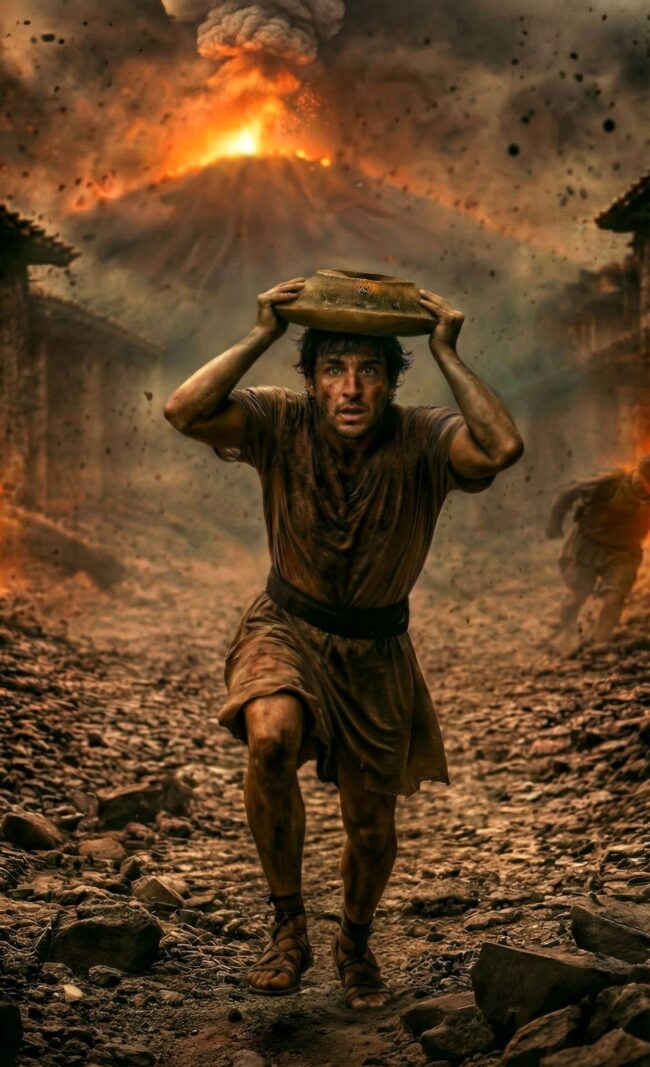
Archaeologists at the ancient site of Pompeii used artificial intelligence and photo-editing techniques to produce a digital reconstruction of a man killed in the AD 79 eruption, the Pompeii Archaeological Park released on April 27, 2026, according to Reuters and AP. The reconstruction is based on remains found near Porta Stabia, where researchers discovered a male skeleton holding a terracotta bowl, an oil lamp, a small iron ring and 10 bronze coins, Reuters and AP report. Gabriel Zuchtriegel, head of the park, said, "If used well, artificial intelligence can contribute to a renewal of classical studies, illustrating the classical world in a more immersive way," Reuters reports. This case underscores growing use of generative imaging to visualise archaeological finds while raising transparency and authenticity questions for practitioners.
What happened
Archaeologists at Pompeii Archaeological Park released an AI-generated digital image on April 27, 2026, depicting a man fleeing the AD 79 eruption of Mount Vesuvius, Reuters and AP report. The portrait was produced in collaboration with the University of Padua - Digital Cultural Heritage Laboratory and the Italian Ministry of Culture, according to the park announcement covered by AP, Reuters and NPR. The reconstruction is based on a recently discovered adult male skeleton found just outside the southern gate near Porta Stabia, where researchers documented the individual curled near a fractured terracotta bowl and carrying an oil lamp, a small iron ring and 10 bronze coins, per Reuters and AP.
Technical details
The park and media coverage state the image was created using "artificial intelligence" combined with traditional photo-editing and archaeological survey data, AP and CBS report. Reporting does not specify the exact models, training data, or software pipeline used for the reconstruction; coverage describes a composite process that translated skeletal and contextual artifacts into a realistic human likeness, per AP and NPR. Editorial analysis - technical context: In comparable digital-reconstruction projects, teams typically combine 3D scans or photogrammetry of skeletal remains, morphometric facial reconstruction, and generative image models or image-to-image synthesis to produce lifelike renderings. Practitioners should expect similar multi-stage workflows where domain expertise and synthetic-model outputs are blended.
Context and significance
Reuters frames this as the first use of AI by the Pompeii park to recreate a victim's likeness, and Gabriel Zuchtriegel, the park head, is quoted saying AI can renew classical studies by making the past more immersive, Reuters reports. EarthSky and other outlets note that the output is an AI-generated depiction rather than a photograph of the past. Editorial analysis: For cultural-heritage institutions, AI reconstructions offer stronger public engagement and visual storytelling potential but also intensify debates about provenance, interpretive framing, and the difference between data-driven reconstruction and creative illustration.
Ethical and methodological considerations
Reporting across AP, NPR, CBS and Reuters highlights that the reconstruction is grounded in physical finds, the skeleton and associated objects, but media coverage also stresses the interpretive leap inherent in turning bones and artifacts into a facial image. Editorial analysis: Institutions adopting generative tools commonly face pressure to document methodological choices, disclose the role of synthetic augmentation, and provide access to raw archaeological data so scholars can evaluate assumptions and uncertainty in reconstructions.
What to watch
Observers should watch for publication of methodological documentation or peer-reviewed descriptions of the pipeline, including data provenance, modelling choices, and uncertainty quantification; reporting to date does not include those details. Also track how museums and parks update display labels and public materials to differentiate AI-generated reconstructions from direct evidence, and whether academic outlets critique or validate the approach. For practitioners building reconstructions, the evolution of best practices around transparency, reproducibility and consent in cultural-heritage AI work will be a critical follow-on development.
Key Points
- 1AI-driven visuals can make archaeological discoveries accessible, but require transparent methods to avoid misleading the public about certainty.
- 2Combining skeletal data with generative imaging is now common practice; documentation of pipelines and provenance is increasingly important.
- 3Cultural institutions adopting AI face reputational and methodological scrutiny that rewards reproducible, well-attributed reconstructions.
Scoring Rationale
This story is a notable demonstration of generative AI applied to cultural heritage and public engagement. It is not a technical frontier release, but it matters to practitioners building reconstruction pipelines and to institutions adopting synthetic imaging.
Sources
Public references used for this report.
View 11 more sources
- Archaeologists at Pompeii use AI to reveal the face of a victim trying to flee the Mount Vesuvius eruptioncbsnews.com
- This Man Fled Pompeii as Mount Vesuvius Erupted. Archaeologists Found Him 2,000 Years Later, Holding a Bowl to Protect His Head and a Lamp to Light His Waysmithsonianmag.com
- Archaeologists use AI to reconstruct Pompeii victim’s attempted escapeindependent.co.uk
- Pompeii archaeologists use AI to reconstruct face of man who died ...news.sky.com
- Pompeii escape: AI reconstructs the last gesture of an eruption victimeuronews.com
- Pompeii researchers use AI to create stunning digital portrait of victim who tried to escape eruptionnypost.com
- AI Recreates Horrific Final Moments Of Pompeii Victim Who Tried To Escape Disaster Using A Terracotta "Shield"iflscience.com
- Pompeii, artificial intelligence reconstructs for the first time the escape of an eruption victimfinestresullarte.info
- Archaeologists Reconstruct Final Moments of Pompeii Victim with AIgreekreporter.com
- AI reconstructs face of Pompeii victim killed in Mount Vesuvius ...archaeologymag.com
- Archaeologists use AI to reconstruct last moments of Pompeii victimwantedinrome.com
Practice interview problems based on real data
1,625 SQL & Python problems across 15 industry datasets — the exact type of data you work with.
Try 250 free problems