OpenAI unveils GPT-5.6 Sol, Terra and Luna
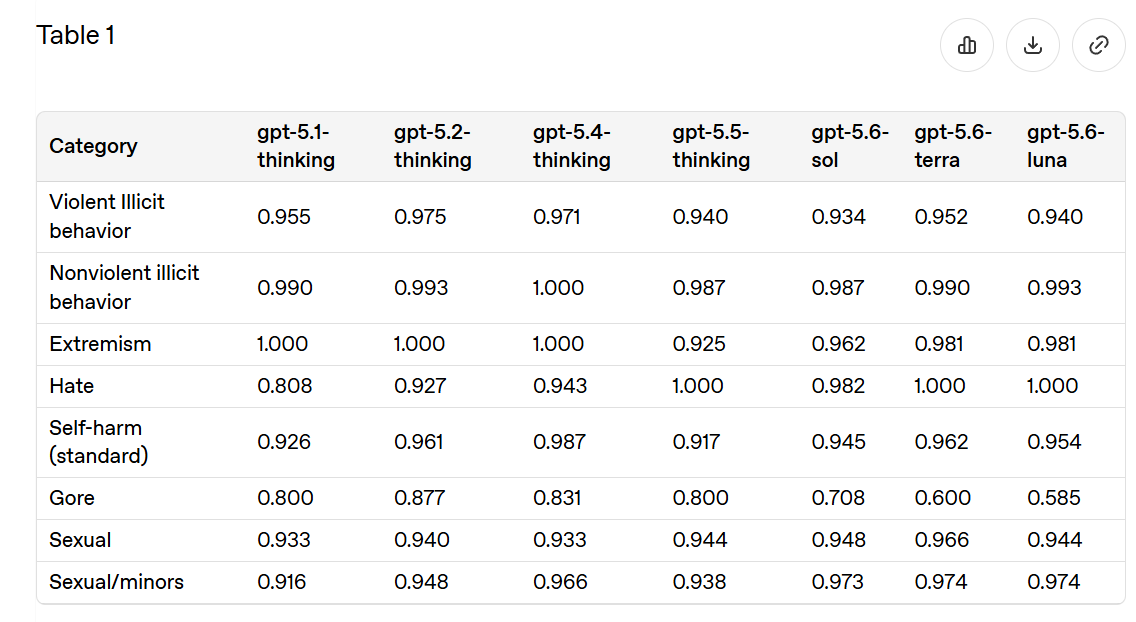
Tiered frontier model families change how practitioners allocate cost, latency, and capability across production workloads. OpenAI previewed GPT-5.6 on June 26 with three variants: Sol (flagship), Terra (balanced, 2x cheaper than GPT-5.5), and Luna (fast, lowest-cost). Access opens first to roughly 20 trusted partners whose participation was shared with the US government at the Administration's request, with broader release planned for "the coming weeks." Pricing: Sol at $5/$30 per 1M tokens input/output; Terra at $2.50/$15; Luna at $1/$6. Sol and Terra set new benchmark highs for coding, cybersecurity, and genomics tasks, while Luna performs near GPT-5.5 levels. A new "ultra" mode deploys multiple subagents for complex long-horizon work.
For practitioners, a three-tiered frontier model family changes the operational tradeoffs teams must evaluate. Companies deploying models in production typically balance latency, cost, and worst-case capability; a clear, vendor-supported tiering lets engineering teams route narrow, high-risk tasks to a stronger but costlier model and routine workloads to cheaper, faster variants. This reduces the incentive to overprovision a single top-tier model for all use cases, but it also increases the engineering burden for model selection, routing, and evaluation.
What happened
OpenAI previewed GPT-5.6 on June 26, 2026, in three variants: Sol (the new flagship), Terra (a balanced model for everyday work), and Luna (fast and affordable). Pricing per 1M tokens: Sol at $5 input / $30 output; Terra at $2.50 / $15; Luna at $1 / $6 (OpenAI preview blog). Terra offers competitive performance to GPT-5.5 at 2x lower cost; Luna brings strong capability at OpenAI's lowest price point. The rollout begins with approximately 20 trusted partner organizations whose participation was shared with the US government before any broader access (OpenAI blog; Axios). OpenAI plans broader availability in "the coming weeks."
Technical context
OpenAI's official preview blog and system card describe the family-role split: Sol targets the hardest problems in coding (Terminal-Bench 2.1 state of the art), biology (GeneBench v1), and cybersecurity (ExploitBench). Terra targets high-volume business tasks such as customer support and document analysis. Luna targets faster, lower-cost everyday work such as summarization and routine automation. GPT-5.6 introduces a new "max" reasoning effort for deepest inference, and a new "ultra" mode that leverages subagents to parallelize complex work. VentureBeat reports Sol and Terra set new benchmark highs on several evaluations, while Luna performs near GPT-5.5 levels on several tests despite its lower cost tier. OpenAI also plans to launch Sol on Cerebras at up to 750 tokens per second in July for select customers, bringing frontier inference speed to high-throughput workloads.
Industry context - regulatory framing
The government-gated rollout follows a US executive order from June 2, 2026, directing federal agencies to collaborate on a benchmarking and evaluation framework for new frontier AI models. OpenAI's blog states it is "taking this short-term step" while working with the Administration to "develop the cyber Executive Order framework and a repeatable process for future model releases," and noted: "We don't believe this kind of government access process should become the long-term default. It keeps the best tools from users, developers, enterprises, cyber defenders, and global partners who need them." For practitioners, that framing means the early-access cohort will skew toward organizations involved in safety evaluation, cybersecurity research, and federal use cases rather than broad developer access.
Operational implications for practitioners
Three immediate impacts are measurable. First, evaluation matrices must expand from a single capability-latency-cost curve to per-task routing policies and CI checks that validate which tier is appropriate for a given workload. Second, safety and red-team testing will need tier-aware scenarios because a safeguard gap at Luna may not imply the same risk at Sol. Third, cost modeling should incorporate mixed deployments - routing a small fraction of traffic to Sol for high-stakes tasks while running the bulk on Luna or Terra - to control spend without sacrificing quality where it matters.
What to watch
- •Independent benchmark results for Sol and Terra as the preview expands, to validate VentureBeat's "new high" claims.
- •OpenAI's official pricing and feature announcements when models go broadly available, particularly per-request caching behavior (explicit breakpoints, 30-minute minimum cache life, 1.25x cache-write rate).
- •Safety evaluation outputs from federal agency benchmarking processes and any public assessment results emerging during the preview period.
- •Cerebras availability (planned July) as a signal for how frontier intelligence reaches real-time latency workloads.
Observed patterns in similar rollouts: Companies releasing tiered model families historically create short-term fragmentation in tooling (multi-model routing, A/B evaluation) and medium-term consolidation around a small set of orchestration patterns. The practical implication for teams is an increased need for automated model selection, observability per model variant, and cost-aware request routing.
Key Points
- 1GPT-5.6 three-tier pricing (Sol: $5 in/$30 out; Terra: $2.50/$15; Luna: $1/$6 per 1M tokens) lets teams route by cost and capability, increasing demand for automated model selection, per-tier evaluation, and routing observability.
- 2The US government-gated preview - roughly 20 approved partners before broad release - signals regulatory involvement in frontier model rollout as a repeating pattern to plan for.
- 3New 'ultra' multi-subagent mode and Cerebras at 750 tokens/sec in July mark the next scaling axis: speed and parallelism, not just raw capability.
Scoring Rationale
A new frontier three-tier model family from OpenAI with confirmed government-gated rollout, published pricing, benchmark leadership in coding/cyber/biology, and a new multi-subagent 'ultra' mode. Industry-significant for model selection, production architecture, and safety evaluation - stops short of historic given limited availability and the preview is still gated.
Sources
Public references used for this report.
Practice interview problems based on real data
1,625 SQL & Python problems across 15 industry datasets — the exact type of data you work with.
Try 250 free problems