NPCI Predicts AI Drives UPI To One Billion
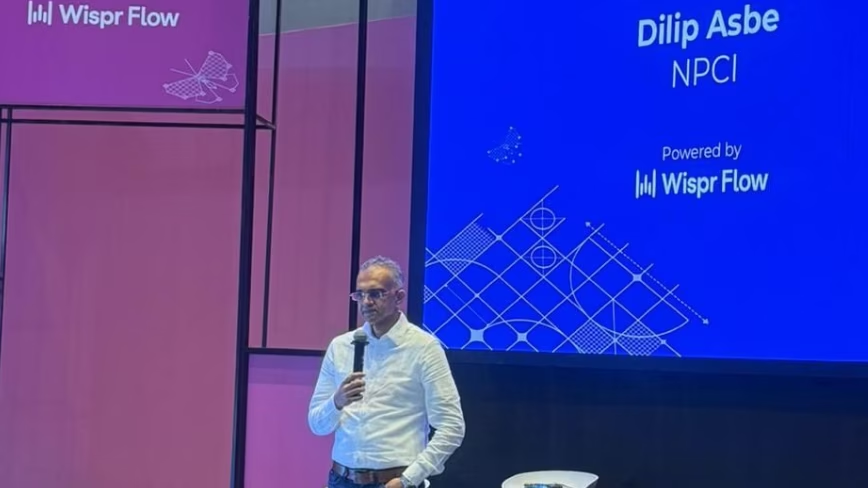
NPCI (National Payments Corporation of India) CEO Dilip Asbe told TechCrunch that AI could push India's UPI payments network from its current 750 million daily transactions toward 1 billion a day by improving fraud detection, credit distribution, and multilingual voice onboarding, according to reporting from The Next Web and Mezha on Asbe's remarks at Mumbai Tech Week. Asbe also described a live NPCI dispute-resolution model called FIMI that now serves over one million users, and said NPCI's 2023 voice assistant still needs accuracy improvements before broader rollout. For AI/ML practitioners, the interview is a concrete case study in what national-scale payments infrastructure demands: low-latency fraud models, bias-aware credit scoring, and small-footprint multilingual speech models built for constrained compute.
For AI/ML practitioners, the more useful takeaway isn't the billion-transaction target itself, it's what national-scale payments infrastructure demands technically: high-recall fraud models on streaming telemetry, bias-aware credit scoring built from alternative data, and small-footprint multilingual speech models that can run within constrained compute budgets.
What happened
Reporting by The Next Web and Mezha summarizes comments from Dilip Asbe, MD and CEO of NPCI, in a TechCrunch interview at Mumbai Tech Week. UPI daily transaction volume has passed 750 million, and Asbe said AI could help reach 1 billion daily transactions by addressing three areas: fraud detection, targeted credit distribution to users and merchants, and voice-based multilingual onboarding. The Next Web reports Asbe describing a live NPCI model called FIMI for dispute resolution that now serves over one million users. The coverage also notes NPCI demonstrated agentic commerce and payments with Razorpay previously, and that NPCI launched a voice assistant in 2023, though Asbe said voice-model accuracy still needs improvement before broad adoption.
Technical context
The three use cases map to distinct technical and governance challenges. Fraud detection at UPI's scale requires low-latency, high-recall models operating on streaming payment telemetry with robust adversarial testing. Credit distribution implies building credit-scoring features from alternative digital footprints while managing bias and explainability. Multilingual voice onboarding demands fine-tuned, small-footprint speech and language models across many Indian languages and dialects, plus strong fallback handling when recognition fails.
For practitioners
Large-scale payments environments raise model-risk vectors beyond offline metrics: production-grade monitoring, human-in-the-loop escalation paths, and traceability of automated decisions all become necessary at this volume. Asbe is quoted advocating traceability of AI agent instructions and consent, which points directly to the provenance, audit-log, and consent-record requirements ML teams need to design into pipelines if regulators or operators later require incident reconstruction.
What to watch
Adoption metrics for voice-onboarding pilots, published performance and fairness evaluations for fraud and credit models, and any regulatory guidance on AI explainability or auditability in Indian financial services. Public deployments of small, local-language models and any published benchmarks will be especially informative for practitioners weighing on-device versus cloud-hosted inference.
Key Points
- 1National-scale payments require streaming ML with adversarial testing to keep false positives low while maximizing fraud capture.
- 2Localized small language models enable voice onboarding in low-resource languages, reducing friction but increasing model governance needs.
- 3Embedding traceability and consent logs into AI-driven payment flows is essential for post-incident audits and regulatory compliance.
Scoring Rationale
A named executive at a systemically important national payments operator (NPCI runs UPI, ~750M daily transactions) describing concrete AI use cases and a live production model (FIMI) is a substantive real-world deployment story, corroborated by TechCrunch's original interview plus two secondary outlets. Kept in the notable tier as a deployment/adoption story rather than a new model or research result.
Sources
Public references used for this report.
Practice with real Ad Tech data
90 SQL & Python problems · 15 industry datasets
250 free problems · No credit card
See all Ad Tech problems