Mukesh Ambani Expands Jio Into AI-Powered Calls, Apps, Homes
Reliance's AI-first push at Jio, laid out in the company's own AGM Chairman's Statement, is less a product launch than a rare public test of carrier-embedded inference at national scale: the new Jio Call Agent builds AI directly into the phone network rather than an app, aimed at a base that generates roughly 20 billion voice minutes a day. The verified technical specifics matter more than the branding: an initial NVIDIA GB300 GPU fleet in Jamnagar already equivalent to more than 75,000 H100 GPUs, scaling past 200,000 as 120 MW of capacity comes online by end-2026, plus a stated requirement to run transcription, summarization, and task execution across 22 Indian languages. TechCrunch also flagged that Reliance has not clarified whether call and app data will train its models or reach partners like Google and Meta, an open data-governance question for anyone evaluating this as a deployment template.
Reliance's AI-first announcements at its 49th AGM are less a product launch than a distribution bet: instead of shipping a downloadable AI app, Reliance is wiring inference directly into the telephony and app layer for a base of more than 500 million Jio subscribers. Per Reliance's own AGM Chairman's Statement, Jio carries about 20 billion minutes of voice traffic a day, which makes the newly announced Jio Call Agent - transcribing calls, identifying up to 10 speakers on a conference call, and executing tasks like bookings - one of the largest live tests yet of real-time, multilingual speech AI at carrier scale. For AI/ML practitioners, that is the more interesting story than the consumer framing: it is a case study in network-level inference rather than on-device or pure-cloud deployment, and in what it takes to run continuous, low-latency transcription and summarization against national telecom traffic, in the caller's own language, with consent captured per call.
The infrastructure behind the demos
At the AGM on June 19, Mukesh Ambani said Reliance Intelligence, launched last year, is moving into an "execution" phase. He framed the push in explicitly nationalistic terms: "India should not be a mere consumer of AI created elsewhere. It must become a creator, adopter, and global leader in AI," he said, per the Chairman's Statement and TechCrunch's reporting. Concretely, Reliance is building a sovereign AI compute backbone in Jamnagar, powered by its Kutch solar platform, with the first 120 MW due by end-2026 running an initial NVIDIA GB300 GPU fleet that Reliance says is already equivalent to more than 75,000 H100 GPUs on an inference basis, scaling past 200,000 H100-equivalents once the site is fully operational. TechCrunch and Indian Express report the consumer layer sitting on top: an AI-powered MyJio, which Reliance says now has more than 600 million users, handling requests like eSIM activation and roaming plans conversationally, plus Jio TeleFrame, a home display for AI agents. Times of India reports, citing PTI, that Jio Platforms filed draft IPO papers the same day, seeking to raise about $4 billion at a valuation of roughly $137 billion.
Why language and latency are the harder problem
The multilingual requirement is a tougher production-ML target than the demos suggest. Reliance says its wider AI stack, including JioBharatIQ, AI Vyapar, JioHealthIQ, JioLearnIQ, and JioKrishiIQ, must work across 22 Indian languages, and the Chairman's Statement says the call agent itself works "in every Indian language" on live calls, not just in text chat. Real-time speech recognition, speaker diarization, summarization, and task execution, stacked across dozens of languages at telecom scale, is a substantially harder deployment target than a single-language chatbot, and it will be a useful public test of how far carrier-grade multilingual voice AI has actually progressed once it ships.
The open question
TechCrunch's reporting flags a detail worth tracking: Reliance said its AI features operate only with user consent but did not clarify whether call and app data will be used to train its models or shared with partners such as Google and Meta, whose free Gemini access and joint LLaMA venture Reliance is already building on. That data-governance gap looks more consequential than any individual product feature, given the volume of conversational data involved.
Investment context
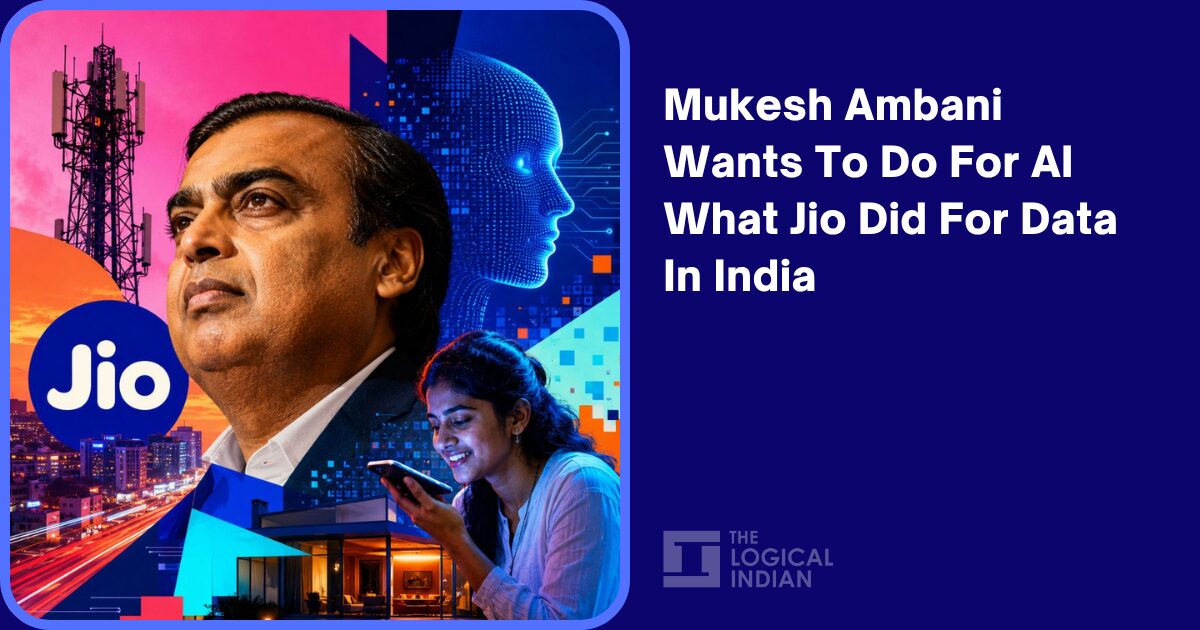
The widely cited Rs 10 lakh crore (about $110 billion), seven-year AI infrastructure commitment did not originate at this AGM. Ambani first announced it in February 2026, as DD News and The Logical Indian both report, and the AGM materials add evidence that the commitment is converting into commissioned capacity on a specific timeline, which is the more verifiable signal for practitioners tracking whether announced AI capex actually gets built. Moneycontrol and Firstpost report further pieces of the buildout: Jio Platforms managing director Akash Ambani outlined the 22-language roadmap and said Jio is separately evaluating a sovereign low-earth-orbit satellite constellation, while an existing internal platform, JioBrain, already handles network planning and predictive maintenance.
What to watch
- •Whether Reliance publishes transcription and diarization accuracy data for Jio Call Agent once it launches for Jio's 500-million-plus base later this year.
- •Whether the 120 MW Jamnagar milestone and GB300 deployment land on the stated end-2026 timeline, and whether model architecture or training-data sourcing gets disclosed.
- •How Reliance answers the data-use and consent questions TechCrunch raised, given the scale of conversational and app data involved.
Key Points
- 1Reliance unveiled Jio Call Agent, an AI voice assistant built into its telephony network for 500 million-plus Jio users, per its own AGM statement.
- 2Verified AGM materials show 120 MW of NVIDIA GB300 compute at Jamnagar by end-2026, scaling past 200,000 H100-equivalent GPUs, backing the rollout.
- 3For practitioners, carrier-scale multilingual voice AI and unanswered training-data questions make this a real test of production ML governance at scale.
Scoring Rationale
Primary-source verification (Reliance's own AGM Chairman's Statement) confirms the core technical claims: an initial NVIDIA GB300 fleet in Jamnagar equivalent to 75,000+ H100 GPUs, scaling past 200,000 H100-equivalents as 120 MW comes online by end-2026, an AI voice agent embedded at carrier scale for 500 million-plus users generating roughly 20 billion voice minutes a day, and a stated 22-language production requirement. This is a well-evidenced major infrastructure and deployment story for AI/ML practitioners (production multilingual speech AI, sovereign compute buildout, unresolved data-governance questions), just short of industry-shaking since it is a corporate strategy and product rollout rather than a new capability or research result. Modest bump from 7.8 reflects the strength of the primary-source verification, not a change in underlying newsworthiness.
Sources
Public references used for this report.
View 7 more sources
- Reliance's Jio Platforms IPO: From Meta, Google backing to AI ambitions -- 10 takeawaystimesofindia.indiatimes.com
- Reliance AI plans at 2026 AGM: Jamnagar, GB300, Jioindiaaipulse.com
- Ambanis outline ambitious vision to build India's sovereign AImoneycontrol.com
- Jio eyes sovereign satellite capability for India; Reliance Intelligence to power AI ambitionsfirstpost.com
- Reliance and Jio to invest Rs 10 lakh crore over seven years for India's AI transformation: Mukesh Ambaniddnews.gov.in
- Mukesh Ambani Wants To Do For AI What Jio Did For Data In Indiathelogicalindian.com
- Forget chatbots, Ambani's Reliance wants to own India's entire AI economym.economictimes.com
Practice interview problems based on real data
1,625 SQL & Python problems across 15 industry datasets — the exact type of data you work with.
Try 250 free problems