
Marvell Expands Role in Non-GPU AI Infrastructure
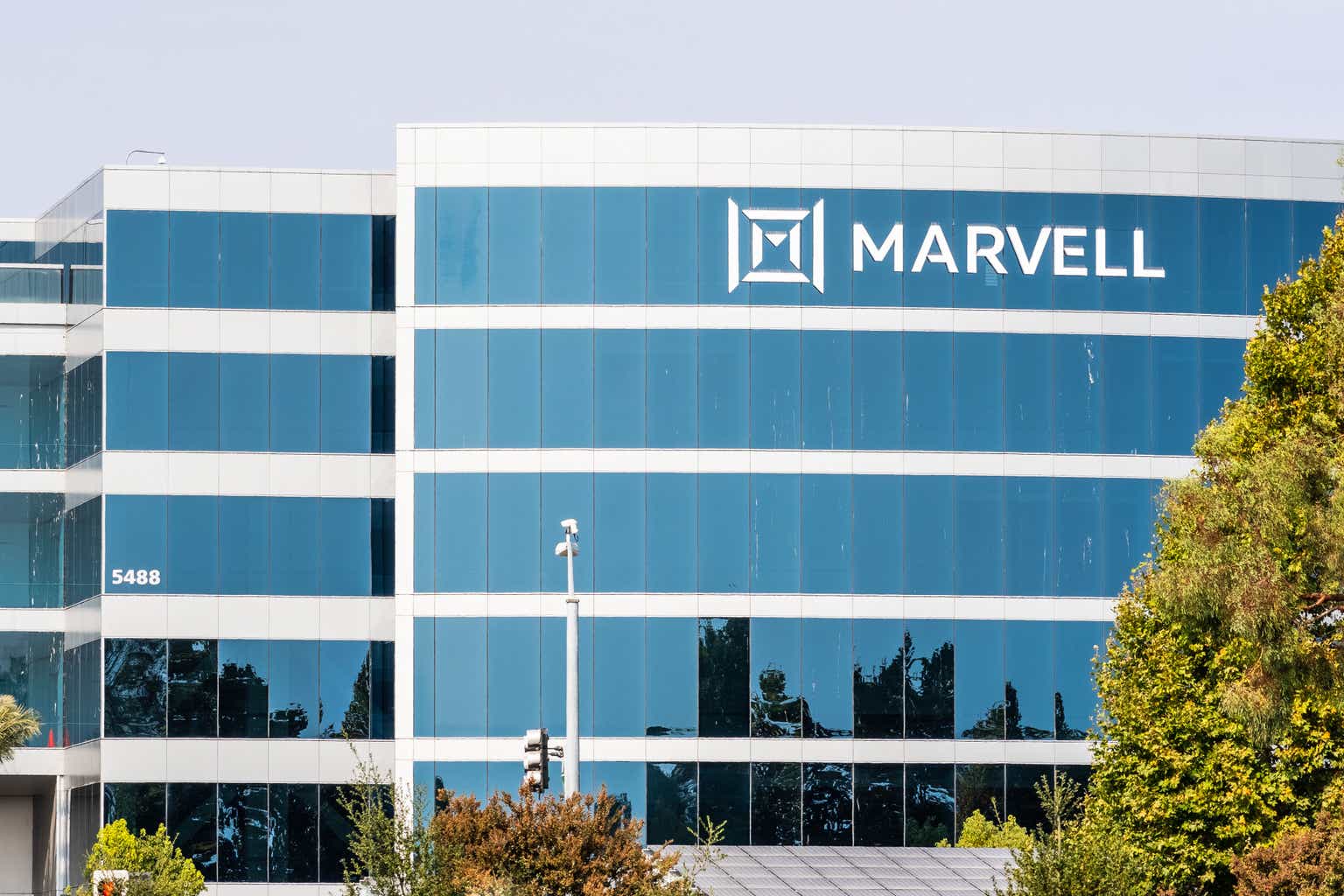
Marvell Technology has moved from a networking specialist to a central supplier for non-GPU AI infrastructure. Two developments are driving the re-rating: Nvidia's $2 billion strategic investment and reports that Google is in talks to co-develop a memory processing unit (MPU) and an inference-optimized TPU with Marvell. Those moves position Marvell to capture XPU attach spend, high-speed interconnect demand, and optical networking upgrades as hyperscalers scale inference deployments. The market is pricing a multi-year earnings trajectory, Marvell already reports record fiscal-year revenue near $8.2 billion and 18 active ASIC designs, but the commercial outcomes hinge on contract timing, production partners, and design wins versus incumbents like Broadcom.
What happened
Marvell Technology has been reclassified by markets as a non-GPU AI infrastructure essential, following Nvidia's $2 billion investment and reports that Google is in talks to co-develop a memory processing unit (MPU) and an inference-optimized TPU with Marvell. The combination of a large strategic stake from Nvidia and a potential Google design partnership has driven a sharp re-rating in Marvell's equity, reflecting anticipated multi-year upside from custom ASICs, high-speed switching, and optical connectivity.
Technical details
Marvell brings design expertise across chiplets, interconnect, SerDes, switch silicon, and optical PHYs that complements TPU compute by addressing memory and I/O bottlenecks. The reported Google scope includes two chip families: a memory-focused MPU to offload memory-bound tasks and an inference TPU tuned for production inference workloads. Marvell's current data points reported in market coverage include 18 active ASIC designs, record fiscal-year revenue near $8.2 billion, and operating leverage that supports high gross margins above 50%.
Key capabilities being leveraged
- •Custom ASIC design and integration focused on memory and I/O subsystems
- •High-speed switching and interconnect silicon to reduce cluster-level bottlenecks
- •Optical transceivers and PHY IP for rack-to-rack and pod-level fabrics
- •Systems integration experience for hyperscaler validation and multi-million unit runs
Context and significance
The reported deals matter because hyperscalers are diversifying compute stacks beyond GPUs to control latency, power, and unit economics at scale. A dedicated MPU addresses the persistent "memory wall" where compute engines idle waiting for data, improving effective throughput for large language models and retrieval-augmented tasks. An inference-optimized TPU targets the shift from training to inference capex, where cost-per-query and power-efficiency dominate procurement decisions. The market reaction also highlights competitive dynamics: Broadcom has been a primary partner for Google historically, and a Marvell tie-up signals hyperscalers are splitting vendor risk and vertically optimizing the stack.
Why practitioners should care
Custom ASICs and attach silicon change operational tradeoffs for data-center architects and ML engineers. Expect tighter co-design between model teams and hardware, with increased emphasis on memory access patterns, quantization-friendly operators, and topology-aware sharding to exploit specialized MPU/TPU combos. Networking teams should plan for higher port densities, new optical requirements, and additional switch offloads that Marvell-based silicon may enable.
What to watch
Confirmation of the Google contract terms, production timelines, and which foundry or manufacturing partners handle initial runs matter most. Watch for supply chain signals such as reported MediaTek involvement, expected unit volumes (reports mention multi-million MPU initial runs), and any formal Broadcom response or counter-deal. Also track integration path with Nvidia's stake and whether Marvell becomes a standard XPU attach vendor for other hyperscalers.
Bottom line
The combination of a strategic Nvidia investment and a potential Google design win makes Marvell a high-leverage play in non-GPU AI infrastructure. The technical rationale is sound: reducing memory and interconnect bottlenecks materially improves inference economics. Execution risk remains centered on contract confirmation, production scale, and competitive responses, but the structural TAM expansion for custom silicon and networking is real and actionable for infrastructure teams and procurement planners.
Key Points
- 1Marvell sits at the XPU attach layer, where MPU and inference TPU designs relieve the memory wall and raise inference efficiency.
- 2Nvidia's $2B stake plus a possible Google tie amplifies Marvell's design wins and accelerates multi-year revenue visibility from custom ASICs.
- 3Hyperscaler diversification away from single incumbents like Broadcom reshapes procurement, favoring vendors with interconnect, optical, and ASIC integration.
Scoring Rationale
This is a major infrastructure development: a potential Google-Marvell co-design plus Nvidia's strategic investment materially shifts non-GPU AI supply chains. The story affects procurement, data-center architecture, and ASIC suppliers, but confirmation and execution risk keep it below industry-shaking top-tier events.
Sources
Public references used for this report.
Practice with real Ad Tech data
90 SQL & Python problems · 15 industry datasets
250 free problems · No credit card
See all Ad Tech problems


