Leaders Prioritize AI Investments for Business Value
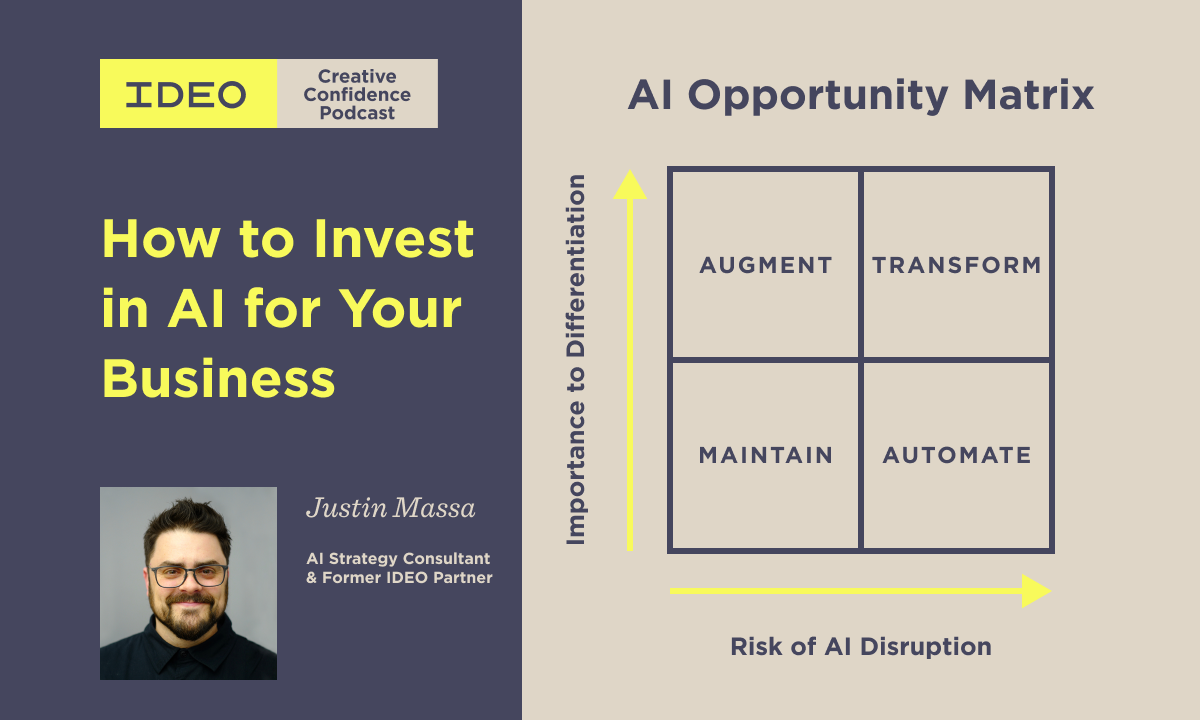
AI strategist Justin Massa advises executives to start AI adoption with strategy, not hype, focusing on real bottlenecks and measurable business outcomes. Use the AI Opportunity Matrix to prioritize initiatives across four quadrants: Maintain, Automate, Augment, and Transform, with special attention to the high-risk, high-reward Transform quadrant. Practical steps include mapping processes, selecting narrow pilots that relieve clear pain points, assembling cross-functional squads, and tracking outcomes tied to revenue, time saved, or customer experience. Balance efficiency plays with creative augmentation, and treat generative AI as a current capability: "When I think about what you should be doing with generative AI right now, it's really about leveraging what the technology can do today, not what it can do tomorrow," said Justin Massa. This approach reduces wasted tooling spend and accelerates scaled adoption.
What happened
Justin Massa, an AI strategist and former IDEO partner, lays out a pragmatic playbook for executives to invest in AI with business impact. He argues for starting with strategy instead of chasing tools, mapping concrete bottlenecks, and using the AI Opportunity Matrix to prioritize where AI delivers differentiation and where it creates risk. He emphasizes four quadrants, Maintain, Automate, Augment, and Transform, and warns that the Transform quadrant carries the highest disruption risk and requires deliberate bets.
Technical details
The core diagnostic is a capability-by-differentiation matrix that scores opportunities on business importance and exposure to AI disruption. Practitioners should:
- •Map high-frequency, high-cost processes and quantify current throughput or error rates
- •Design narrow pilot scopes that relieve a single bottleneck and define success metrics up front
- •Assemble cross-functional teams combining domain experts, product managers, and engineers for rapid iteration
- •Establish measurement and guardrails for model outputs, including quality thresholds and human-in-the-loop checkpoints
Context and significance
This guidance reframes generative AI from a speculative trend into a practical set of capabilities to deploy today. By prioritizing problems over tools, leaders avoid technology-in-search-of-a-problem mistakes and reduce wasted spend on one-off pilots. The framework echoes established strategy practices, notably Roger Martin's Playing to Win approach, making it easier for organizations to integrate AI decisions into existing strategic planning cycles.
What to watch
Track how teams translate pilots into repeatable patterns and operationalized platforms for model lifecycle management. The critical questions are whether leaders tie investments to measurable outcomes and whether they balance efficiency gains with creative augmentation opportunities.
"When I think about what you should be doing with generative AI right now, it's really about leveraging what the technology can do today, not what it can do tomorrow," said Justin Massa.
Key Points
- 1Start with business problems, not tools, to avoid wasted pilots and align AI to measurable outcomes.
- 2Use the AI Opportunity Matrix to prioritize bets across Maintain, Automate, Augment, and Transform quadrants.
- 3Deploy narrow pilots with cross-functional teams and clear success metrics to scale value and manage risk.
Scoring Rationale
Practical and actionable guidance for executives, but not novel technical research. The piece helps reduce wasted spend and improve adoption, yet it is evergreen strategy advice rather than a frontier breakthrough. The source is older than three days, so timeliness reduces the immediate impact.
Practice with real Ad Tech data
90 SQL & Python problems · 15 industry datasets
250 free problems · No credit card
See all Ad Tech problems