KNDS unveils CAPINT tank; India advances FRCV programme
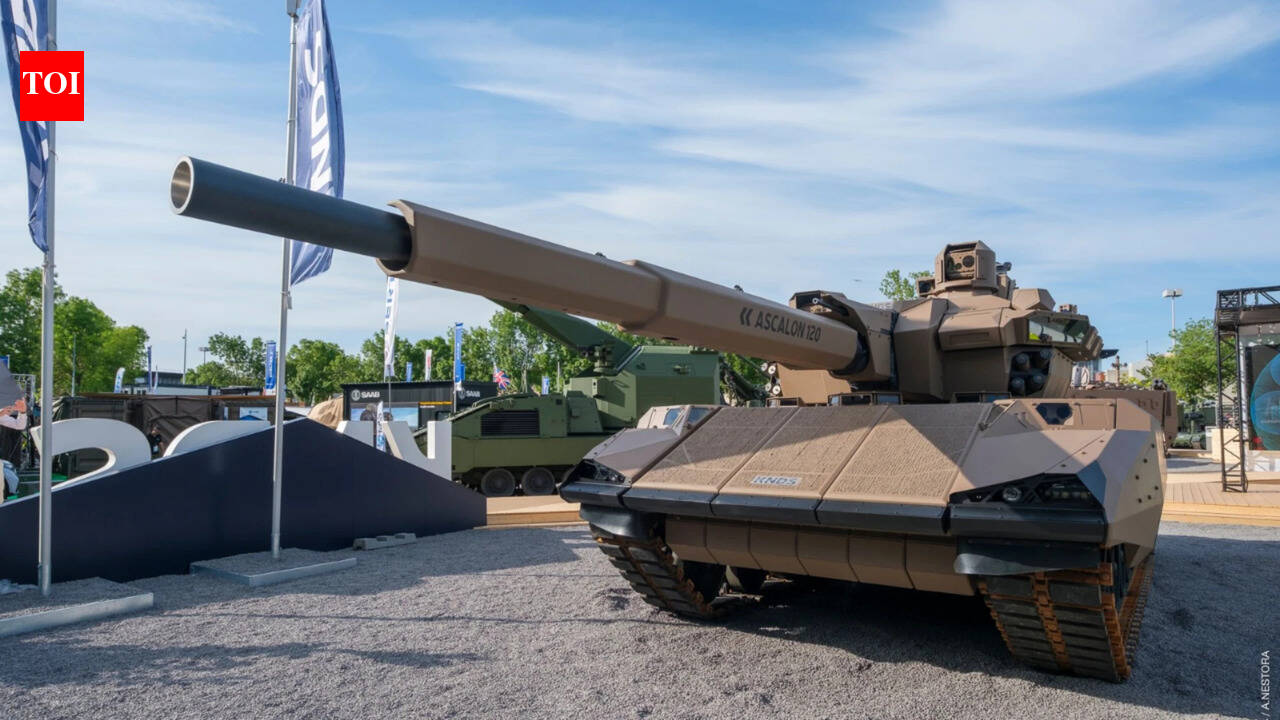
A new main battle tank called CAPINT was revealed at Eurosatory 2026, according to a KNDS press release and reporting by Reuters and DefenseNews. CAPINT pairs a German Leopard 2-derived hull with a French ASCALON unmanned turret and a 120 mm smoothbore gun that KNDS says can be upgraded to 140 mm, per the company release. Reuters and France24 report the vehicle is presented as an "intermediary capability" to bridge France's aging Leclerc fleet while the Franco-German MGCS programme remains delayed, with entry into service previously targeted for 2040-2045. DefenseNews reports KNDS aims to present a demonstrator by 2030, produce first units by 2035, and field units by 2037. Separately, Times of India reports India is accelerating its Future Ready Combat Vehicle (FRCV) effort, envisaged as a digitised, networked platform supporting unmanned systems and hardened communications.
What happened
KNDS unveiled the CAPINT main battle tank demonstrator at the Eurosatory 2026 defence exhibition, per the company press release and coverage by Reuters and France24. KNDS frames CAPINT as an "intermediary capability" built on an enhanced Leopard 2 A8-derived chassis with a French ASCALON unmanned turret, according to the KNDS press release. The press release and DefenseNews note the vehicle mounts a 120 mm smoothbore gun with an option to upgrade to 140 mm. Reuters and France24 report CAPINT is presented as a stopgap to replace France's Leclerc fleet while the Franco-German Main Ground Combat System (MGCS) programme remains delayed, with the MGCS previously projected for entry into service around 2040-2045. DefenseNews reports KNDS aims to provide a demonstrator to France's procurement authority by 2030, produce first units by 2035, and deploy to forces by 2037, citing KNDS product-line staff.
Technical details
Per KNDS documentation and DefenseNews reporting, CAPINT mixes a German-produced hull and mobility suite with a French unmanned turret and autoloader. The platform is described in company materials as incorporating active, reactive and passive protection layers, counter-drone capabilities, an open digital architecture, and connectivity for robotic wingmen. DefenseNews quotes KNDS technical staff describing tests of firing on the move and early integration work on remote and autonomous teammates.
Industry context
Operational and systems implications
India parallel
Times of India reporting states India is accelerating its Future Ready Combat Vehicle (FRCV) initiative, which is envisioned as a highly digitised, network-centric replacement for older tank types. The Times of India article describes FRCV ambitions to enable human-machine teaming and to command unmanned systems such as UGVs and UAVs, along with battlefield management and electronic-warfare resilience.
What to watch
Editorial analysis
European reporting frames CAPINT as part of a broader pattern where states pursue interim modernisation while multinational successor programmes face delays. Public coverage places CAPINT alongside other global fourth-generation armour trends, including unmanned turrets, active protection systems, drone integration, and increased digitisation reported for systems such as the Russian T-14 Armata and US development work on the M1E3 Abrams family.
For defence technologists and systems engineers, CAPINT illustrates three convergent trends: modular platform assembly across suppliers, early adoption of unmanned turrets and autoloaders to reduce crew exposure, and architecture choices that prioritise connectivity for UGVs and UAVs. These patterns raise practical engineering priorities commonly observed in comparable programmes, such as interoperable communications, hardened friend-or-foe systems, latency and bandwidth management for beyond-line-of-sight engagement, and integration of active protection with sensor fusion.
Observers should track three indicators. First, procurement milestones and demonstrator timelines from France's procurement authority, which will reveal whether the 2030 demonstrator and 2035-2037 production cadence reported by DefenseNews are sustained. Second, technical interoperability choices, especially communications standards and autonomy interfaces, which determine how well robotic wingmen and counter-drone systems integrate. Third, export and industrial cooperation signals, since KNDS is combining Franco-German subsystems and public reporting highlights geopolitical drivers behind accelerated procurement.
Bottom line
Public reporting documents CAPINT as a KNDS-backed interim MBT demonstrator that bundles unmanned turret tech, modular gun options, and digital connectivity to address capability gaps while MGCS timelines slip. Times of India coverage shows India moving in parallel with digitised, networked tank concepts under its FRCV programme. These developments reflect an industry shift toward hybrid crewed-uncrewed systems and AI-enabled sensor and effects integration in armoured platforms.
Key Points
- 1KNDS unveiled the CAPINT demonstrator at Eurosatory 2026, combining a Leopard 2-derived hull with a French unmanned ASCALON turret.
- 2Industry pattern: interim platforms often adopt unmanned turrets, autoloaders, active protection, and networked robotic wingmen before full successor systems arrive.
- 3Operational focus: practitioners will need to address hardened comms, sensor-fusion latency, and interoperability when integrating UGVs, UAVs, and counter-drone systems.
Scoring Rationale
The CAPINT reveal is a notable industry development showing concrete fielding timelines and integration of unmanned turrets and digital architectures, relevant to systems and ML engineers working on autonomy, sensor fusion, and resilient communications. It is not a frontier-model or platform release for the AI research community, so impact is significant but not transformative.
Sources
Public references used for this report.
View 8 more sources
- KNDS proposes mixed French-German tank to replace France’s Leclercdefensenews.com
- European manufacturers unveil new main battle tank variants at Eurosatorybreakingdefense.com
- KNDS unveils CAPINT main battle tank to bridge the gap between ...armyrecognition.com
- capint Archives - EDR Magazineedrmagazine.eu
- Le successeur du Leclerc sera le CAPINT, un char doté d’une tourelle ASCALON et d’un châssis allemandopex360.com
- Pensado para la capacidad intermedia de Francia, KNDS presenta en Eurosatory 2026 el CAPINT con chasis alemán y torre no tripulada Ascalon 120zona-militar.com
- EUROSATORY 2026: KNDS Unveils CAPINT New Main Battle Tank ...fragoutmag.com
- KNDS Capint: New Main Battle Tank as an Interim Solutionaerospace-and-defence.com
Practice interview problems based on real data
1,625 SQL & Python problems across 15 industry datasets — the exact type of data you work with.
Try 250 free problems