India launches AI literacy drive to train 1 million teachers
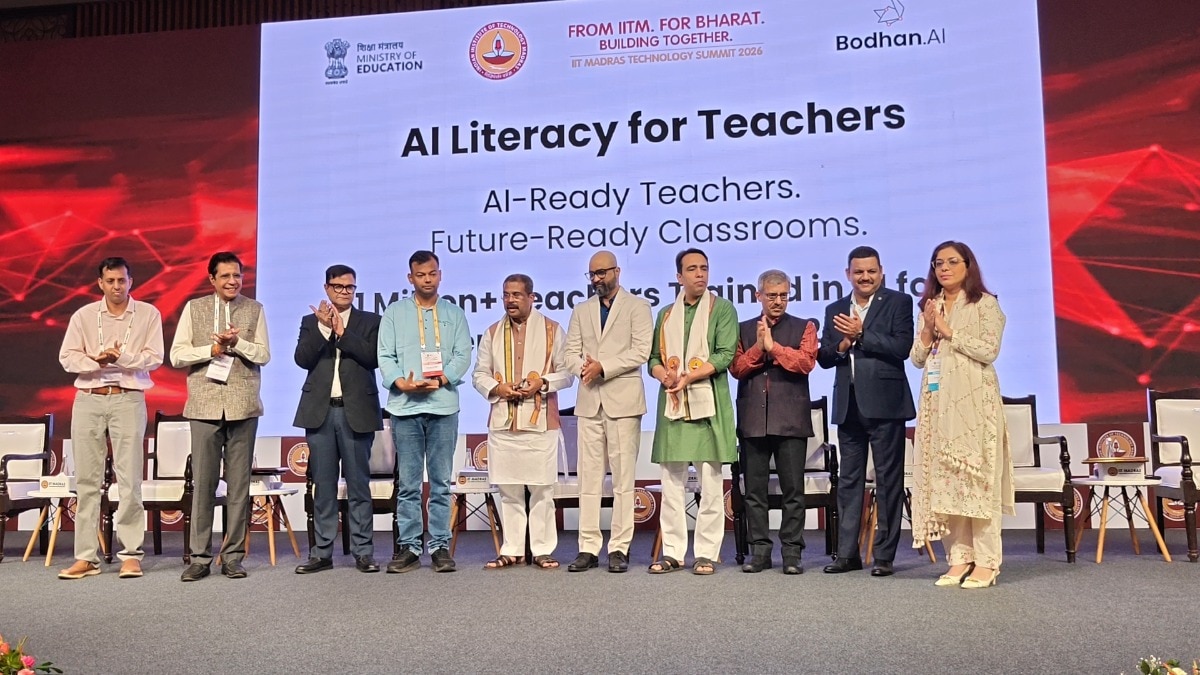
India has launched a national programme, "AI Literacy for Teachers," that aims to train over 1 million teachers by 2027, according to reporting by India Today and India Education Diary. The initiative was announced by Union Education Minister Dharmendra Pradhan at the IIT Madras Technology Summit held at Bharat Mandapam on 5 May 2026, per both reports. The programme is run by Bodhan AI, a Centre of Excellence in AI for Education incubated at IIT Madras, and is described in coverage as embedding AI into daily classroom workflows rather than treating it as an optional tool. Reported use cases for teacher training include lesson planning, content creation, student assessments, and feedback systems. Dharmendra Pradhan is quoted in both outlets emphasizing scale, inclusivity, and an India-centric AI ecosystem.
What happened
India launched a national programme called "AI Literacy for Teachers" that aims to train over 1 million teachers by 2027, according to reporting by India Today and India Education Diary. The announcement was made at the IIT Madras Technology Summit held at Bharat Mandapam on 5 May 2026, where Union Education Minister Dharmendra Pradhan spoke about the initiative, per both reports. The programme is being delivered by Bodhan AI, described in coverage as a Centre of Excellence in AI for Education incubated at IIT Madras.
Technical details
Per reporting, the curriculum and training focus on making AI an everyday classroom assistant, with explicit teacher-facing use cases listed as lesson planning, content creation, student assessments, and feedback systems. Both outlets present the initiative as national-scale and classroom-facing rather than limited to pilot projects.
Editorial analysis - technical context
Classroom adoption at scale typically requires three technical building blocks: accessible teacher tooling, robust offline-capable deployments for low-connectivity regions, and localized datasets or guidance so outputs align with regional curricula and languages. Industry experience shows teacher-facing AI also raises requirements for simple UX, explainability of model outputs, and guardrails for safety and bias before broad rollout.
Context and significance
What to watch
Editorial analysis
A programme that trains teachers at national scale can materially change uptake of AI in K-12 settings because teachers are gatekeepers of classroom tools. Comparable national training efforts historically accelerate demand for vendor tooling, teacher-facing authoring platforms, and local content adaptation services, while also increasing pressure on education departments to set interoperability and privacy standards.
Observers should track:
- •the programme's training delivery model and accreditation mechanism
- •language and curriculum localization details
- •announced partnerships with edtech vendors or platform providers
- •any published guidance on student data privacy, assessment integrity, and model evaluation. Neither source details the programme's funding model or long-term governance arrangements in the reports cited
Key Points
- 1National training of 1 million teachers by 2027 creates a large, near-term market for teacher-facing AI tools and localized content.
- 2Embedding AI into lesson planning and assessments shifts focus from pilot demos to scalable usability, requiring offline-capable, explainable tooling.
- 3Large-scale teacher upskilling programs typically raise policy questions on privacy, evaluation, and vendor interoperability that policymakers must address.
Scoring Rationale
A national programme targeting 1 million teachers is a notable, practical step toward large-scale AI adoption in education and will affect edtech tooling, localization, and policy priorities. The story is policy and deployment focused rather than a frontier research breakthrough.
Sources
Public references used for this report.
Practice with real Ad Tech data
90 SQL & Python problems · 15 industry datasets
250 free problems · No credit card
See all Ad Tech problems