IDEO Data Scientist Answers Researchers' AI Tool Questions
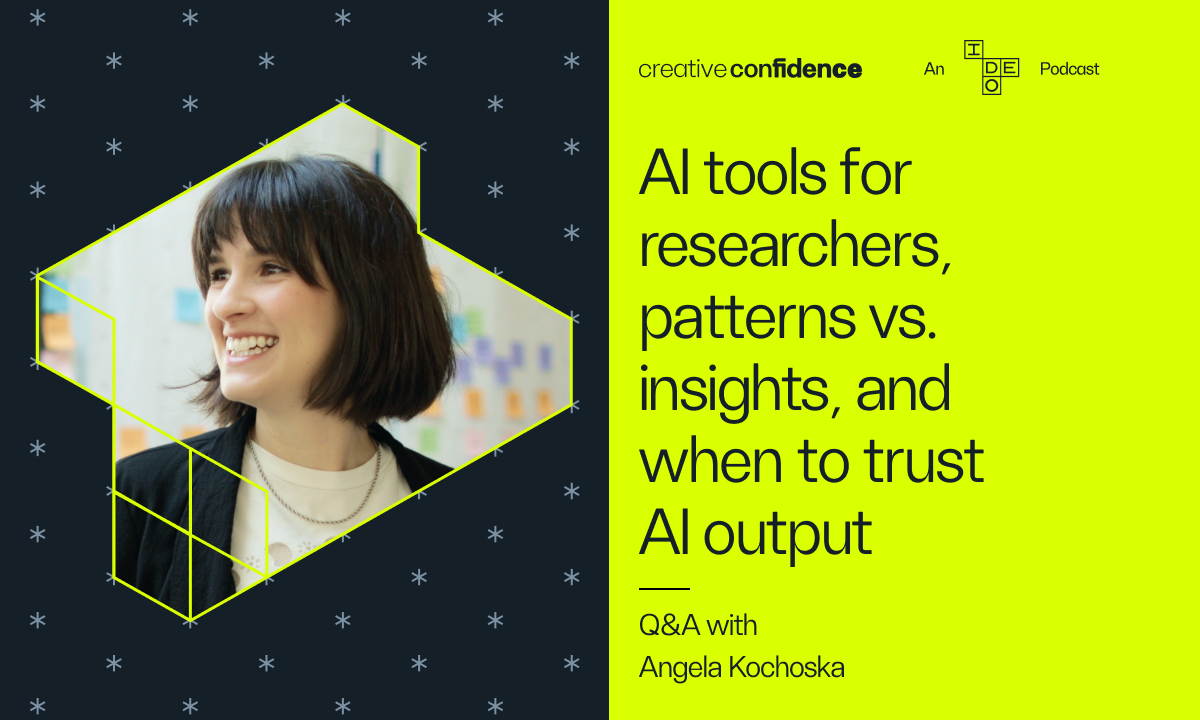
According to IDEO's blog post published May 14, 2026, IDEO Design Researcher and Data Scientist Angela Kochoska answered listener questions about using AI in research, covering topics such as AI-assisted synthesis, distinguishing patterns from insights, prompt design, and preserving qualitative depth. The article notes Kochoska's background building machine learning models for NASA and the European Space Agency and her role as co-instructor of an IDEO U course, per IDEO. For practitioners, the conversation reframes AI as an assistive layer - useful for surfacing patterns and speeding synthesis, but requiring human validation and contextual judgement to produce actionable insights.
What happened
According to IDEO's blog post dated May 14, 2026, IDEO published a Q&A in which Design Researcher and Data Scientist Angela Kochoska answered listener questions on practical use of AI tools for researchers. The published highlights list topics including validation of AI-assisted synthesis, how to distinguish AI-generated patterns from human insights, avoiding thematic flattening, when prompting becomes outsourcing of thinking, and methods for moving from AI output to human-centered decisions. IDEO's page states Kochoska previously built machine learning models for NASA and the European Space Agency, and that she co-instructs a new IDEO U course.
Editorial analysis - technical context
AI-assisted workflows commonly accelerate the earliest stages of qualitative analysis by surfacing recurring patterns across transcripts and notes. Industry-pattern observations: automated theme extraction and clustering are effective at pattern detection but do not on their own establish causality, intent, or the contextual nuance that makes an insight actionable. Prompt engineering in research contexts therefore focuses less on getting a single "answer" and more on producing traceable, verifiable artifacts (excerpted evidence, timestamps, source-links) that human researchers can audit.
Editorial analysis - context and significance
For teams doing qualitative work, the salient trade-off is between scale and depth. Industry observers note that teams using AI for synthesis often capture broader coverage faster but must build validation steps- triangulation with field notes, participant quotes, and iterative human sense-making- to preserve specificity. The IDEO conversation underscores a practitioner-oriented stance: treat models as amplifiers of researcher throughput rather than replacements for interpretive work.
For practitioners - what to watch
Look for tools and workflows that:
- •surface provenance with AI outputs
- •expose supporting excerpts rather than only labels
- •integrate human review checkpoints
- •enable iterative prompting that refines candidate themes rather than finalizing them. Observers should also track whether teams document the human validation steps that convert patterns into insights
Key Points
- 1AI speeds pattern detection in qualitative data but often requires deliberate human validation to produce actionable insights.
- 2Prompting in research should prioritize traceable evidence and auditability over single-shot answers or polished summaries.
- 3Teams that pair AI synthesis with iterative human sense-making retain depth and specificity while scaling analysis.
Scoring Rationale
Practical guidance for researchers is useful for ML-adjacent teams but not a frontier technical advance. The piece influences workflow choices rather than model development, making it moderately relevant to practitioners.
Practice with real Streaming & Media data
90 SQL & Python problems · 15 industry datasets
250 free problems · No credit card
See all Streaming & Media problems