Hyundai Cuts Crash Test Review Time With AI
Hyundai Motor Group reported on Aug. 12 that its Crash Safety AI Assistant reduced engineers' time spent searching and reviewing historical crash-test materials by about 90%. SBS and Automotive World report that the tool compares prior crash-test results, images and analysis data, while Hyundai's broader AI program also spans manufacturing and maintenance operations.
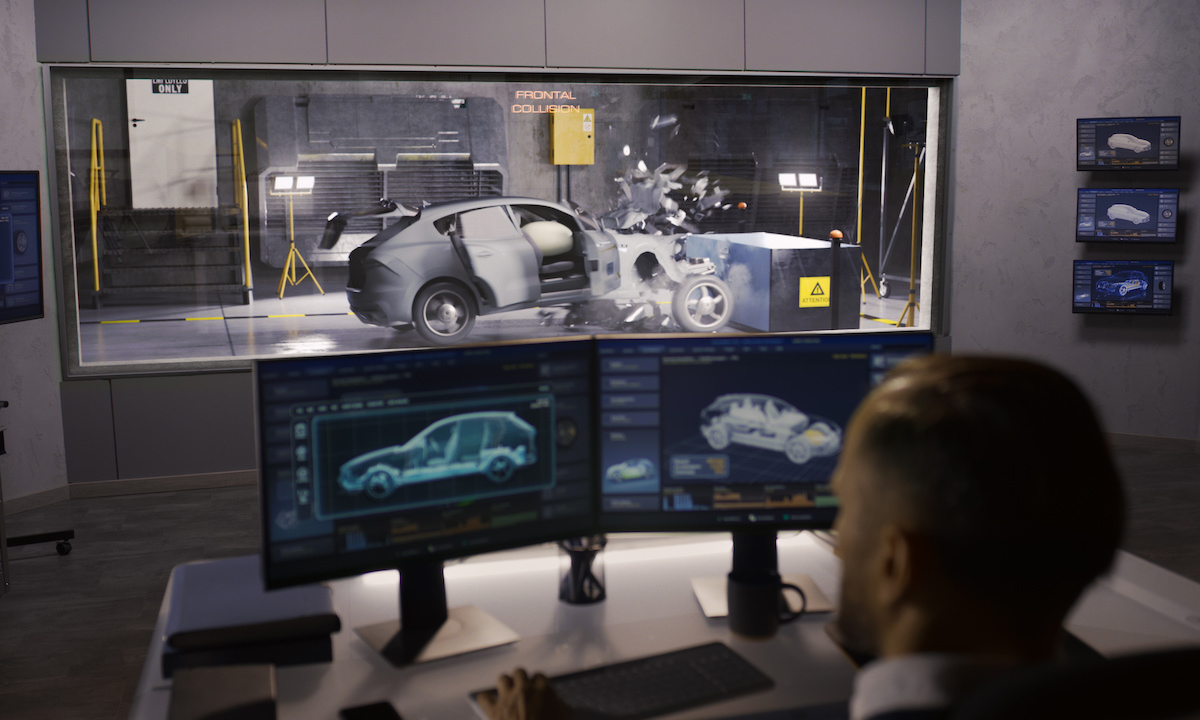
Hyundai Motor Group reported on Aug. 12 that its Crash Safety AI Assistant has cut the time engineers spend searching for and reviewing historical crash-test cases by about 90%. According to SBS, the R&D system, introduced at the Namyang Research Institute in late 2025, brings together prior crash-test results, images and analysis data and helps engineers compare similar cases.
The reported gain concerns information retrieval and review ahead of engineering analysis, rather than the crash-testing process itself. PYMNTS describes the system as helping engineers identify comparable historical tests and assemble relevant material for evaluating current results.
Data infrastructure precedes deployment
Hyundai presented the crash-test result at an AI Transformation Performance Presentation at its Yangjae headquarters in Seoul. SBS reports that the group began a phased digital-transformation effort in 2019 and subsequently deployed Microsoft 365, Jira, Dooray and Confluence to standardize collaboration and knowledge sharing.
The group also established its Global One Data Pipeline, which SBS describes as connecting data across R&D, production, quality and sales. Automotive World characterizes this infrastructure work as the foundation for the organization's wider AI deployment.
That sequencing is consequential for industrial AI teams. Comparable deployments often depend less on a standalone model than on whether historical records are consistently indexed, governed and connected across engineering systems. Retrieval quality, provenance and access control become particularly important when engineers use prior safety cases as inputs to a new analysis.
Broader operational metrics
Hyundai's presentation included several additional internal productivity figures:
- •Automotive World reports that the in-house generative AI platform H Chat Pro had more than 30,000 active users, or roughly 80% of Hyundai Motor and Kia employees covered by the company's measure.
- •SBS reports that the platform lets staff select external generative AI models including ChatGPT, Gemini and Claude.
- •Automotive World reports that an AI Automated Recognition Service verifies vehicle identification information across about 70 production processes and saves approximately KRW 5.24 billion, or about $3.9 million, annually.
- •Automotive World also reports that a reinforcement-learning cart-routing system cut unnecessary production downtime by about 86%, while an AI maintenance-support service reduced technician response time by about 42%.
According to Automotive World, Hyundai also launched E-FOREST: POLARIS, a manufacturing platform for building production-line AI agents. At the presentation, Eunsook Jin, president and head of Hyundai Motor Group's ICT Management Division, said the company was expanding its AI transformation through the integration of AI and other intelligent technologies, Automotive World reported.
What remains unverified
The figures are company-reported operational metrics. PYMNTS noted that the crash-test, production-downtime and maintenance-response results had not been independently audited, citing TechTimes.
For practitioners, the reported crash-test workflow is a concrete example of enterprise AI applied to high-volume technical records rather than to a customer-facing chatbot. In comparable safety-critical settings, a large reduction in search time does not by itself establish the quality of an engineering decision. Teams generally need evaluation procedures that measure retrieval accuracy, document completeness, traceability to original test data and the treatment of conflicting historical cases.
Key Points
- 1Hyundai reported a 90% reduction in crash-test search and review time by applying AI to historical engineering records and comparisons.
- 2The deployment follows a multi-year data and collaboration foundation, illustrating how industrial AI often depends on governed, connected operational data.
- 3Company-reported productivity metrics are notable, but comparable safety-critical workflows require separate validation of retrieval accuracy, provenance and engineering decision quality.
Scoring Rationale
The reported deployment offers a substantial, specific example of AI-assisted retrieval and review in automotive safety engineering. Its practical relevance extends to teams building data-intensive industrial workflows, although the performance figures are company-reported and not independently audited.
Sources
Public references used for this report.
Practice interview problems based on real data
1,625 SQL & Python problems across 15 industry datasets — the exact type of data you work with.
Try 250 free problems