
Honor Positions PCs As AI Partners With YOYO Claw
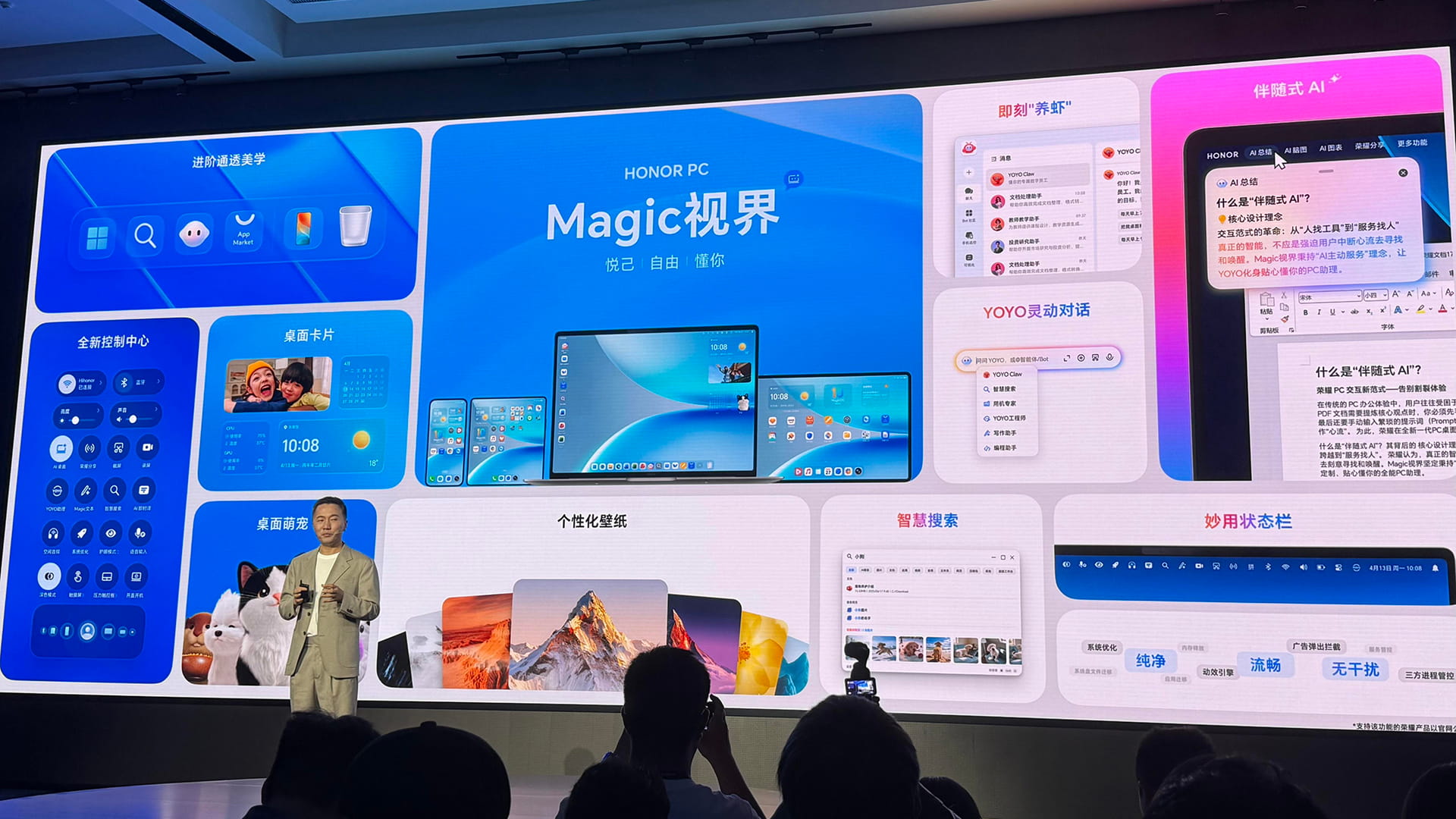
Honor has integrated an on-device AI agent, YOYO Claw, into its MagicBook laptop series, positioning PCs as active creative partners. Built from OpenClaw, the agent ships with five primary agents and 23 sub-agents that target education, productivity, research, and content creation. Honor claims a 50% reduction in token consumption versus OpenClaw and reports task success improving from 89.5% to 94.5% on the PinchBench set. YOYO Claw uses a token scheduling engine to route tasks between local execution and cloud, enabling zero-token local handling for frequent tasks. The system includes cross-device collaboration and a dedicated security agent to block high-risk operations.
What happened
Honor launched `YOYO Claw`, an on-device agent derived from `OpenClaw`, and embedded it as a built-in capability in the MagicBook laptop line. The agent debuts with five primary agents and 23 sub-agents, covering education, office productivity, academic research, content creation, and general assistance. Honor reports a 50% reduction in token usage on average versus OpenClaw, and improved task success from 89.5% to 94.5% on the PinchBench test set.
Technical details
YOYO Claw relies on a token scheduling engine that implements an end-device to cloud routing mechanism. High-frequency, locally solvable tasks execute on-device, yielding zero token consumption. Cloud calls remain for heavier tasks, where the system uses context compression and memory matching to reduce payload and call frequency. Practitioners should note the following capabilities:
- •Preloaded agent catalog: five primary agents and 23 sub-agents across common vertical scenarios
- •Token efficiency: claimed 50% average token savings vs OpenClaw
- •Task success improvements: 89.5% to 94.5% on PinchBench
- •Cross-device collaboration and local memory sharing across phones, tablets, and PCs
- •Built-in security agent that monitors AI actions and blocks high-risk operations
Context and significance
This rollout exemplifies OEMs shifting from generic OS features to device-embedded AI agents, treating the PC as a persistent context-aware collaborator rather than a stateless compute tool. The hybrid routing model mirrors industry trends toward on-device inference for latency, cost, and privacy, combined with cloud for heavier reasoning. Token-aware scheduling and context compression are practical optimizations that reduce API costs and latency for mixed workloads. By pre-installing verticalized agents, Honor lowers the activation friction typical of third-party agent ecosystems, which could accelerate user uptake of agent workflows.
What to watch
Adoption will hinge on real-world robustness, third-party integration hooks, developer tooling, and transparency around the security agent's policies. Monitor benchmark replication, telemetry on local vs cloud call ratios, and whether Honor exposes developer APIs or model weights for customization.
Key Points
- 1Honor embeds `YOYO Claw` in MagicBook laptops, shifting PCs toward persistent, context-aware AI partners.
- 2A token scheduling engine routes work between device and cloud, lowering costs and localizing frequent tasks, improving efficiency.
- 3Preloaded vertical agents and a security agent reduce activation friction and surface risk controls, which may speed user adoption.
Scoring Rationale
This is a notable OEM product move that advances on-device agentization and hybrid routing, relevant to practitioners designing agent workflows. It is not a frontier model release or industry-defining milestone, hence a mid-high significance score.
Sources
Public references used for this report.
Practice interview problems based on real data
1,625 SQL & Python problems across 15 industry datasets — the exact type of data you work with.
Try 250 free problems
