Honor advances on-device AI with robot phone and Magic V6
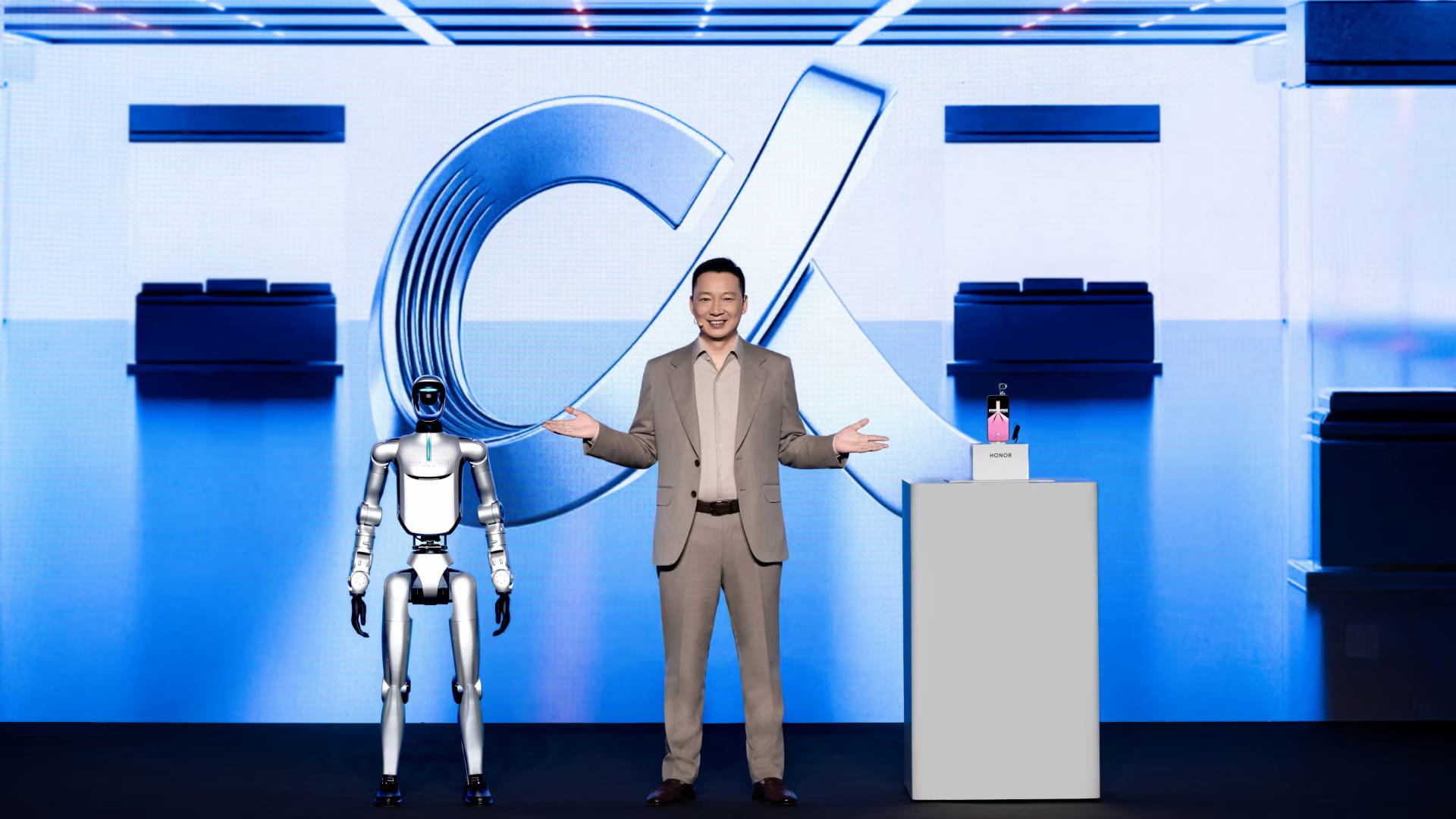
Reporting from Mobile World Congress and company releases shows that Chinese smartphone maker Honor showcased a prototype "Robot Phone," a humanoid companion and the flagship Magic V6 as part of a broader push into on-device AI. According to PR Newswire and coverage in SCMP and CNET, Honor demonstrated embodied-intelligence concepts and new hardware at MWC 2026. KR-Asia reports that Honor announced plans to invest USD 10 billion in AI over five years and has restructured R&D, launched MagicOS and the agent product Yoyo, and integrated AI features into devices. KR-Asia also cites Google's open-source Gemma 4 as lowering barriers for on-device model deployment. Industry observers will watch how advances in model efficiency, sensors, and foldable hardware translate into usable on-device agents for real-world tasks.
What happened
Reporting from Mobile World Congress and company releases shows that Honor unveiled a suite of AI-focused hardware and software demonstrations in early 2026. According to PR Newswire, Honor presented a prototype "Robot Phone," previewed a humanoid companion and launched the flagship Magic V6 at MWC 2026. Reporting by SCMP and CNET corroborates the Robot Phone and humanoid demonstrations and notes public demos and demonstrations in Barcelona. KR-Asia reports that Honor announced plans to invest USD 10 billion in AI over five years and has reorganized engineering into an AI and software division; KR-Asia also reports that Honor released MagicOS and an agent product named Yoyo that integrates services such as shopping and ride-hailing.
Technical details
Reporting by PR Newswire describes the Magic V6 as a foldable flagship with new battery and hinge engineering; PR Newswire lists IP68 and IP69 ratings and an 8.75mm closed profile. KR-Asia highlights device-level AI capabilities on Honor phones, including on-device meeting summarization, photo-to-document conversion and agent-managed session support. KR-Asia additionally notes Google's open-source model release, Gemma 4, and reports that architectural innovations in Gemma 4 have reduced the computational barrier for deploying models on devices.
Editorial analysis - technical context
Context and significance
What to watch
Industry context
Advances in model architecture and quantization, along with the Gemma 4 family reported by Google, are lowering the compute and memory requirements for useful generative agents to run on phones. Companies integrating agent frameworks with OS-level hooks tend to emphasize latency, privacy, and offline capability; on-device execution reduces round-trip latency and external dependency for some workflows. Sensor and actuator convergence-cameras, IMUs, motors in the Robot Phone and humanoid platforms-creates new input modalities that amplify agent usefulness but also increase system complexity for power, thermal, and reliability engineering.
Observers should monitor three indicators to assess whether device demos translate to developer and user impact:
- •the availability of on-device model runtimes and developer SDKs tied to Gemma 4 or equivalent models
- •carrier and app-ecosystem support for OS-level agent integrations like MagicOS and Yoyo
- •power, thermal and reliability metrics on shipping hardware under sustained agent workloads
Reporting sources have not published a product roadmap or shipping dates for the Robot Phone; PR Newswire quotes James Li, CEO of Honor: "With Human-centric as our lighthouse, we navigate the growth of AI through the two beams of IQ and EQ, bringing three forms of intelligence together." That quote is from the PR Newswire release.
For practitioners
Editorial analysis
Smartphone vendors have manufacturing scale, supply chains and consumer distribution that can accelerate adoption of on-device AI features, particularly in midrange segments where unit volumes matter. Reporting on Honor's robotics demos and CNET coverage of Honor-built humanoid runners demonstrates cross-application reuse of mobile components such as cameras, thermal management, and compute stacks into embodied systems. CNET reports that an Honor humanoid robot, named Flash, completed a half-marathon in 50 minutes 26 seconds, outperforming a human benchmark in that event; this detail illustrates rapid progress in motion and control when consumer-electronics engineering is applied to robotics.
Engineers building on-device agent experiences should expect tighter coupling between model efficiency, systems engineering and UX. Devices that combine foldable displays, motors or additional actuators will require new benchmarks for sustained throughput and energy cost per token, plus robust update paths for local models. Integrations that rely on local sensors and actuator feedback will elevate requirements for on-device privacy-preserving telemetry and verification.
Key Points
- 1Honor showcased a prototype "Robot Phone", a humanoid companion and the flagship Magic V6 at MWC 2026, per PR Newswire and SCMP.
- 2KR-Asia reports Honor announced a USD 10 billion AI investment over five years and reorganized R&D to focus on AI and software.
- 3Industry context: Model efficiency gains like Google's Gemma 4 lower the barrier for deploying useful on-device agents on smartphones and connected hardware.
Scoring Rationale
The story is notable for device-level deployments of AI and demonstrations of embodied intelligence, which matter to practitioners working on model efficiency, mobile inference, and system integration. It is not a frontier-model release or a major funding event, hence a mid-tier impact score.
Sources
Public references used for this report.
Practice interview problems based on real data
1,625 SQL & Python problems across 15 industry datasets — the exact type of data you work with.
Try 250 free problems