Greg Kroah-Hartman Uses Local AI Bot to Find Kernel Bugs
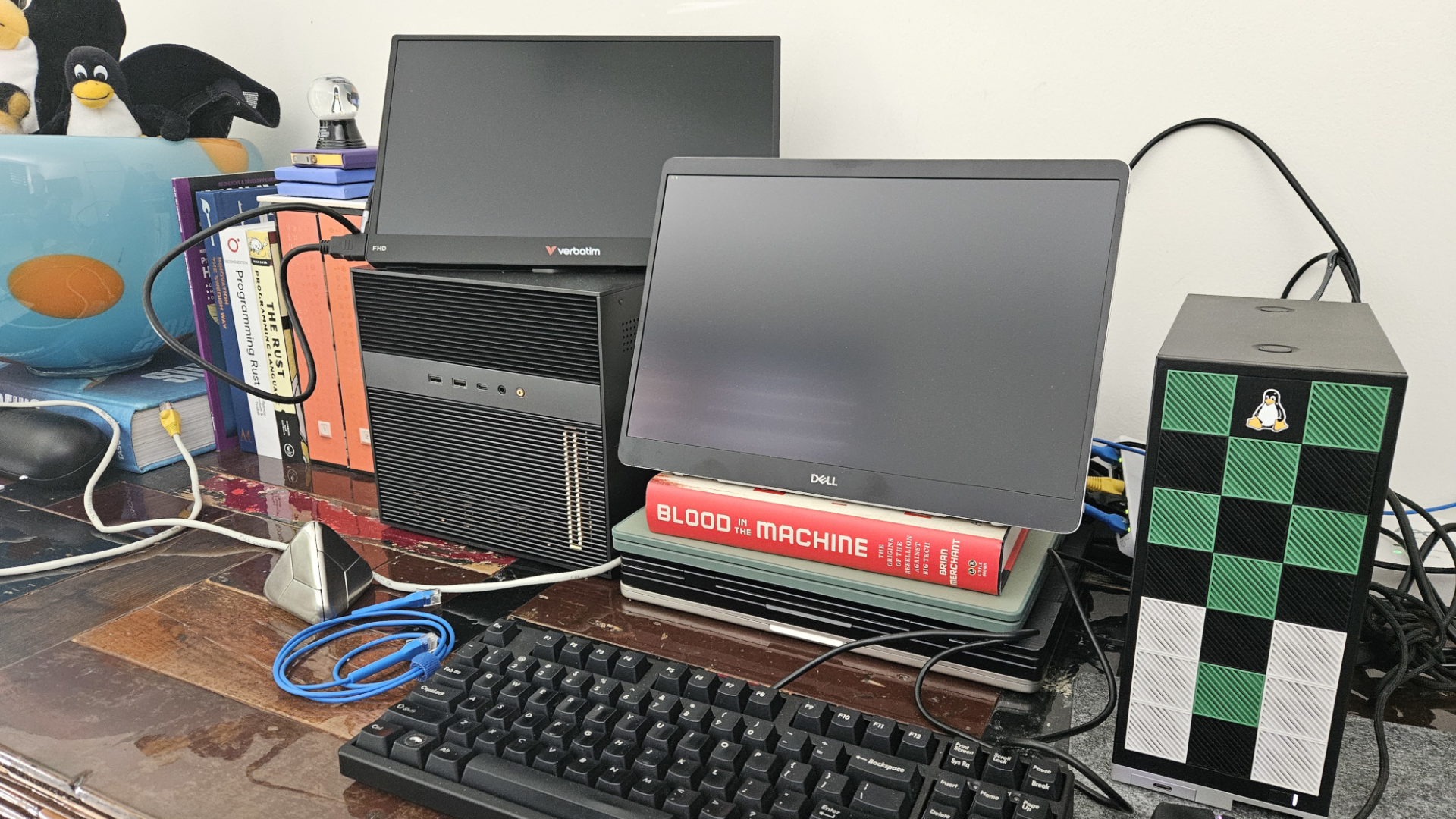
Phoronix and Tom's Hardware report that Greg Kroah-Hartman, the Linux kernel stable maintainer, posted a photo of a system he calls gkh_clanker_t1000 that runs locally on a Framework Desktop powered by an AMD Ryzen AI Max+ "Strix Halo" processor. Phoronix reports that, since April 7, nearly two dozen patches assisted by the gkh_clanker_t1000 have been merged into the mainline Linux kernel, addressing bugs in ALSA, HID, SMB, Nouveau, and IO_uring. Tom's Hardware reports Kroah-Hartman began testing the tool against the kernel's ksmbd and SMB code earlier this month, using virtual machines for local testing. Phoronix notes Kroah-Hartman has not yet revealed further software details of the system. For practitioners, this is a concrete example of running local LLM-driven tooling on desktop AI hardware to contribute to open-source quality assurance without cloud dependencies.
What happened
Phoronix and Tom's Hardware report that Greg Kroah-Hartman, the Linux kernel stable maintainer, shared a photo of a locally hosted AI-assisted fuzzing setup he calls gkh_clanker_t1000. Tom's Hardware reports the photographed system is a Framework Desktop equipped with an AMD Ryzen AI Max+ "Strix Halo" processor. Phoronix reports that, since April 7, nearly two dozen patches assisted by gkh_clanker_t1000 have been merged into the mainline Linux kernel, fixing issues across ALSA, HID, SMB, Nouveau, and IO_uring. Tom's Hardware reports Kroah-Hartman started by testing the tool against the kernel's ksmbd and SMB code earlier this month and used virtual machines to run local tests. Phoronix adds that Kroah-Hartman has not disclosed further details about the software stack behind gkh_clanker_t1000.
Editorial analysis - technical context
Local LLMs and on-premise inference hardware like the AMD Ryzen AI Max+ are increasingly used for developer workflows that require low-latency loopback testing and data privacy. Industry-pattern observations: teams experimenting with LLM-assisted fuzzing often prefer local setups when the target is a system-level codebase such as the Linux kernel, because reproducing failures and capturing logs is easier on controlled VMs and physical test rigs. For practitioners, the practical takeaway is that desktop AI accelerators are now capable of hosting models that can assist automated test generation and triage without routing sensitive test artifacts through cloud APIs.
Technical details
Reported facts about the hardware and outcomes are limited to the photo and merged patches; Phoronix reports the hardware combination performs well on open-source stacks, and Tom's Hardware documents the use-case around SMB/ksmbd. There is no public technical disclosure from Kroah-Hartman about the specific model weights, prompting framework, fuzzing harness, or the integration method between the LLM and kernel test runners. Phoronix explicitly notes the software side has not been revealed.
Context and significance
Editorial analysis: This episode illustrates two broader trends in tooling for systems software. First, developers are moving some LLM-enabled engineering tasks back on-premise as consumer-class AI accelerators become more capable. Second, LLMs are being trialed as assistants for test generation and bug triage rather than only as coding aides. For the Linux kernel ecosystem, the immediate significance is pragmatic: several patches credited as assisted by the tool have already landed, demonstrating an operational proof-of-concept for the approach.
What to watch
Editorial analysis: Observers should look for any follow-up posts or repositories that document the gkh_clanker_t1000 software stack, including the model used, prompting strategy, fuzzing harness, and test reproducibility. Also watch whether other maintainers begin to adopt local LLM-assisted workflows and whether projects publish reproducible methodologies for evaluating LLM-suggested patches. Finally, practitioners should monitor how maintainers attribute and review LLM-generated diagnostic output in upstream code review processes.
Bottom line
The reported deployment of gkh_clanker_t1000 on a Framework Desktop with an AMD Ryzen AI Max+ has already coincided with nearly two dozen merged kernel patches per Phoronix and Tom's Hardware, but critical implementation details remain undisclosed. Editorial analysis: the incident signals growing practicality of local LLM workflows for systems-level testing, and it sets a precedent for documentation and reproducibility that the community will likely demand.
Key Points
- 1Local LLM-assisted tooling on desktop AI hardware can produce actionable fixes, as multiple kernel patches were merged after gkh_clanker_t1000 testing.
- 2On-premise AI accelerators like AMD Ryzen AI Max+ enable low-latency, private fuzzing workflows, reducing reliance on cloud inference for sensitive system tests.
- 3Practitioners will need clear reproducibility and review practices when integrating LLM-generated test cases and patch suggestions into open-source projects.
Scoring Rationale
The story shows a practical, validated use of local LLM-driven tooling yielding merged kernel patches, which is notable for developer workflows and tooling but not a paradigm-shifting model release. It is directly relevant to practitioners evaluating on-premise LLM use for testing.
Sources
Public references used for this report.
Practice interview problems based on real data
1,625 SQL & Python problems across 15 industry datasets — the exact type of data you work with.
Try 250 free problems