Google Workspace Intelligence Enhances Gemini Contextual Capabilities
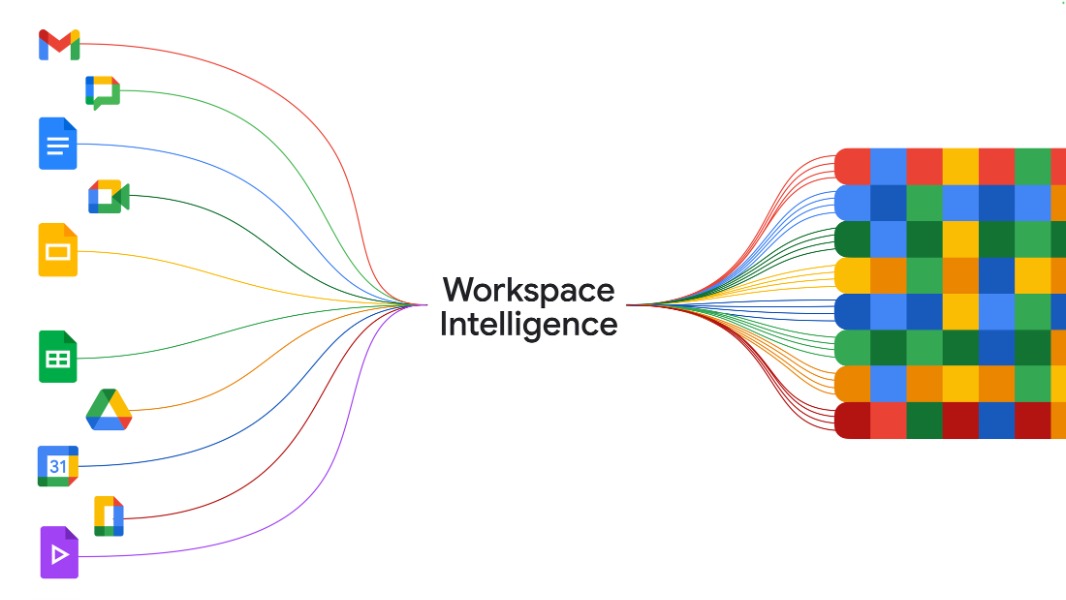
Google launched Workspace Intelligence, a semantic context layer that grounds Gemini features across Google Workspace in company data, projects, and collaboration graphs. The system builds a dynamic knowledge graph from Gmail, Docs, Drive, Chat, Sheets, and other Workspace signals, using advanced Gemini reasoning to surface relevant information, prioritize actions, and personalize outputs to a user's style. Key surface features include "Ask Gemini" in Google Chat as a unified command line for work, AI Inbox and AI Overviews in Gmail, natural-language spreadsheet building in Sheets, infographic generation and comment triage in Docs, and Drive Projects as a shared context hub. The update focuses on agentic workflows, real-time situational awareness, and enterprise governance, with third-party integrations for tools like Asana, Jira, and Salesforce.
What happened
Google introduced Workspace Intelligence at Cloud Next 2026, a new semantic layer that grounds Gemini-powered features across Google Workspace in customers' real-time data, projects, and collaboration graphs. The system is described as a dynamic, secure knowledge graph that understands relationships across Gmail, Docs, Slides, Sheets, Chat, Drive, and other Workspace signals, enabling agentic features that can gather context, prioritize actions, and produce personalized outputs.
Technical details
Workspace Intelligence combines Google Search capabilities, domain knowledge, and advanced Gemini reasoning to deliver situational awareness and personalized responses. The release highlights three core capabilities: information gathering, situational awareness, and true personalization. Practitioners should note the following implementation cues and surface features:
- •Ask Gemini in Google Chat acts as a unified command line that can run multi-step tasks: document generation, file retrieval by description, schedule coordination, and daily briefings.
- •Gmail updates include AI Inbox and AI Overviews that surface prioritized messages and summaries rooted in a user's workspace context.
- •Docs and Slides now support data-grounded content generation: infographics built from business data, batch image edits for visual consistency, comment triage and automated edits, and one-pass deck generation using company templates and visual rules.
- •Sheets gains natural-language spreadsheet building and third-party imports for apps such as HubSpot and Salesforce, plus a new canvas layer for dashboards and kanban-style views.
- •Drive adds Drive Projects as a shared context hub that ties files and email together for team workflows.
Context and significance
This is a product-first move to make generative AI agentic and context-aware in enterprise productivity software. By turning scattered application signals into a unified knowledge graph, Google is reducing the context engineering burden for customers and internal developer teams that previously had to stitch APIs and embeddings together. The emphasis on personalization and situational awareness positions Google to compete directly with other vendor efforts to embed large models into work apps, but with a competitive advantage: direct ownership of email, docs, and search signals at scale. The integration of third-party tools such as Asana, Jira, and Salesforce also signals a practical approach to enterprise adoption, where cross-system orchestration matters more than single-model quality.
Security and governance
Google frames Workspace Intelligence as a secure, enterprise-grade system with domain-level controls and governance. For ML engineers and security teams, this will raise operational questions about access control, data lineage, model explainability, and audit logging when models act on or synthesize sensitive corporate material.
What to watch
Adoption will hinge on enterprise trust: visibility into what context is used, admin controls to limit cross-domain exposure, and predictable RBAC. Also watch how Google exposes developer hooks or APIs for custom agents, and whether Gemini-powered actions are available via the existing Gemini API or a specialized Workspace agent API. "Simply state your goal, and Gemini will work behind the scenes to deliver the finished result directly into your chat," said Google, highlighting the product intent to automate multi-step workflows.
Practical implications for teams
Organizations should prepare governance policies, update data labeling and retention rules, and revisit SSO and least-privilege access models before wide rollout. ML practitioners should map where Workspace data can augment internal models, and SRE/infra teams should evaluate the operational footprint of agentic features on audit and compliance workflows. This release is not a single-model milestone; it is a systems-level integration that changes how enterprise context is captured and consumed by generative AI. Companies adopting Workspace Intelligence gain faster, more integrated automation but must budget for governance and change management.
Key Points
- 1Workspace Intelligence creates a dynamic, semantic knowledge graph from Workspace apps, reducing manual context stitching for generative tasks.
- 2Ask Gemini in Chat and AI Inbox features use Gemini reasoning to execute multi-step, domain-grounded workflows across Docs, Slides, Sheets, and Drive.
- 3Enterprise adoption depends on governance and access controls; visibility into context usage and audit trails is the critical operational bottleneck.
Scoring Rationale
A major product integration that materially improves enterprise productivity by grounding generative features in corporate context. It is not a frontier model release, but it meaningfully shifts how organizations operationalize LLMs inside core productivity stacks.
Sources
Public references used for this report.
Practice interview problems based on real data
1,625 SQL & Python problems across 15 industry datasets — the exact type of data you work with.
Try 250 free problems