GitHub Brings AI Security Detections Into Pull Requests
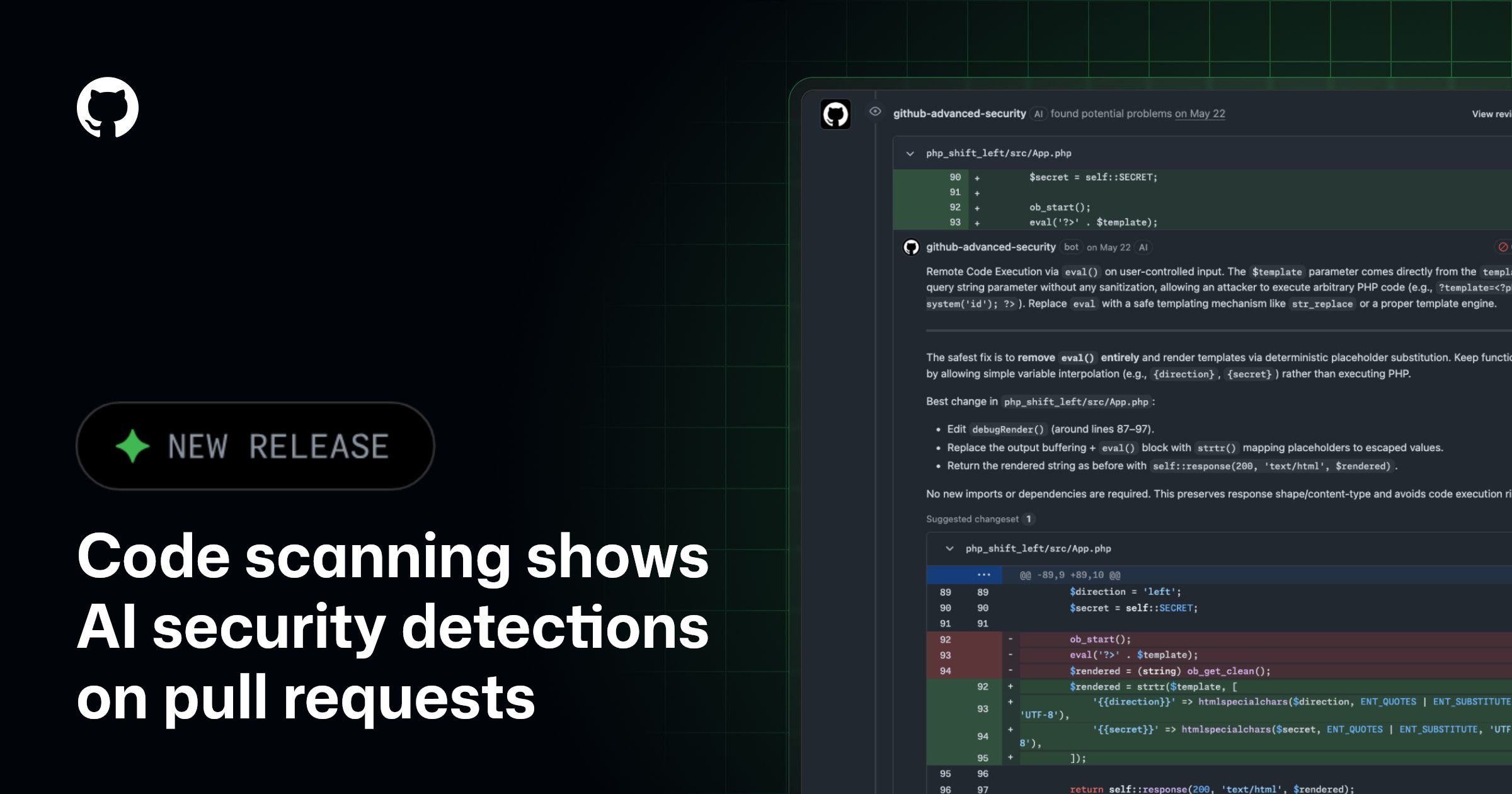
GitHub has introduced AI-powered security detections inside pull requests for GitHub Code Security customers in public preview. The detections are intended to extend coverage beyond languages and frameworks supported by CodeQL, appear alongside existing code-scanning results, and carry an AI label. They are informational and do not block merges. The preview requires enterprise and organization enablement, CodeQL default setup, a Copilot license, and AI credits. GitHub has not published independent accuracy or false-positive benchmarks. LDS recommends treating the feature as a separate experimental signal: measure incremental true findings, duplicate alerts, false positives, review time, and repair regressions before allowing it to influence merge policy.
What happened
GitHub has added AI-powered security detections directly to pull requests for eligible GitHub Code Security customers in public preview. The company says the feature is designed to find potential issues in languages and frameworks outside CodeQL's current built-in coverage. Findings appear in the normal pull-request workflow and are labeled as AI-generated so developers can distinguish them from CodeQL results.
The detections run when a pull request is opened or updated. GitHub says results may arrive as the engine produces them, remain informational, and do not block merges. Enterprises must allow the feature, organizations must enable it, and repositories must use CodeQL default setup. The preview also requires a Copilot license and consumes AI credits.
GitHub's release establishes availability and workflow behavior. It does not provide independent precision, recall, severity-calibration, or repair-safety results across supported repositories.
Security context
The AI engine and CodeQL should be treated as different evidence channels. CodeQL executes tested queries over supported languages; the AI detector aims to cover patterns and ecosystems without equivalent native rules. Mixing the results into one undifferentiated metric would hide whether the new system adds useful coverage or simply more alerts.
| Measure | Useful comparison | Risk exposed |
|---|---|---|
| Incremental recall | Seed issues outside CodeQL coverage | Missed novel vulnerability |
| Precision | Expert-triage sampled findings | Alert fatigue |
| Duplication | Match AI and CodeQL findings | Double-counted risk |
| Stability | Rerun unchanged pull request | Nondeterministic result |
| Repair safety | Test suggested remediation | Security or functional regression |
For practitioners
Enable the preview on a representative repository set before wider rollout. Maintain a labeled test pack with vulnerable and clean changes, record whether each finding was novel or duplicated, and have reviewers classify exploitability and severity without relying on the model's wording. Track reviewer minutes per useful finding as well as raw alert count.
Because the preview consumes AI credits, cost should be measured per validated incremental finding, not per scan. Teams should also confirm what code and metadata leave the repository boundary, how findings are retained, and whether enterprise audit logs identify feature enablement and reviewer actions.
Editorial analysis
LDS sees the integration as a potentially useful coverage layer, especially for repositories outside CodeQL's strongest language support. It should not inherit trust from the existing code-scanning interface. The AI label, non-blocking default, and separate evaluation metrics are essential until teams have repository-specific evidence.
What to watch
Watch for public benchmark data, support for policy tuning, cost controls, data-handling documentation, reproducibility improvements, and whether GitHub offers metrics that separate AI-only findings from rule-based detections.
Key Points
- 1GitHub now surfaces labeled AI security detections inside pull requests to extend coverage beyond CodeQL-supported languages and frameworks.
- 2The public-preview findings are informational and non-blocking, with enterprise controls, licensing requirements, and AI-credit consumption.
- 3LDS recommends measuring incremental true findings, false positives, duplicates, reviewer effort, stability, and repair regressions separately from CodeQL.
Scoring Rationale
An impact score of 6.0 reflects expanded security coverage in a major developer workflow, tempered by preview status and missing independent effectiveness evidence.
Sources
Primary source and supporting public references used for this report.
Practice interview problems based on real data
1,625 SQL & Python problems across 15 industry datasets — the exact type of data you work with.
Try 250 free problems