Generative AI Transforms Dashboards into Decision Narratives
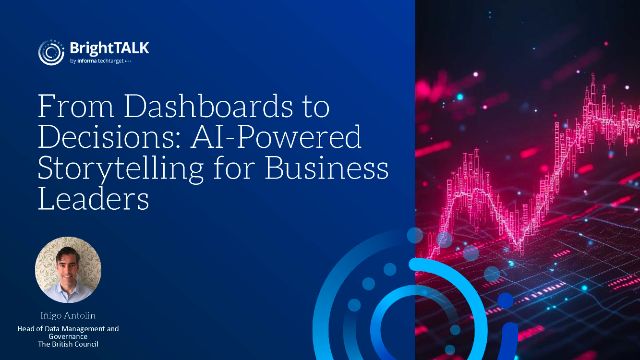
BrightTALK lists a 60-minute webinar on May 26, 2026, titled "From Dashboards to Decisions: AI-Powered Storytelling for Business Leaders," presented by Iñigo Antolin, Head of Data Management and Governance at The British Council. The session description states organizations increasingly suffer decision paralysis as dashboards proliferate and metrics conflict, and that Generative AI can convert fragmented data into coherent, decision-ready narratives. BrightTALK says the talk will include real-world use cases, a step-by-step framework, methods to integrate diverse data sources, techniques to reduce noise, and common pitfalls to avoid.
What happened
BrightTALK lists a 60-minute webinar on May 26 2026 titled "From Dashboards to Decisions: AI-Powered Storytelling for Business Leaders," presented by Iñigo Antolin, Head of Data Management and Governance at The British Council. The session description states organizations face growing data overload from proliferating dashboards and conflicting metrics, and that Generative AI can transform multiple data sources into coherent, decision-ready narratives. The BrightTALK listing identifies these key takeaways:
- •Why data overload often leads to poor decisions and how to overcome it.
- •A step-by-step framework for creating structured narratives with Generative AI.
- •Methods to integrate diverse data sources into a single coherent story.
- •Techniques to reduce noise and highlight decision-critical insights.
- •Real-world examples of effective AI-driven storytelling and common pitfalls to avoid.
Editorial analysis - technical context
Generative AI-powered storytelling, as framed in the session description, typically relies on three technical building blocks: unified data ingestion and schema alignment, signal extraction (feature selection and anomaly detection), and natural-language generation layered with retrieval or grounding to source data. Industry practitioners deploying similar workflows commonly combine ETL/ELT pipelines, lightweight OLAP or feature stores, and LLM-based narrative layers to produce explainable summaries rather than raw visualizations.
Industry context
Organizations wrestling with dashboard sprawl often report low trust in analytics and slow decision cycles. For practitioners, focusing on end-to-end lineage, provenance, and transparent grounding of automated narratives is a recurring theme in production deployments.
What to watch
Observers should track how vendors and teams validate generated narratives against source metrics, how hallucination and provenance controls are implemented, and which integration patterns for multi-source data prove repeatable in operations.
Key Points
- 1Generative AI can reduce dashboard noise by converting multiple sources into single, narrative summaries that highlight decision-critical signals.
- 2Effective AI storytelling requires data alignment, signal extraction, and grounding the narrative to source metrics to maintain trust.
- 3Practitioners should prioritize provenance, validation, and integration patterns when operationalizing narrative-driven analytics to avoid hallucinations.
Scoring Rationale
This webinar addresses a practical, recurring challenge for analytics teams: converting dashboard output into actionable narratives. It matters to practitioners building production analytics workflows but does not introduce a new model or platform-level innovation.
Sources
Public references used for this report.
Practice interview problems based on real data
1,625 SQL & Python problems across 15 industry datasets — the exact type of data you work with.
Try 250 free problems