Forrester Warns AI Erodes Human Cognitive Sovereignty
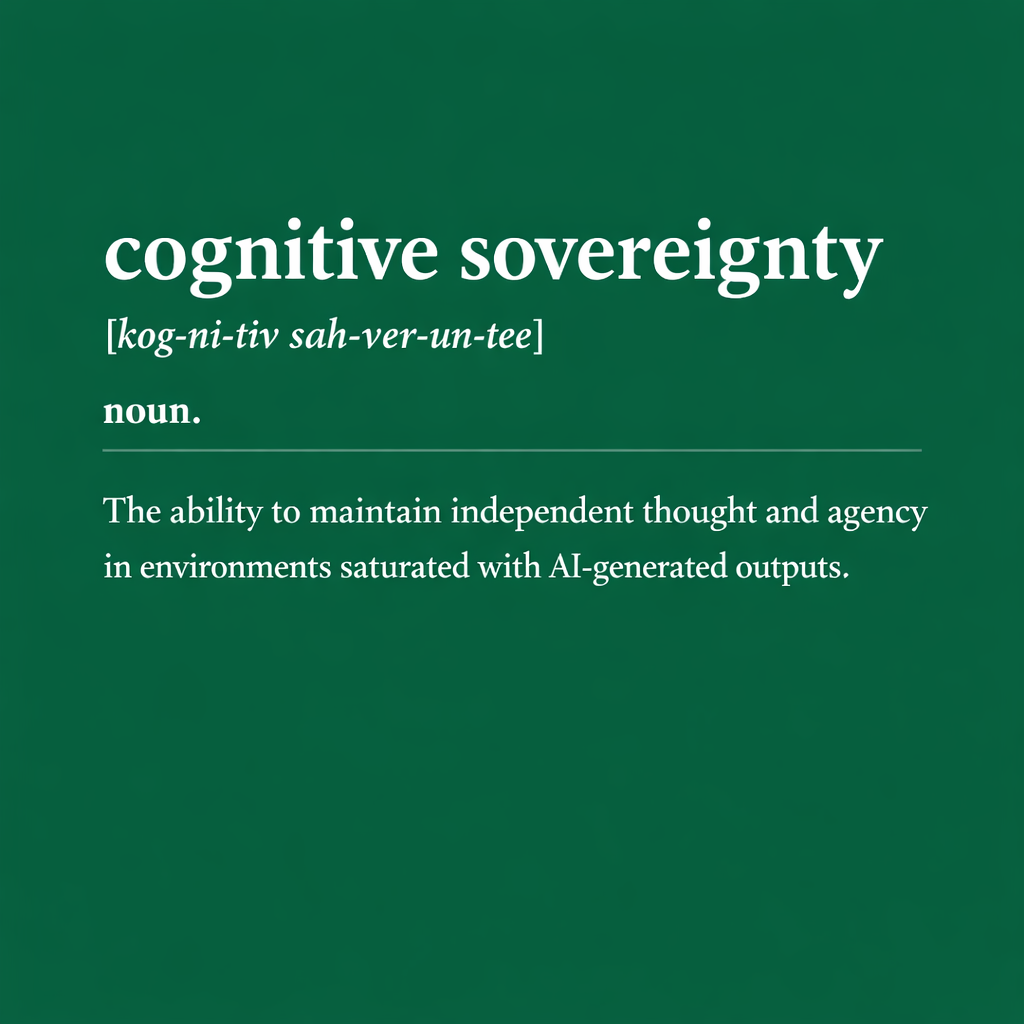
A Forrester blog post published April 27, 2026, introduces the term "cognitive sovereignty" and defines it as "the ability to maintain independent thought and agency in environments saturated with AI-generated outputs," quoting the post directly. The post frames AI saturation as a risk not only of technical error but of humans gradually stopping independent thought, and it argues that protecting the ability to "think, decide, and intervene" is operationally important. The blog also cites educator Kelsey Pomeroy's reframing of AI guidance for children toward "brain protection." The post calls for stronger data literacy and human-in-the-loop practices as safeguards against erosion of judgment.
What happened
A Forrester blog post published April 27, 2026, introduces the term "cognitive sovereignty", quoting the post: "Cognitive sovereignty is the ability to maintain independent thought and agency in environments saturated with AI-generated outputs." The post states, quoting the authors, that "AI isn't just accelerating work, it's saturating it," and that the risk is that "humans slowly stop thinking independently." The authors assert, in the post, that "we must protect the ability to think, decide, and intervene." The post also references educator Kelsey Pomeroy and her recommendation to reframe discussions with children around "brain protection."
Editorial analysis - technical context
Industry-pattern observations: As AI outputs become pervasive across tooling and workflows, the practical control points shift from raw model accuracy to how people use and interpret model outputs. Companies and teams that embed humans in decision loops typically face tradeoffs between throughput and judgement quality, often needing investment in data literacy, feedback pipelines, and interface controls to preserve effective oversight. For practitioners, those controls are as important as model selection when the objective is reliable human decision making rather than raw automation.
Context and significance
The Forrester framing connects ethical and operational concerns. Framing the problem as "cognitive sovereignty" highlights human judgement as a corporate risk and capability, rather than only a compliance or accuracy problem. For product and UX teams, this shifts emphasis toward design patterns that surface model uncertainty, provide provenance for outputs, and require human confirmation where consequences are material. For learning and development teams, the post reinforces a growing emphasis on data literacy as a risk-mitigation and value-unlocking capability.
What to watch
Industry context
Observers should track three signals that operationalize this framing: adoption of human-in-the-loop checkpoints in downstream workflows; investments in explainability and provenance features in vendor tooling; and updated training programs that teach employees not only how models work but when to override them. Public reporting or vendor documentation that ties model outputs to decision-level controls will be an actionable indicator that organizations are treating cognitive sovereignty as an operational objective.
Key Points
- 1Forrester defines "cognitive sovereignty" as the ability to keep independent thought in AI-saturated environments, reframing human judgement as an operational capability.
- 2Practical safeguards cited include stronger data literacy and human-in-the-loop checkpoints, shifting focus from pure model metrics to decision workflows.
- 3For practitioners, design patterns that expose uncertainty, provenance, and confirmation controls matter more as AI saturates tools and interfaces.
Scoring Rationale
The piece reframes an operational risk that is broadly relevant to practitioners building and deploying AI, but it is a conceptual intervention rather than a technical or product breakthrough. It matters for governance, UX, and L&D work streams across organizations.
Practice interview problems based on real data
1,625 SQL & Python problems across 15 industry datasets — the exact type of data you work with.
Try 250 free problems