Eon Systems Simulates Fly Brain, Sparks Uploading Debate
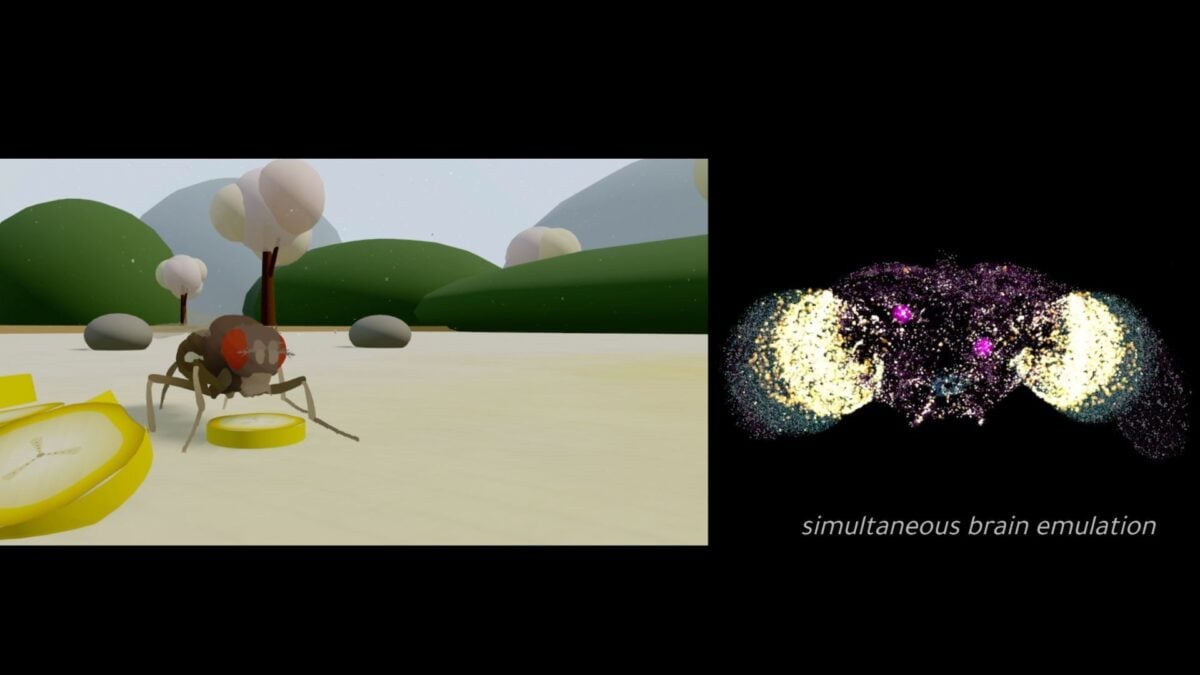
Eon Systems released a demo of a virtual fly driven by a digital replica of a complete fruit fly connectome: 125,000 neurons and 50 million synaptic connections, paired with an AI algorithm Eon says matches biological firing with 95% accuracy. The fly navigates a Sims-like environment, reacts to stimuli, and performs goal-directed actions, which Eon frames as an early form of mind-uploading. The result is technically impressive for connectomics and embodied simulation, but it does not imply human-level brain emulation. Major gaps remain: scaling from insects to mammalian brains, capturing non-electrical biology, data completeness, plasticity, and the enormous compute and measurement challenges of living human brains. Practitioners should treat this as a notable connectomics milestone, not proof that human mind-uploading is near-term feasible.
What happened
Eon Systems unveiled a demonstration of a virtual fly whose control is produced by a digital reconstruction of a complete fruit fly connectome, containing 125,000 neurons and 50 million synaptic connections, paired with an AI model Eon claims reproduces biological firing with 95% agreement. The simulated insect acts inside a physics-backed virtual environment, seeking food and responding to contact events. Co-founder Alex Wissner-Gross framed the result as more than animation, calling it a copy of biological neural activity in motion.
Technical details
Eon combined high-resolution electron microscopy-based connectomic imaging with computational modeling to drive an embodied agent in a synthetic world. Key technical elements include:
- •a full wiring diagram derived from serial-section electron microscopy
- •a neuron-by-neuron simulation layer that translates connectome structure into spiking behavior
- •sensorimotor coupling between the simulated body and the environment for closed-loop behavior
Eon reports 95% correspondence between simulated and recorded fly neuron firing patterns. The team did not publish full methods or open datasets in the demo release, so reproducibility and validation across conditions remain unverified.
Context and significance
This is a meaningful step for large-scale connectomics and embodied brain simulation because it stitches anatomical wiring, dynamical simulation, and an environment into a functional loop. For practitioners, it demonstrates practical progress on: electron-microscopy pipeline scaling, simulator-embedded neural models, and stimulus-response validation metrics. However, the jump from an insect nervous system to mammalian, let alone human, brains is orders of magnitude larger in neuron count, synapse complexity, neuromodulation, glial and metabolic contributions, and developmental history. Claims that this equates to mind-uploading conflate reproducing stimulus-response dynamics with reproducing subjective experience and whole-organism physiology.
What to watch
Scrutinize the methods, released code, and datasets when they arrive. The field needs open benchmarks for dynamical fidelity, controls for overfitting to stimuli, and clarity on what the reported 95% match actually measures. Scalability of imaging, labeled data, and compute cost will determine whether connectome-first approaches remain primarily insect-scale or become viable for larger nervous systems.
Bottom line
A noteworthy demonstration for connectomics and embodied neural simulation, technically interesting but far from validating human mind-uploading claims.
Key Points
- 1Eon Systems paired a 125,000-neuron, 50 million synapse connectome with a simulator and reports 95% firing-match fidelity.
- 2Closed-loop embodiment in a virtual environment is the key advance, but lacks published methods, datasets, and independent validation.
- 3Scaling to human brain emulation is blocked by orders-of-magnitude gaps in neurons, non-electrical biology, plasticity, and data collection.
Scoring Rationale
Technically notable for connectomics and embodied brain simulation, but single-insect scope and missing reproducibility keep it from being paradigm-shifting. Relevant to researchers but not an imminent path to human mind-uploading.
Practice with real Ad Tech data
90 SQL & Python problems · 15 industry datasets
250 free problems · No credit card
See all Ad Tech problems