Enterprise Leaders Prioritize AI Platforms and People
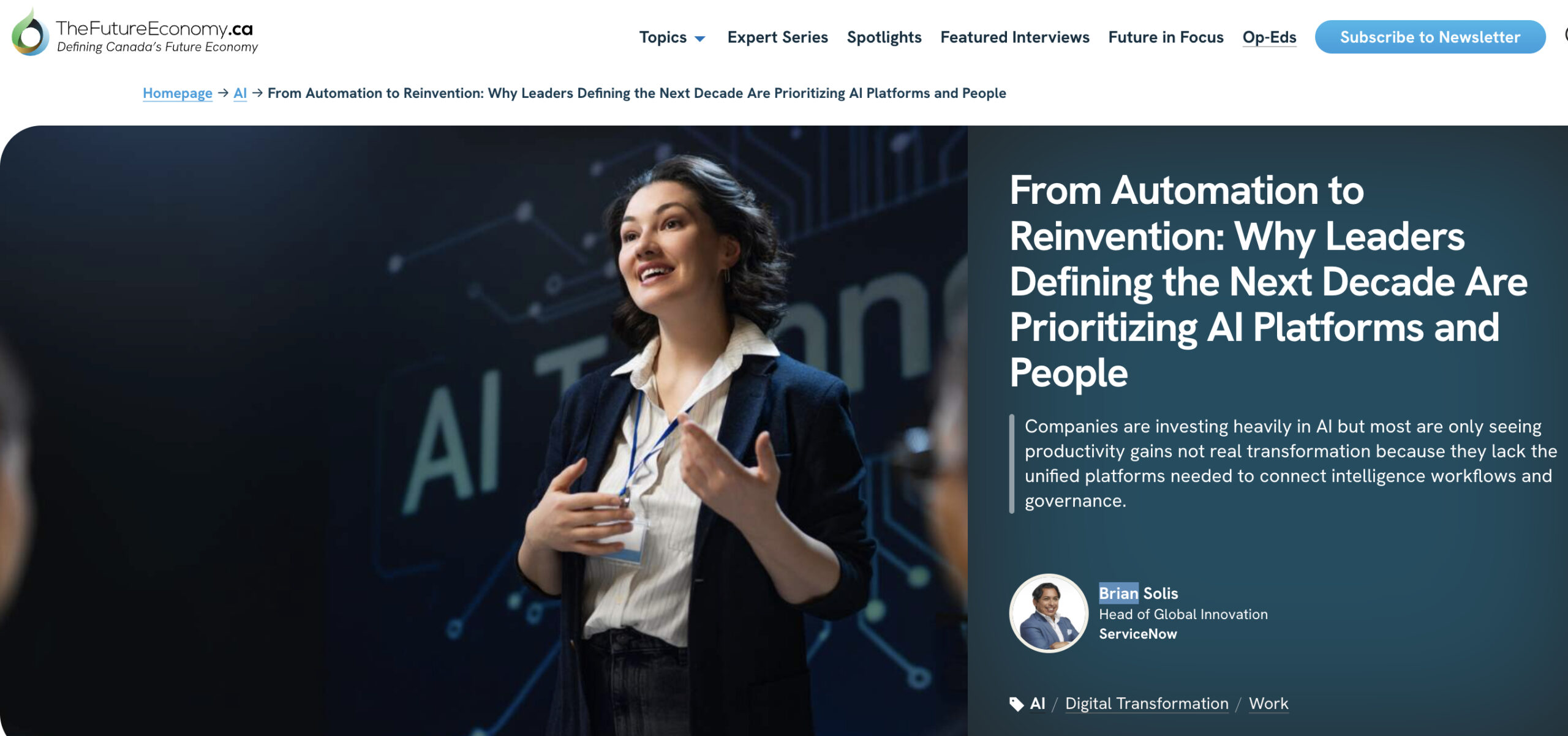
Brian Solis, Head of Global Innovation at ServiceNow, argues in a June 17, 2026 op-ed for TheFutureEconomy.ca that most enterprises investing billions in AI copilots and assistants are capturing only isolated productivity gains rather than real business transformation, a pattern he calls the transformation gap. The piece is a single-author opinion column, not independent reporting, so its claims reflect one executive's framing rather than verified industry data. Solis coins the term agent sprawl to describe disconnected department-level AI agents (customer service, procurement, HR, IT) that optimize individual tasks without sharing context or producing a unified audit trail. He argues the fix is a unified platform that connects intelligence, workflows, and governance, unsurprisingly the category ServiceNow itself sells into, and asks whether organizations are building AI "to act with confidence, at scale, within governance structures."
This piece is worth reading less as news and more as a named articulation of a pattern many practitioners already sense: AI pilots that show local productivity wins but never change how the organization actually operates. Its main value is vocabulary, "transformation gap" and "agent sprawl", for a problem that is otherwise hard to name in status reports, not new data or a disclosed study.
What happened
Brian Solis, Head of Global Innovation at ServiceNow, published an op-ed on TheFutureEconomy.ca (also cross-posted to his personal site) arguing that enterprises investing heavily in individual AI copilots and models are mostly seeing compartmentalized productivity gains rather than operating-model transformation. Solis writes that organizations increasingly deploy separate agents for customer service, procurement, HR, and IT support, none of which share context, enforce consistent policy, or produce a coherent audit trail, a pattern he terms "agent sprawl." He poses the framing question: "Are we building the organizational architecture that allows AI to act with confidence, at scale, within the governance structures our business requires, and in genuine partnership with people?"
Industry context
The argument is a single-author opinion column from a ServiceNow executive, not independently reported or peer-reviewed, and its prescription (a unified platform connecting intelligence, workflows, and governance) describes the product category ServiceNow itself sells. That does not make the underlying observation wrong, fragmented point-solution AI deployments are a widely discussed failure mode in enterprise AI adoption, but readers should treat the specific framing and terminology as one vendor executive's perspective rather than a neutral industry finding.
For practitioners
Independent of the source's incentives, the described failure mode maps to concrete engineering gaps worth auditing internally: whether agents across departments share a common inventory and identity model, whether policy enforcement happens at the point of action rather than through after-the-fact human review, and whether telemetry from disparate agents rolls up into a single audit trail. Teams evaluating multiple department-level copilots or agents can use Solis's three questions, does the architecture connect intelligence to execution, is governance enforced at the point of action, and is intelligence compounding over time, as a lightweight internal checklist, regardless of which vendor's platform they ultimately choose.
What to watch
Whether other analysts or independent research (Gartner, Forrester, IDC) publish data quantifying "agent sprawl" as a measurable phenomenon, rather than a named pattern from a single vendor perspective, will determine whether this becomes an industry-standard framing or stays a ServiceNow talking point.
Key Points
- 1A ServiceNow executive's op-ed names 'agent sprawl,' disconnected department-level AI agents that optimize tasks without shared context or audit trails.
- 2The piece is single-author opinion from a vendor executive, not independent reporting, and its platform prescription matches ServiceNow's own product category.
- 3Practitioners can still use the underlying architecture questions as an internal checklist for auditing fragmented AI deployments, regardless of vendor choice.
Scoring Rationale
This is a single-author opinion piece from a vendor executive (ServiceNow), not independent reporting or research, and its recommended solution matches the author's own company's product category. The underlying observation about fragmented enterprise AI deployments is a real and relevant pattern for practitioners, but without independent data or corroboration the story caps at a minor/solid-boundary score rather than the notable tier its original 6.8 implied.
Sources
Public references used for this report.
Practice interview problems based on real data
1,625 SQL & Python problems across 15 industry datasets — the exact type of data you work with.
Try 250 free problems