Elasticsearch Optimizes Vector Search With simdvec Engine
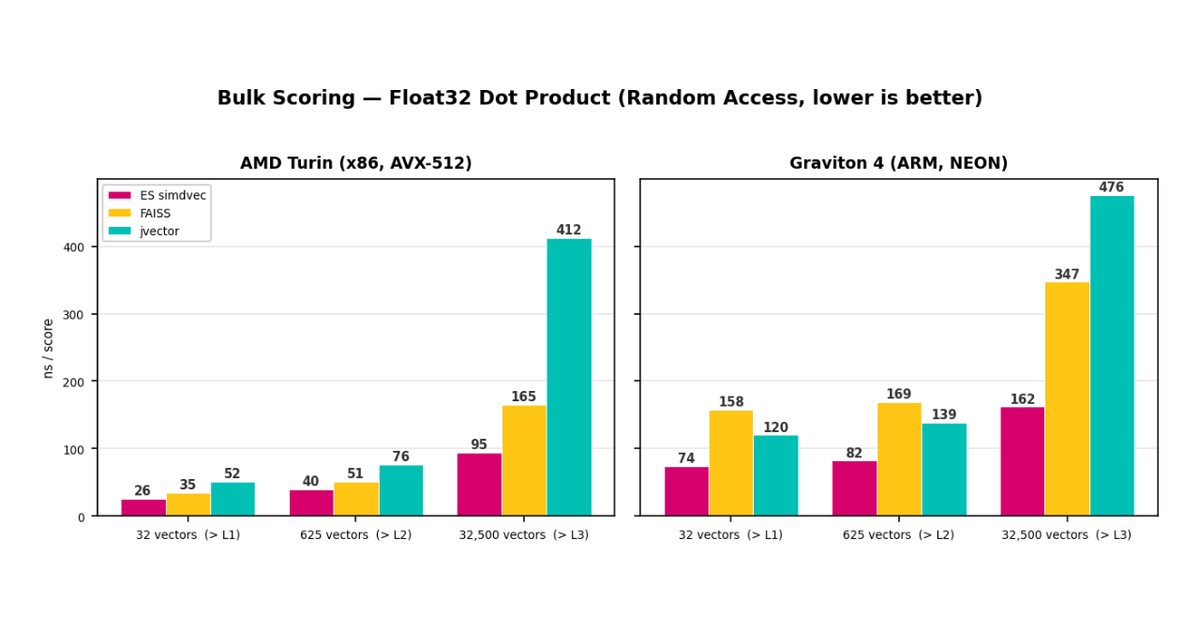
Elasticsearch built simdvec, a hand-tuned SIMD kernel library that powers every vector distance computation in Elasticsearch. simdvec implements native C++ distance kernels called from Java via FFI, with purpose-built AVX-512 and NEON implementations and a bulk scoring architecture that hides memory latency through explicit prefetching on x86 and interleaved loading on ARM. It supports multiple vector types including float32, int8, bfloat16, binary, and Better Binary Quantization (BBQ). Benchmarks show simdvec can outperform FAISS and jvector by up to 4x when working sets exceed CPU caches, making CPU-based vector search substantially more cost- and latency-efficient for many production search workloads.
What happened
Elasticsearch released simdvec, a hand-tuned SIMD kernel library that centralizes every vector distance computation in Elasticsearch and pushes CPU vector search performance toward hardware limits. The engine provides native C++ distance functions invoked from Java via FFI, with purpose-built AVX-512 and NEON kernels and a bulk scoring architecture that hides memory latency. In internal comparisons, simdvec can exceed the performance of FAISS and jvector by up to 4x when data no longer fits in CPU caches.
Technical details
simdvec is engineered for maximum throughput on commodity CPUs. Key capabilities implemented in native code include:
- •Hand-tuned SIMD kernels for AVX-512 (x86) and NEON (ARM)
- •Bulk scoring that batches distance computations and reduces per-vector overhead
- •Explicit cache-line prefetching on x86 and interleaved loading on ARM to hide memory latency
Supported vector representations
- •float32
- •int8 (quantized)
- •bfloat16
- •binary vectors
- •Better Binary Quantization (BBQ)
Integration & API
simdvec exposes native distance functions to the Java search stack via FFI (the Panama Vector workstream informed the approach). The library is optimized for the common retrieval patterns Elasticsearch executes: inverted file scans, traversal passes, and bulk scoring pipelines. The implementation focuses on minimizing memory-bound stalls, not on algorithmic ANN novelty.
Context and significance
Purpose-built CPU kernels like simdvec close the performance gap between CPU-based retrieval and GPU/ANN-focused systems in many real-world settings. When working sets exceed LLC and main memory bandwidth dominates, algorithmic improvements alone are insufficient; explicit prefetching and interleaved loads matter. For practitioners operating search clusters on CPU instances, simdvec promises lower latency and reduced cost per query compared with generic libraries that do not hide memory latency as aggressively. The design also highlights a trade-off: hand-tuned native kernels increase maintenance and portability costs but deliver material production gains.
What to watch
Monitor upstream availability, wider benchmark reproducibility across workloads, and whether simdvec becomes a reference implementation other search engines adopt. Also watch how simdvec interacts with evolving quantization formats and future CPU ISAs.
Key Points
- 1simdvec delivers hand-tuned AVX-512 and NEON kernels, extracting CPU vector throughput by hiding memory latency.
- 2When working sets exceed CPU caches, simdvec can be up to 4x faster than FAISS or jvector, reducing latency and cost.
- 3Support for float32, int8, bfloat16, binary, and BBQ makes simdvec practical across recall-vs-throughput trade-offs in production.
Scoring Rationale
This is a notable infrastructure advance for production vector search: it materially improves CPU-based retrieval performance and cost-efficiency, but it is not a frontier model or paradigm shift. The story is fresh, so score reflects immediate relevance to practitioners.
Practice interview problems based on real data
1,625 SQL & Python problems across 15 industry datasets — the exact type of data you work with.
Try 250 free problems