Developers Confront AI-Driven Software Development Future
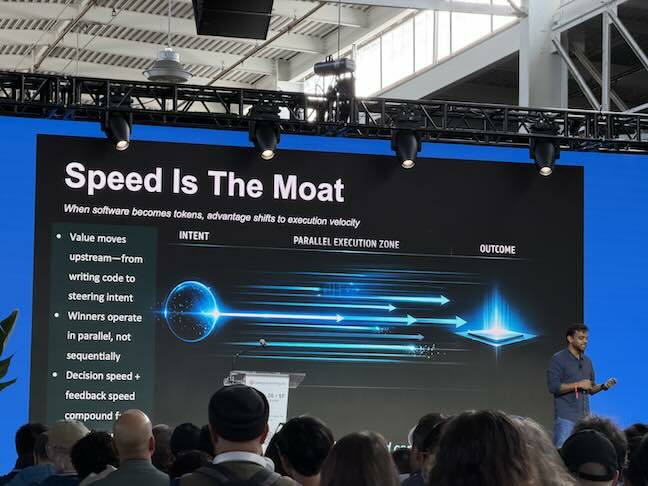
More than 3,000 software developers gathered in San Francisco for AI Dev 26 x SF, a conference organised by Andrew Ng's DeepLearning.AI, reported The Register. Jonathan Heyne, COO of DeepLearning.AI, framed the key question as what software engineering will look like in five years and said the longstanding bottleneck of writing code has shifted: "the bottleneck is our imagination," The Register quotes him. Anush Elangovan, corporate VP of AI software at AMD, highlighted work on ROCm, including projects named HotSwap, a native HIP backend for llama.cpp, and a high performance IREE C tokenizer, according to The Register. Marc Brooker, a VP and distinguished engineer at AWS, was also quoted on the pace of change. The conference underscores a developer-facing shift from coding volume toward higher-level specification and tooling.
What happened
According to The Register, more than 3,000 software developers attended AI Dev 26 x SF, a conference organised by Andrew Ng's DeepLearning.AI. Jonathan Heyne, COO of DeepLearning.AI, was quoted as saying the historical bottleneck of writing code has given way to a new constraint: "the bottleneck is our imagination," The Register reports. The Register also reports that Anush Elangovan, corporate VP of AI software at AMD, described work on ROCm and mentioned specific projects including HotSwap, a runtime that intercepts GPU kernel workloads and retargets the ISA, a new native HIP backend for llama.cpp, and a high performance IREE C tokenizer. The Register quotes Marc Brooker, VP and distinguished engineer at AWS, saying he writes production software daily and that this is "the most exciting time in my career."
Editorial analysis - technical context
Industry-pattern observations: comments and demos highlighted at the event focus on lowering friction between model development and production execution. Tooling efforts like ROCm-level optimizations, runtime retargeting (as in HotSwap), and new backends for llama.cpp are consistent with a broader industry push to support diverse silicon and to speed end-to-end deployment. Companies and open-source projects that invest in GPU toolchains and runtime portability typically shrink the delta between prototype and production deployment, reducing long tail integration work for engineers.
Context and significance
panels and vendor talks framed the change as both technical and cultural. The emphasis on "imagination" over manual coding suggests an increasing premium on prompt design, system orchestration, and observability rather than line-by-line implementation. The Register noted a tongue-in-cheek aside that legal concerns over code provenance appear to have eased, phrased as "the courts seem satisfied with AI code laundering." That language reflects public debate, not a legal ruling.
What to watch
For practitioners
monitor maturation of GPU stacks such as ROCm, runtime retargeting approaches like HotSwap, and native backends for popular inference engines and model runtimes. Observers should also track how developer roles shift toward integration, specification, and validation work as AI-assisted generation changes day-to-day engineering tasks.
Key Points
- 1AI-assisted development is shifting the bottleneck from typing code to specifying intent, raising demand for prompt and design skills.
- 2Advances in GPU toolchains like ROCm and runtime retargeting reduce friction for deploying LLMs on alternative silicon.
- 3Large developer gatherings indicate sustained commercial momentum, increasing demand for production-grade AI engineering tooling.
Scoring Rationale
Conference coverage highlights practical tooling progress and developer sentiment, which matters to practitioners evaluating deployment and workflow changes. The story is notable but not a major technical breakthrough.
Practice interview problems based on real data
1,625 SQL & Python problems across 15 industry datasets — the exact type of data you work with.
Try 250 free problems