Decision Design Unlocks Business Value from AI Models
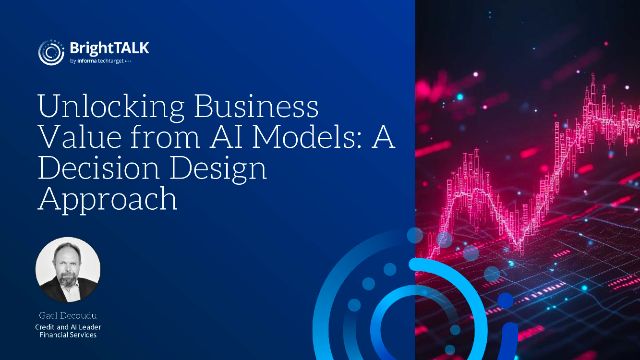
BrightTalk lists a webinar on May 26, 2026, presented by Gael Decoudu, Credit & AI Leader, Financial Services. The BrightTalk description says many organizations build highly predictive machine learning models but struggle to convert predictions into measurable business results because failure modes often live in the decision systems rather than the AI model itself. The session, titled "Unlocking Business Value from AI Models: A Decision Design Approach," aims to show practical strategies for designing decision systems that align models with business objectives, anticipate production challenges, and deliver consistent results. The BrightTalk listing highlights five takeaways: why strong model accuracy does not guarantee impact, how decision design drives outcomes, common production failure modes and mitigations, methods to align models with business objectives, and measuring success via outcome-based metrics.
What happened
BrightTalk is hosting a webinar on May 26, 2026, titled "Unlocking Business Value from AI Models: A Decision Design Approach," presented by Gael Decoudu, Credit & AI Leader, Financial Services, according to the BrightTalk event page. The BrightTalk description states that many teams achieve high predictive performance yet fail to generate measurable business results because shortcomings often arise in the decision systems surrounding models rather than the models themselves. The event description lists key takeaways that include why strong model accuracy does not guarantee business impact, how decision design drives measurable outcomes, common production failure modes and mitigation strategies, practical methods to align models with business objectives, and measuring success through outcome-based metrics.
Editorial analysis - technical context
Companies deploying models at scale commonly encounter constraints such as feature availability, data latency, and operational business rules. Industry-pattern observations show these factors frequently dominate end-to-end performance and can make incremental improvements in model accuracy yield limited business lift. For practitioners, designing the decision pipeline - thresholds, feature gating, latency budgets, and operational fallbacks - is often a higher-leverage engineering problem than further model tuning.
Industry context
Observed patterns in similar programs indicate teams that adopt outcome-oriented KPIs and instrument decision points tend to close the gap between prediction and action faster. This webinar's focus on production failure modes and outcome-based measurement aligns with a broader shift toward treating ML as a systems engineering challenge rather than an isolated modeling task.
What to watch
- •Whether the session provides concrete instrumentation patterns or KPI examples for outcome-based metrics
- •Any operational guardrails or decision-design templates for real-time scoring deployments
- •Examples or case studies from financial-services settings that illustrate production fixes
Key Points
- 1Decision-system failures, not model accuracy, often block business impact; practitioners should focus on pipeline and gating.
- 2Outcome-based metrics and instrumented decision points convert predictions into measurable business results across industries.
- 3Production constraints like feature availability and latency typically limit realized model value more than marginal accuracy gains.
Scoring Rationale
This is a practical practitioner-focused webinar addressing the common ML-to-value gap, useful for ML engineers and product teams. It is informative but not a novel research or product release, so its impact is moderate.
Sources
Public references used for this report.
Practice interview problems based on real data
1,625 SQL & Python problems across 15 industry datasets — the exact type of data you work with.
Try 250 free problems