Databricks Adds OpenAI Agent Tools for Enterprise AI
Databricks said on July 6, 2026 that its OpenAI partnership is now centered on production agents, with Databricks Agent Tools giving Codex and GPT-powered agents governed access to enterprise data through MCPs. The important point for data teams is that model intelligence is no longer the only deployment constraint. Databricks is selling context, permissions, lineage, cost controls, and evaluation as the missing production layer around frontier models, which makes the announcement more relevant to platform architecture than to another model benchmark.
The Databricks-OpenAI update is useful because it frames enterprise agents as a governed data-access problem. For LDS readers, the strongest takeaway is that production agent quality increasingly depends on context, permissions, evaluation, and cost controls around the model, not only on the model family selected.
What happened
Databricks published a July 6 DAIS 2026 partnership recap with OpenAI, saying customers are building agents with GPT models and Codex on Databricks' unified data and AI platform. The post highlights Databricks Agent Tools in Agent Bricks, Unity AI Gateway, and governed MCP access to enterprise systems.
Technical context
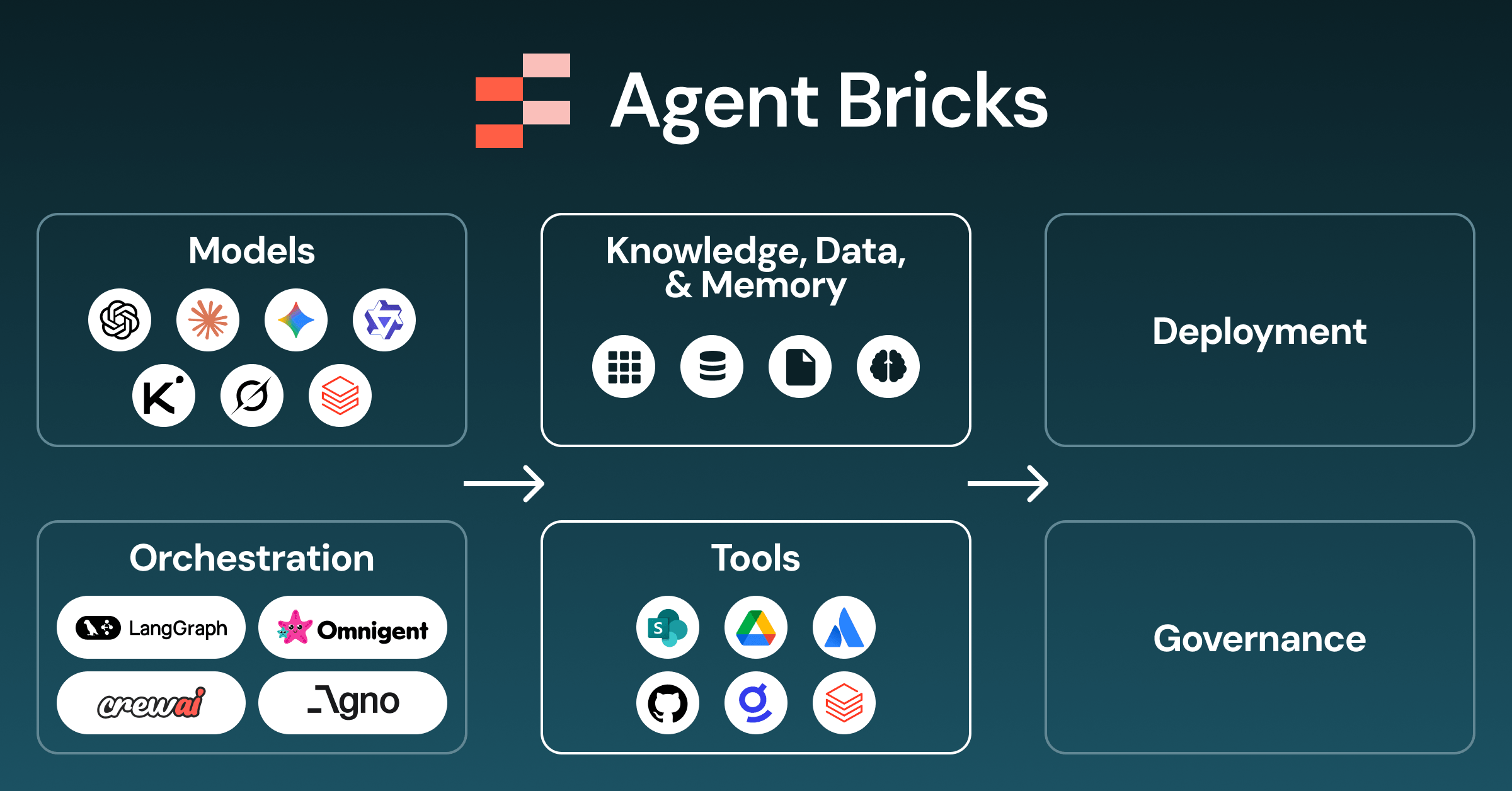
The Agent Bricks platform announcement describes the surrounding infrastructure for agents: model choice, enterprise context, tool access, evaluation, monitoring, memory, deployment, and governance. That is the practical layer many teams have to build before an agent can safely search documents, call tools, or act on sensitive business data.
For practitioners
Data and platform teams should read this as a control-plane story. The evaluation question is whether existing lakehouse governance, Unity Catalog permissions, and AI gateway policies can be reused for agent fleets instead of creating separate security, cost, and observability systems.
What to watch
The next proof point is customer evidence: whether joint OpenAI-Databricks deployments produce measurable time-to-value, safer tool use, and lower operating cost compared with custom agent stacks assembled from separate components.
Key Points
- 1Databricks is positioning Agent Tools as governed enterprise context for Codex and other OpenAI-powered agents.
- 2The deployment bottleneck shifts from raw model intelligence to permissions, lineage, evaluation, observability, and cost controls.
- 3Teams already invested in Unity Catalog should test whether existing governance can extend cleanly to agent fleets.
Scoring Rationale
This is a notable enterprise-agent infrastructure update because it ties frontier models to governed data, tool access, and cost controls inside a widely used data platform. It is not industry-shaking on its own because the post is primarily a partnership recap and still needs more public customer outcome evidence.
Sources
Public references used for this report.
Practice interview problems based on real data
1,625 SQL & Python problems across 15 industry datasets — the exact type of data you work with.
Try 250 free problems