
Chinese researchers convert wastewater nitrate into fertilizer feedstock
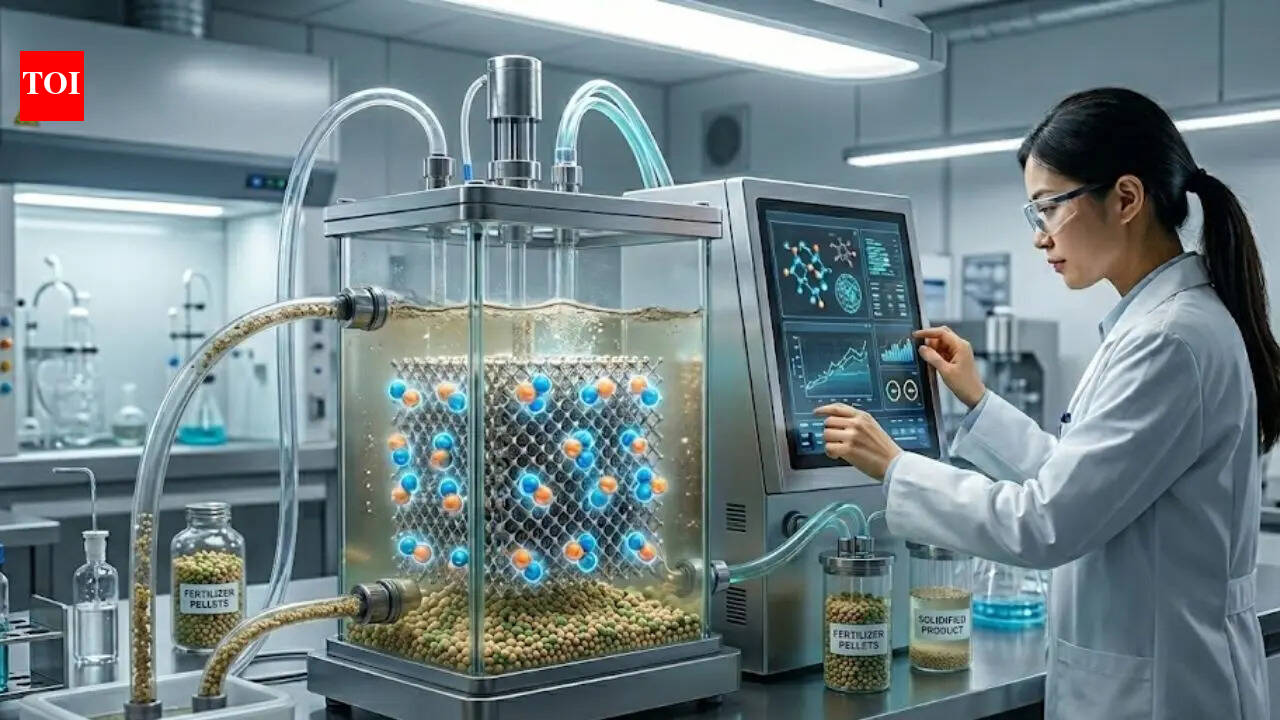
A Chinese research team led by Han Lili at the Fujian Institute of Research on the Structure of Matter, Chinese Academy of Sciences, published a study in the Journal of the American Chemical Society that demonstrates a dual-atom catalyst (DAC) converting nitrate-laden wastewater into ammonia, a key fertilizer feedstock. The paper, published March 18 and reported by SCMP and Newsbytes, describes DACs with metal loadings of 12.8 to 30.7 percent by weight, and an electrolytic ammonia yield about 2.7 times higher than conventional catalysts (SCMP). The authors report that they used deep learning to screen and identify promising metal pairs for the DACs (SCMP; Newsbytes). Industry coverage frames the result as a low-energy, waste-to-resource approach with potential implications for fertilizer supply chains and circular nitrogen management (SCMP; Daily Beirut).
What happened
A Chinese team led by Han Lili at the Fujian Institute of Research on the Structure of Matter, Chinese Academy of Sciences, published a study in the Journal of the American Chemical Society on March 18 that demonstrates a dual-atom catalyst (DAC) converting nitrate from wastewater into ammonia. Reporting by the South China Morning Post (SCMP) and Newsbytes summarises the paper's experimental results showing an electrolytic ammonia yield about 2.7 times higher than ordinary catalysts and catalyst metal loadings of 12.8 to 30.7 percent by weight, a more than fourfold increase over prior benchmarks (SCMP; JACS paper as reported).
Technical details
The researchers constructed 14 DACs using pairs drawn from rare-earth and transition elements including yttrium, scandium, lanthanum, cerium, samarium, europium, erbium, and ytterbium, according to SCMP. The team reports using deep learning to train an AI model that screened for metal pairs with high pairing propensity, which guided catalyst selection and accelerated discovery (SCMP; Newsbytes). Per the published paper as covered by outlets, the DAC architecture provides abundant adjacent active sites that facilitate the multi-step electron transfers required to reduce nitrate to ammonia.
Industry context
Context and significance
What to watch
Editorial analysis
Industry observers of materials discovery and catalysis note that combining machine learning screening with atomically precise catalyst design is an emerging pattern that shortens search cycles and can raise active-site density. Comparable AI-assisted approaches have been applied in battery materials, CO2 reduction catalysts, and heterogeneous catalysis discovery.
For practitioners, the result is notable for two reasons. First, it demonstrates that AI-guided selection can yield DACs with materially higher metal loading and per-site activity, addressing common limits in single-atom catalyst approaches. Second, the reaction pathway-converting environmental nitrate into ammonia-links computational materials design to a circular-economy application that could reduce reliance on energy-intensive Haber-Bosch routes, if and when the lab-scale findings translate to pilot or industrial scale. Reporting outlets emphasise potential low-energy, waste-to-resource benefits but do not document commercial deployments or industrial-scale economics (SCMP; Daily Beirut; Newsbytes).
Observers should track replication studies, scale-up experiments, and life-cycle energy analyses that quantify energy per kilogram of ammonia produced versus Haber-Bosch and other electrochemical routes. Other signals include peer labs adopting similar AI screening workflows, follow-on patents or pilot projects, and independent assessments of catalyst longevity, selectivity, and tolerance to real wastewater contaminants. The original study does not provide industrial-scale flow reactor data or long-term stability metrics in field conditions (SCMP; JACS reporting).
Key Points
- 1AI-guided screening enabled targeted dual-atom catalyst discovery, yielding approximately 2.7x higher ammonia production versus conventional catalysts.
- 2Higher metal loadings (12.8-30.7% by weight) increase active-site density, a common bottleneck in single-atom catalyst approaches.
- 3Industry observers frame AI-plus-DAC workflows as accelerating materials discovery with potential circular-economy applications, pending scale-up and durability data.
Scoring Rationale
The story is notable for AI-assisted materials discovery that produced a measurable performance jump and links to a high-impact industrial chemical (ammonia). It matters to ML practitioners working on materials informatics and to engineers considering circular-nitrogen processes. Freshness gives only a small penalty.
Sources
Public references used for this report.
Practice interview problems based on real data
1,625 SQL & Python problems across 15 industry datasets — the exact type of data you work with.
Try 250 free problems

