China Court Rules Firing Workers For AI Illegal
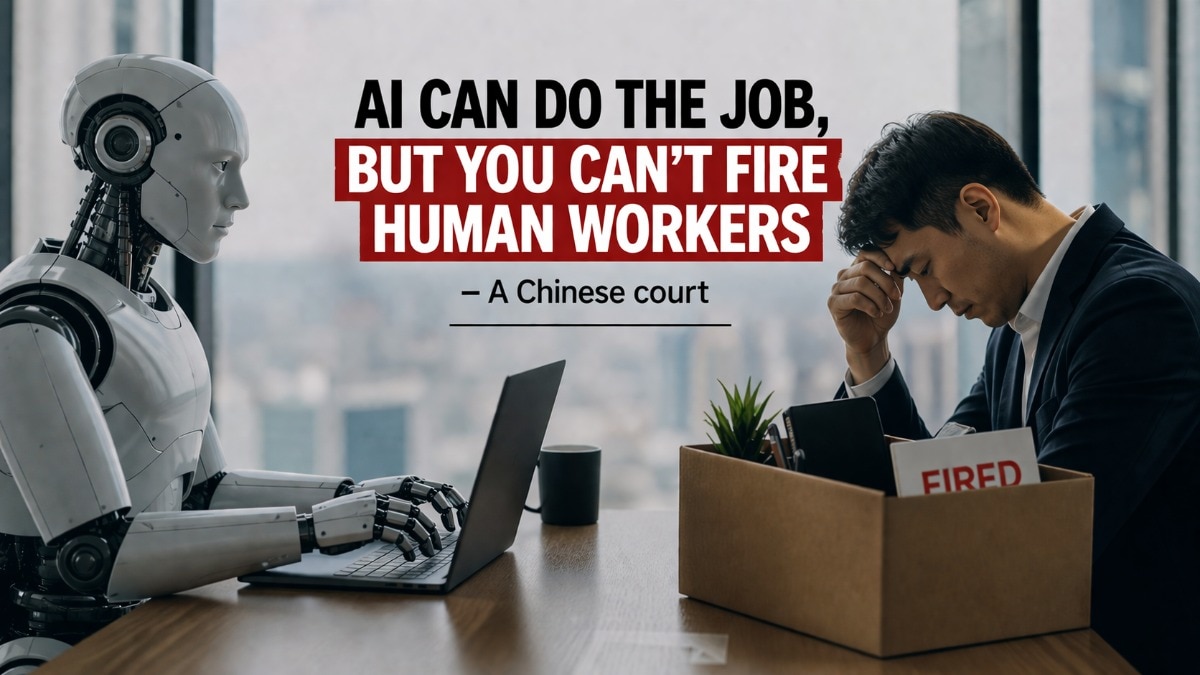
The Hangzhou Intermediate People's Court ruled on April 28, 2026 that a tech company illegally fired an employee, identified only by surname Zhou, after replacing part of his quality-assurance work with large language models, according to NPR and Caixin Global. Zhou, who verified the accuracy of LLM-generated answers, earned about 25,000 yuan ($3,655) a month before the company tried to reassign him to a lower role at 15,000 yuan, a 40 percent cut he refused; an arbitration panel and a district court both found the firing unlawful, and the Hangzhou appeals court upheld that finding, ruling that AI adoption alone is not a legal "major change" justifying termination. NPR reports a Zhejiang labor lawyer called the ruling a reassuring signal for workers even as Beijing pushes wider AI adoption; a similar case involving a Beijing data-mapping worker was decided the same way in December 2025. For AI teams, the rulings mean automating a role does not on its own clear employers of retraining, reassignment or compensation obligations.
Two Chinese labor rulings, seven months apart in different cities, now point the same way: judges are treating a company's decision to automate a role with AI as an ordinary business choice, not an unforeseeable event, which means it does not by itself satisfy the legal bar for firing someone. For any team using AI to cut headcount or reshape roles in a market with similar worker-protection law, the emerging rule is that automation shifts a job's tasks, but not automatically the legal risk and cost of losing the person doing it.
What happened
The Hangzhou Intermediate People's Court published its ruling on April 28, 2026 as one of several "typical cases" on AI and worker protections, upholding a lower district court's finding that a Hangzhou tech firm illegally dismissed an employee identified by the court only as Zhou (NPR, Caixin Global). Zhou joined the company in 2022 as a quality-assurance supervisor verifying the accuracy of answers generated by large language models, earning about 25,000 yuan a month (roughly $3,655), according to India Today and NPR. After AI took over more of his tasks, the company tried to reassign him to a lower-level role at 15,000 yuan, a 40 percent pay cut; when he refused, it terminated his contract, citing AI-driven reductions in staffing need. Zhou won an arbitration claim for wrongful-termination compensation, the company sued to reverse that finding in 2025 and lost at the district-court level, and the Hangzhou Intermediate People's Court rejected the company's appeal, per NPR and Caixin. The court held that AI adoption did not meet the legal threshold of a "major change" making the employment contract impossible to continue, and that the pay cut attached to Zhou's proposed reassignment was not reasonable.
Timeline
- •December 2025: Beijing's Human Resources and Social Security Bureau rules, in a separate case, that a data-mapping worker's 2024 dismissal after his role was automated was also illegal.
- •2025: The Hangzhou tech company sues to overturn Zhou's arbitration win and loses at the district-court level.
- •April 28, 2026: The Hangzhou Intermediate People's Court publishes the case as a "typical example," upholding the ruling on appeal.
Industry context
Caixin Global reports a parallel Beijing case reached the same conclusion in December 2025: a worker named Liu, hired in 2009 for manual map-data entry, was dismissed in late 2024 after the company switched to AI-based data collection; the Beijing Human Resources and Social Security Bureau ruled the switch was a deliberate, predictable business strategy rather than an uncontrollable event, so the dismissal illegally shifted the cost of automation onto the employee. NPR quotes Zhejiang lawyer Wang Xuyang, via Xinhua, saying AI adoption does not automatically justify ending a labor contract to cut costs. NPR also notes the rulings arrive as China's central leadership pushes broad AI adoption while a sluggish economy and other cost pressures give employers incentive to cut headcount, a tension the courts appear to be resolving in workers' favor for now.
For practitioners
These are industry-pattern observations about Chinese labor jurisprudence, not claims about any single employer's intent. Two rulings in two cities are not yet binding nationwide guidance, but they establish a consistent judicial reading, that deploying LLMs or other automation to eliminate or reduce a role is a controllable business decision, not a legally qualifying "major change." Teams and legal counsel planning AI-driven role changes in China should budget for negotiated reassignment, retraining offers, or severance rather than assuming automation itself is sufficient grounds for termination.
What to watch
Watch whether China's labor authorities formalize this line of cases into binding administrative guidance or legislation, whether similar rulings extend beyond white-collar and data roles into manufacturing, and how employers revise contract language or workforce-transition policies in response. Caixin Global and English-language state outlets are likely to keep publishing further "typical cases" as this area of law develops.
Key Points
- 1A Hangzhou court upheld a ruling that a tech firm illegally fired QA worker Zhou over a 40 percent AI-related pay cut.
- 2A parallel December 2025 Beijing ruling found a data-mapping worker's AI-driven dismissal illegal too, showing a judicial pattern across cities.
- 3Courts are treating AI automation as a controllable business choice, not a legal 'major change,' so teams should budget for reassignment or severance costs.
Scoring Rationale
A well-corroborated, multi-outlet-verified appellate ruling (NPR, Caixin Global, India Today, official Chinese state media) that establishes a consistent judicial pattern across two Chinese cities on AI-driven dismissals. Notable operational and legal-compliance relevance for any company using LLMs to restructure roles in China, but it is a regional labor-law precedent rather than a frontier technical or market-moving development, so it sits in the 'notable' rather than 'major' tier.
Sources
Public references used for this report.
View 5 more sources
- Chinese court defends labor rights in new AI-replacement caseenglish.scio.gov.cn
- The AI Termination Ban: Why Chinese Courts Just Made It Illegal to Replace Workers with Robotsfinance.yahoo.com
- A Chinese court has ruled that companies cannot be allowed to lay off workers and replace them with AIgigazine.net
- China Bans Companies From Replacing Human Workers With AI for Cost Cuttingthelogicalindian.com
- Chinese Courts Just Ruled That AI Automation Is Not a Legal Reason to Fire Someonestartupfortune.com
Practice interview problems based on real data
1,625 SQL & Python problems across 15 industry datasets — the exact type of data you work with.
Try 250 free problems