Celebrities File Trademarks To Shield Identity From AI Clones
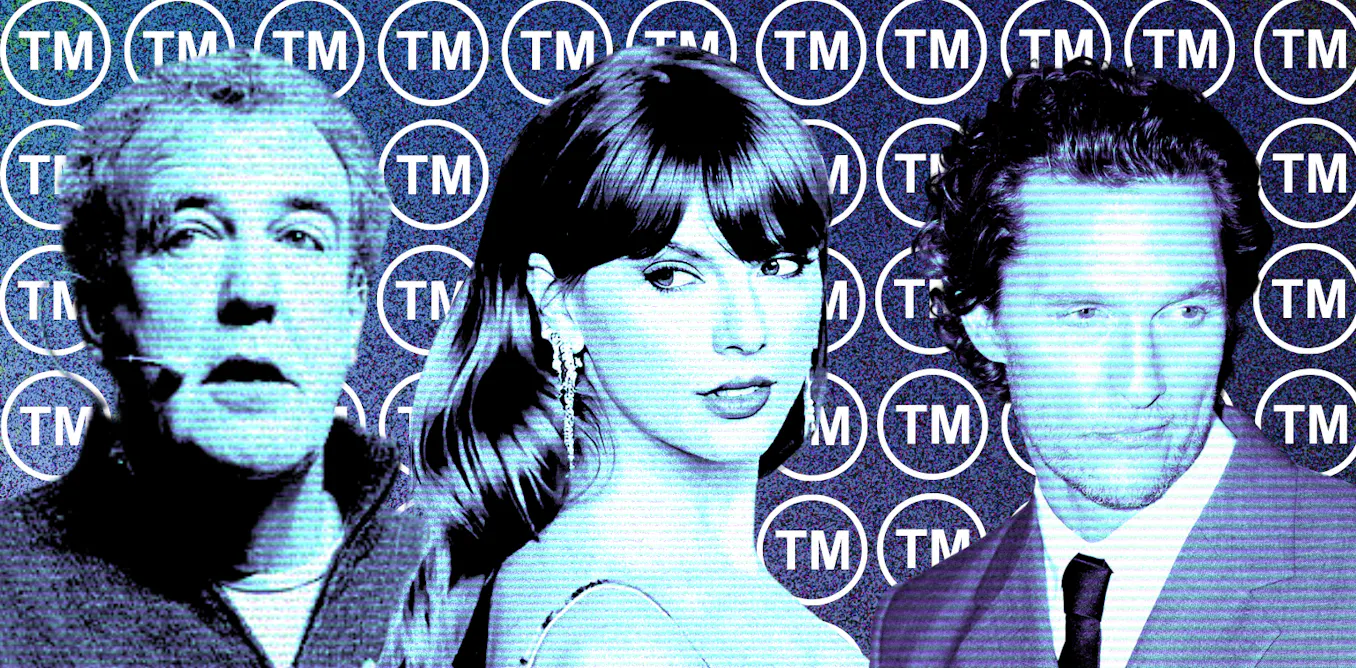
Celebrities including Taylor Swift, Matthew McConaughey and Jeremy Clarkson have filed or secured trademark registrations that cover short voice clips, motion marks and images, reporting an attempt to use trademark law to limit AI-driven impersonations (The Conversation; Gallium Law; GMLaw; RennerOtto). According to Gallium Law and RennerOtto, Swift filed three USPTO applications in late April 2026, two sound marks and one visual mark, and GMLaw and GMLaw-affiliated reporting state McConaughey holds multiple federal registrations covering vocal phrases and motion marks. Legal commentators and law-firm writeups describe this as a novel, largely untested tactic that repurposes trademark doctrine alongside state right-of-publicity claims (Stradley; RennerOtto). This trend reflects practitioners seeking federal, nationwide tools to address cross-jurisdictional harms from generative AI; its efficacy will depend on how courts apply trademark doctrines like consumer confusion and secondary meaning.
What happened
Celebrities have increasingly filed trademark applications aimed at aspects of personal identity that generative AI can replicate. According to Gallium Law and RennerOtto, Taylor Swift submitted three U.S. trademark applications in late April 2026, two seeking protection as sound marks capturing brief vocal clips and one seeking a visual mark described as a photograph of her Eras Tour staging. Reporting from GMLaw and other IP-firm coverage states Matthew McConaughey has obtained multiple federal trademark registrations covering his distinctive vocal phrase "Alright, alright, alright," other short audio recordings, and motion-based video marks; those filings and registrations date from filings beginning in 2023 through registrations in late 2025 and early 2026 (GMLaw; RennerOtto; Stradley). Jeremy Clarkson has also pursued trademark remedies after AI-generated social-media impersonations were reported, per The Conversation and allied legal coverage.
Editorial analysis - legal framing
Law-firm writeups and legal commentary frame these filings as an attempt to use trademark law to provide a federal, nationwide enforcement path where state-level rights of publicity vary. Stradley and RennerOtto explain that trademark doctrine treats identifiers as source signals under the Lanham Act and, if a court accepts an identity element as a source identifier, trademark registration creates enforceable federal rights. The Conversation and other commentators note this is an unconventional use of trademark law and remains largely untested in courts.
Editorial analysis - technical context
Generative AI systems have lowered the cost and technical barrier to producing convincing voice clones and photorealistic deepfakes. Industry observers in the cited pieces connect the filing activity directly to that technological trend, noting that synthetic audio/video can create apparent endorsements or fabricated conduct at scale (The Conversation; Gallium Law). For practitioners, this changes the enforcement landscape: federal trademark registrations provide a different statutory route than state publicity claims, but they still require establishing consumer confusion, secondary meaning, or that the mark functions as a source identifier, legal thresholds that historically were not designed to cover an entire human persona (Stradley; GMLaw).
Context and significance
The filings illustrate how existing IP doctrines are being repurposed to address harms from AI that cross state and national boundaries. Because the right of publicity remains a state-by-state mosaic, legal commentators argue that trademark protection offers national scope but raises doctrinal strain. Observers cited in the coverage call the approach novel and unsettled; courts have previously been reluctant to expand trademark principles to encompass broad personality rights, and the cited authors identify open questions about scope, fair use, parody, and expressive defenses (Stradley; The Conversation).
What to watch
Industry context
Key indicators will include: whether any of these filings lead to USPTO refusals or oppositions that clarify registrability of sound or motion marks tied to persons; whether plaintiffs bring Lanham Act suits based on alleged AI-generated consumer confusion; and whether appellate courts reconcile trademark doctrines with state publicity rights. Legal commentators also flag practical enforcement issues, such as policing AI output across decentralized platforms and proving consumer confusion in contexts where AI content is explicitly synthetic. Finally, watch for any legislative responses: several sources note proposals for federal publicity or anti-deepfake statutes that could change incentives for relying on trademarks (RennerOtto; Stradley).
Bottom line
Editorial analysis
The celebrity filings illuminate a broader pattern of actors adapting existing IP tools to novel technological harms. The strategy gives rights-holders a potentially broader, federal toolkit, but its ultimate effect depends on litigation outcomes and possible statutory changes that address AI-driven impersonation more directly.
Key Points
- 1Celebrities file trademarks covering voice clips, motion marks and images to create federal enforcement routes against AI deepfakes.
- 2Trademark protection offers nationwide reach but requires treating identity elements as source identifiers, a novel and untested doctrinal stretch.
- 3Industry observers say litigation and potential federal legislation will determine whether trademarks become a reliable tool against AI impersonation.
Scoring Rationale
Notable legal-development with direct operational relevance for practitioners dealing with AI-driven impersonation and IP enforcement. The approach is untested in court and could reshape remedies, so it is important but not yet industry-shifting.
Sources
Public references used for this report.
Practice with real Ad Tech data
90 SQL & Python problems · 15 industry datasets
250 free problems · No credit card
See all Ad Tech problems