Cate Blanchett Launches Human Consent Registry for AI
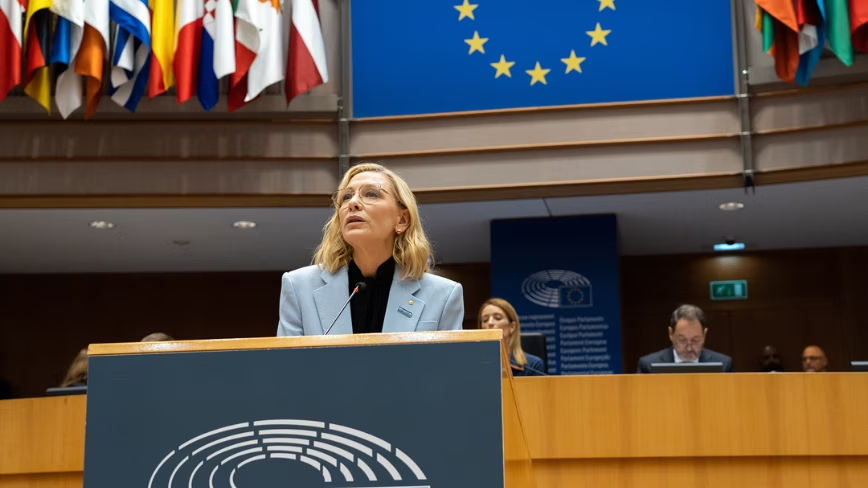
The Next Web and Euractiv report that actress Cate Blanchett launched the RSL Media Human Consent Registry at an event in the European Parliament in Brussels on June 24, 2026. The free, public website at rslmedia.org lets individuals record whether AI systems may use their name, image, voice, likeness, movement or other personal attributes, and offers three machine-readable options: allowed, allowed with terms, or prohibited, according to The Next Web, NZ Herald and Plataforma Media. The launch was hosted by MEP Eva Maydell and attended by filmmaker Steven Soderbergh, per AFP and multiple outlets. Blanchett was quoted saying, "Your identity is your IP in the age of AI, and every person deserves the right to decide how AI can or cannot use it," (The Next Web). Plataforma Media and other coverage report the registry is free for individuals and that organisers envisage extending coverage to creative works and trademarks in a later phase.
Technical details
Reporting across outlets states the registry exposes preferences in a machine-readable form meant for AI developers and third parties to consult before using personal attributes. Plataforma Media and The Brussels Times note the system accommodates individual self-registration and third-party actors such as agents or guilds. Plataforma Media additionally reports organisers describe a planned second phase to extend protections to creative works and registered trademarks; coverage frames that extension as future-facing rather than immediate.
Editorial analysis - technical context
Industry observers: Machine-readable consent signals are increasingly proposed as a pragmatic interoperability layer between legal rules and automated systems. For practitioners, a public registry that encodes consent states as structured data could be integrated into compliance checks or content-generation pipelines where identity filtering or provenance checks are required. Observers following the sector will watch for whether AI developers adopt registry queries as part of pretraining data selection, inference-time content filters, or consent-check gates in production systems.
Context and significance
The launch occurred against the backdrop of European AI policymaking, including the AI Act, which Euractiv and other outlets reference when describing the choice of venue. Coverage frames the initiative as voluntary: multiple outlets flag that the registry currently depends on AI companies and platforms electing to consult it rather than being legally compelled to do so. The project follows a broader creative-industry push against unconsented AI use; several reports reference Blanchett's participation in prior open letters from artists opposing non-consensual model training.
What to watch
Practical implications for practitioners
For legal, compliance, and ML ops teams, the registry introduces a potential additional metadata layer to consider in data sourcing and model-use governance. Editorial analysis: Companies building content-generation pipelines or datasets should monitor adoption, evaluate the registry's schema and verification mechanisms, and assess how a machine-readable consent signal would interact with existing copyright, portrait-rights, and data-protection obligations.
Limitations in coverage
What happened
The Next Web and Euractiv report that actress Cate Blanchett unveiled the RSL Media Human Consent Registry at an event held in the European Parliament in Brussels on June 24, 2026. Coverage from AFP, NZ Herald and Plataforma Media describes the registry as a public website hosted at rslmedia.org where people can record permissions for AI use of their name, image, voice, likeness and movement. Per The Next Web and NZ Herald, users can set one of three machine-readable preferences for each registered item: allowed, allowed with terms, or prohibited. The launch event was hosted by MEP Eva Maydell and attended by director Steven Soderbergh, according to AFP and local reporting.
None of the scraped coverage asserts that AI companies have adopted the registry or that its preferences are legally binding today. Several outlets, including Euractiv and NZ Herald, explicitly characterise the registry as voluntary and note organisers acknowledge it will not solve all issues immediately.
Bottom line
Industry context
Key indicators of the registry's practical impact will include:
- •whether major AI training-data vendors or model providers integrate registry checks into procurement or data-filtering workflows
- •adoption signals from talent agencies, unions, or representative bodies that might bulk-register members
- •any move by regulators to reference machine-readable consent standards in guidance or transposition of the AI Act. Reported attendance by policymakers and cultural figures gives the registry visibility, but coverage uniformly notes its voluntary nature and the limits that implies for enforceability
The registry is a visible, voluntary attempt to make individual consent explicit and discoverable to automated systems. Its practical effect will depend on uptake by platforms, integration into developer workflows, and any future regulatory steps that reference or require machine-readable consent mechanisms.
Key Points
- 1Public launch of the RSL Media Human Consent Registry creates a machine-readable way to record consent for AI use of identity attributes.
- 2Because the registry is voluntary, its effect depends on adoption by AI companies, data vendors, and representative organisations.
- 3Practitioners should monitor registry schema, verification and provenance controls before relying on it for compliance or filtering.
Scoring Rationale
Notable AI governance initiative with EU Parliament backing and high-profile launch - the RSL Media Human Consent Registry is the first machine-readable, structured consent layer for personal AI use permissions, relevant to practitioners building content pipelines and compliance systems. Score held below 7.0 because the registry is voluntary with no enforcement mechanism yet, and adoption by AI developers remains to be demonstrated.
Sources
Public references used for this report.
View 6 more sources
- Cate Blanchett launches AI 'consent' tool in Parliamenteuractiv.com
- Cate Blanchett launches free tool to protect identity from AIeuronews.com
- Actor and Producer Cate Blanchett and EU Parliament Member Eva Maydell Launch RSL Media Human Consent Registrymarkets.businessinsider.com
- Oscar winner Cate Blanchett launches consent registry for AI systemsmalaymail.com
- Cate Blanchett Launches 'Human Consent Registry' to Help Protect Your Likeness From AI Industry Scrapinggizmodo.com
- RSL Media Human Consent Registry Launch - Official Newsroomrslmedia.org
Practice interview problems based on real data
1,625 SQL & Python problems across 15 industry datasets — the exact type of data you work with.
Try 250 free problems