Cao Fei Examines AI-driven Farming and Labour
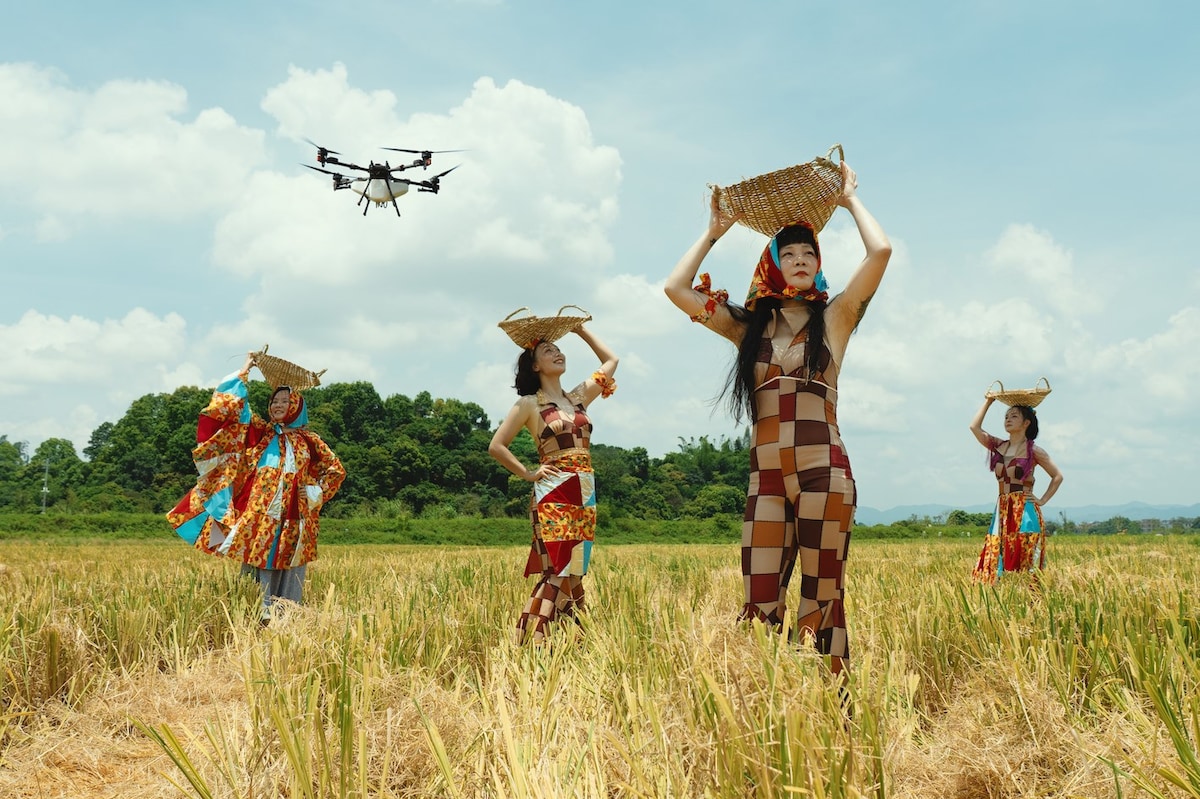
Fondazione Prada is presenting "Dash", a new multimedia project by Chinese artist Cao Fei that synthesizes three years of fieldwork in China and Southeast Asia on smart agriculture. The exhibition centers on the deployment of agricultural drones and autonomous farming equipment, produced in collaboration with robotics firm XAG, and interrogates the tradeoffs between efficiency, labour displacement, and cultural continuity. Visitors encounter real-scale installations-a grain warehouse, a farmer-training station, a temple made from fertiliser bags, and a banana plantation-alongside video, documentary footage, and a virtual reality game that places the user in the perspective of a discarded agricultural drone. The show foregrounds concrete metrics from the sector, including agricultural drones covering 173 million hectares in 2024 and a domestic market valued at 13 billion yuan (about $1.8 billion), while asking how algorithms reshape knowledge, ritual, and rural livelihoods.
What happened
Fondazione Prada opened "Dash," a major multimedia exhibition by Cao Fei that presents three years of immersive fieldwork into the rise of smart agriculture across southern and northwestern China and Southeast Asia. The project grew from Cao Fei's engagement with agricultural robotics company XAG and combines documentary footage, installations, archival material, and a virtual reality game to examine how drones and algorithmic systems are transforming labour, ecology, and ritual. The exhibition runs from April 9 to September 28, 2026.
Technical details
"Dash" assembles a multi-sensorial catalogue of contemporary farming practice and automation. Key components include:
- •a full-scale grain warehouse, a farmer-training station, a temple constructed from fertiliser bags, and a banana plantation populated with smart agricultural hardware
- •large-screen videos and documentary footage capturing workers, technicians, and ritual practices around drones
- •a virtual reality installation often cited as "Dash-180c," which places users in the subjective point of view of a discarded model agricultural drone, imagining modalities of obsolescence and agency
The exhibition also embeds sector metrics and technical framings. Cao Fei emphasizes satellite positioning, sensor signals, and algorithmic decision-making as constitutive elements of contemporary agriculture. The catalogue cites that agricultural drones in China covered 173 million hectares in 2024, generating roughly 13 billion yuan in market value, and credits those platforms with reducing water use and chemical inputs while accelerating task completion.
Context and significance
This show is not aestheticizing technology as neutral; it stages the dialectic between efficiency gains and sociocultural dislocation. Cao Fei quotes Bernard Stiegler: "Technology is both the remedy and the poison," to capture the double-edged nature of automation. For practitioners, the exhibition is a field-level ethnography that surfaces problems rarely visible in lab papers: datafication of embodied agrarian know-how, shifts in gendered labour access as drones lower physical barriers, and the formation of new training infrastructures that mediate urban-rural transitions. The work highlights three concurrent trajectories in the AI-for-agriculture ecosystem: accelerating hardware deployment, tighter integration of geospatial and sensor data, and emergent governance questions about knowledge transfer and machine decision rights.
Why practitioners should care
Ethnographic narratives like this provide ground truth for modelers and product teams. They show where sensors and algorithms meet contingent human practices, revealing failure modes, hidden incentives, and the social cost of optimization. The exhibition signals that design choices in autonomous-spraying algorithms, route planners, or predictive yield models will have downstream impacts on labour markets, cultural practices, and land stewardship. It also highlights corporate-ecosystem dynamics: partnerships like the one with XAG act as vectors for wide technical adoption and dataset centralization.
What to watch
The exhibition raises operational questions: who owns the sensor and ritual data generated on farms, how are training programs reshaping rural expertise, and what regulatory or economic interventions will govern the pace of adoption? For engineers and researchers, the immediate takeaways are to prioritize explainability, human-in-the-loop workflows, and participatory design when deploying automation that alters livelihoods.
What comes next
As smart agriculture scales, expect more cross-disciplinary scrutiny from artists, ethnographers, and policy actors. The show is a useful prompt for teams building agricultural AI to instrument field trials with social metrics, not only yield and efficiency, and to engage local communities in data governance and model evaluation.
Key Points
- 1Cao Fei's "Dash" uses three years of fieldwork to surface how agricultural drones and AI reshape labour, ritual, and knowledge.
- 2Smart agriculture delivers efficiency and resource savings but displaces embodied expertise and alters rural economies, requiring new governance and training.
- 3Practitioners must integrate ethnographic insight, explainability, and human-in-the-loop design when deploying farm automation at scale.
Scoring Rationale
The exhibition offers valuable ethnographic insight into real-world AI deployment in agriculture, relevant to designers, researchers, and policy teams. It is not a technical breakthrough, so its importance is moderate but concrete for practitioners working on agricultural systems, deployment ethics, and socio-technical design.
Sources
Public references used for this report.
View 7 more sources
- Enhanced Technologies - Aesthetica Magazineaestheticamagazine.com
- "Dash" Cao Fei @FondazionePrada - EN - Muse Magazinemusemagazine.it
- Cao Fei: Dash | Exhibitions | MutualArtmutualart.com
- Fondazione Prada presents “Dash”, a new project by Cao Fei in Milancawa.art
- DASH — CAO FEI AT FONDAZIONE PRADA, MILAN | Sugar & Creamsugarandcream.co
- Multimedia Agriculture Exhibitions : dash exhibition - Trend Huntertrendhunter.com
- EVENT: CAO FEI DASH (9 APRIL – 28 SEPTEMBER 2026, MILAN ...gamescenes.org
Practice interview problems based on real data
1,625 SQL & Python problems across 15 industry datasets — the exact type of data you work with.
Try 250 free problems