Bybit AI Launches MCP for Multi-Agent Trading Infrastructure
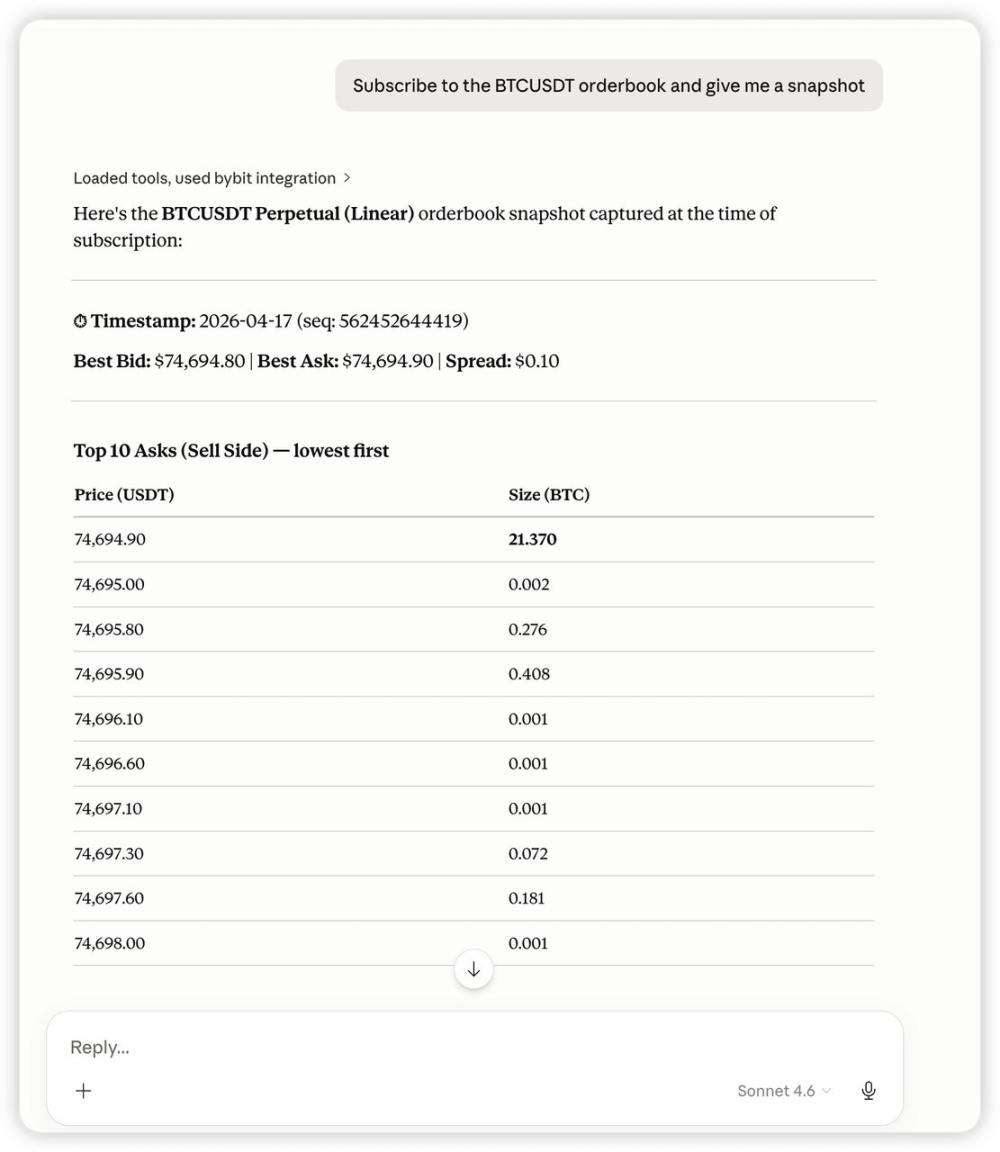
Bybit launched an official Model Context Protocol (MCP) that standardizes infrastructure for multi-agent trading. The MCP enables integration of AI agents such as Claude, ChatGPT, and Cursor with Bybit services without custom API work, exposing real-time market data, order book snapshots, candlestick aggregations, fee schedules, portfolio visibility, and trading capabilities that include spot, perpetual futures, conditional orders, stop-loss, and take-profit. The protocol is designed for scalable single-agent to multi-agent architectures and supports discovery and interoperability for MCP-compatible applications. For traders and developers this reduces integration friction, accelerates deployment of automated strategies across the data-to-execution path, and shifts exchange infrastructure toward AI-native workflows.
What happened
Bybit, the world's second-largest cryptocurrency exchange by trading volume, released its official Model Context Protocol (MCP) to provide a standardized infrastructure layer for multi-agent trading. The MCP lets AI agents discover and use Bybit services, enabling natural-language-driven workflows and eliminating bespoke API integrations for models such as Claude, ChatGPT, and Cursor.
Technical details
The MCP exposes four core functional modules that agents can call via the protocol. Key capabilities include:
- •Market Data Module: real-time tickers, candlestick aggregations, order book snapshots, and fee schedules to keep agents aligned with live market state.
- •Trading Module: support for spot trading, perpetual futures, conditional orders, stop-loss and take-profit primitives, and leveraged position handling; Bybit indicates continued expansion of execution features.
- •Account and Asset Module: portfolio visibility, account balances, and open positions to enable stateful strategy orchestration.
The protocol focuses on discovery and interoperability, allowing any MCP-compatible agent to find Bybit tools and integrate without custom code. On the model side, Bybit positions MCP as a bridge from agent reasoning to exchange execution, supporting both single-agent and multi-agent topologies for coordinated strategies. The announcement emphasizes natural-language commands and developer customization for composing complex automated systems across the full data-to-execution journey.
Context and significance
This release reflects a broader industry move toward AI-native infrastructure for financial workflows. By standardizing a tools-and-discovery layer, MCP reduces the engineering friction that traditionally separated model experimentation from live execution. Exchanges that offer protocolized access increase the addressable market for autonomous trading agents and lower operational overhead for hedge funds, prop firms, and developer teams building algorithmic strategies. At the same time, protocolized execution raises operational and market-structure questions around latency, order-risk controls, and auditability when multiple agents operate concurrently.
What to watch
Adoption by prominent agent ecosystems, third-party tooling that implements MCP, and the emergence of safety and access controls (rate limiting, whitelisting, simulation sandboxes) will determine whether MCP becomes an industry standard or a proprietary on-ramp to Bybit liquidity.
Key Points
- 1Bybit released an official Model Context Protocol, enabling seamless integration of AI agents with exchange services without custom API work.
- 2MCP provides real-time market data, execution primitives, and portfolio visibility, enabling stateful, multi-agent trading systems across the data-to-execution path.
- 3Standardizing discovery and tool access lowers integration cost, accelerating autonomous trading deployment while raising operational risk and governance needs.
Scoring Rationale
Notable product launch from a major exchange that standardizes agent-to-exchange interactions. Important for practitioners building production trading agents, but not a frontier model or industry-shaking regulation.
Practice with real FinTech & Trading data
90 SQL & Python problems · 15 industry datasets
250 free problems · No credit card
See all FinTech & Trading problems