
Bruker Expands Atinary Collaboration for Self-Driving Labs
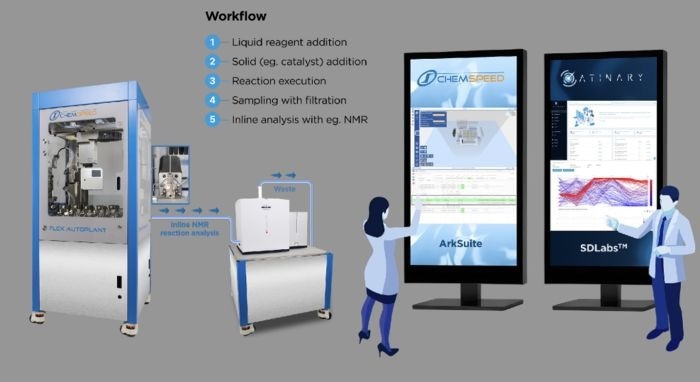
Bruker announced an expanded collaboration with Atinary Technologies on August 12 and made a minority investment in the self-driving laboratory software company. News-Medical reports that Atinary intends to connect Chemspeed automation, Bruker analytical instruments, and SciY scientific software with its SDLabs agentic AI workflows. The companies also operate a joint demonstration laboratory near Basel, Switzerland; financial terms were not disclosed.
Bruker has expanded its collaboration with Atinary Technologies and made a minority investment in the self-driving laboratory software company, according to announcements carried by News-Medical and AZoM on August 12. Financial terms were not disclosed.
The collaboration covers AI-driven research and development workflows for pharmaceuticals, chemicals, energy, and materials. Dealroom reports that Atinary develops self-driving laboratory and AI-driven R&D tools in those sectors, while its SDLabs platform uses AI agents and machine learning to design experiments and manage closed-loop workflows.
Connecting automation, measurement, and experiment design
According to News-Medical, Atinary intends to integrate Chemspeed configurable laboratory automation platforms, Bruker analytical instruments, and SciY scientific software into its agentic AI workflows. The intended stack joins robotic execution with analytical measurement and software that can select, run, evaluate, and iterate experiments.
News-Medical describes SDLabs as a code-free platform for automated Design-Make-Test-Analyze-Learn workflows. The report states that AI agents and machine learning are used to design experiments, navigate molecular spaces, execute runs, visualize and interpret results, and recommend subsequent experiments.
An image description published by News-Medical depicts a workflow combining Chemspeed robotics, Bruker's Fourier 80 FT-NMR instrument, and SDLabs. It automates reagent and catalyst addition, reaction execution, filtered sampling, and inline NMR analysis for reactions including Suzuki and Buchwald-Hartwig cross-coupling.
Demonstration labs in Switzerland and Boston
Atinary and Chemspeed have established a joint demonstration laboratory near Basel, Switzerland, at Chemspeed's headquarters, News-Medical reports. Separately, Atinary opened a Boston self-driving laboratory in early 2026. The Boston site includes Chemspeed robotics, Bruker benchtop NMR, and tools from other vendors, with work focused on small-molecule synthesis and catalysis for pharmaceutical R&D and process development, according to News-Medical.
Dealroom reports that the integrated workflows are intended to produce reproducible, AI-ready datasets. News-Medical similarly characterizes such datasets as important for model training, experimental success rates, and discovery speed.
For ML and laboratory-automation teams, the reported integration illustrates a recurring requirement in closed-loop scientific systems: model output is only one component of the workflow. Comparable systems depend on structured experiment metadata, instrument data capture, robotic execution, and consistent analytical measurements to make each experimental cycle usable for subsequent optimization. Whether an integrated platform improves experimental outcomes in practice depends on validation across laboratory protocols, instruments, and chemistry domains.
Key Points
- 1Bruker expanded its Atinary relationship with a minority investment, linking analytical instrumentation to AI-driven laboratory workflow software.
- 2Atinary intends to combine Chemspeed robotics, Bruker instruments, and SciY software within closed-loop Design-Make-Test-Analyze-Learn workflows.
- 3Comparable self-driving laboratories depend on reproducible experimental data, instrument integration, and reliable execution to support iterative model optimization.
Scoring Rationale
The collaboration is a notable applied-AI and laboratory-automation development, combining robotics, analytical instrumentation, and closed-loop experiment design. It is directly relevant to teams building scientific ML systems, though no new model, benchmark, or quantified technical performance result was disclosed.
Sources
Public references used for this report.
Practice interview problems based on real data
1,625 SQL & Python problems across 15 industry datasets — the exact type of data you work with.
Try 250 free problems
