Biological Age Tools Reveal Preclinical Health Risks
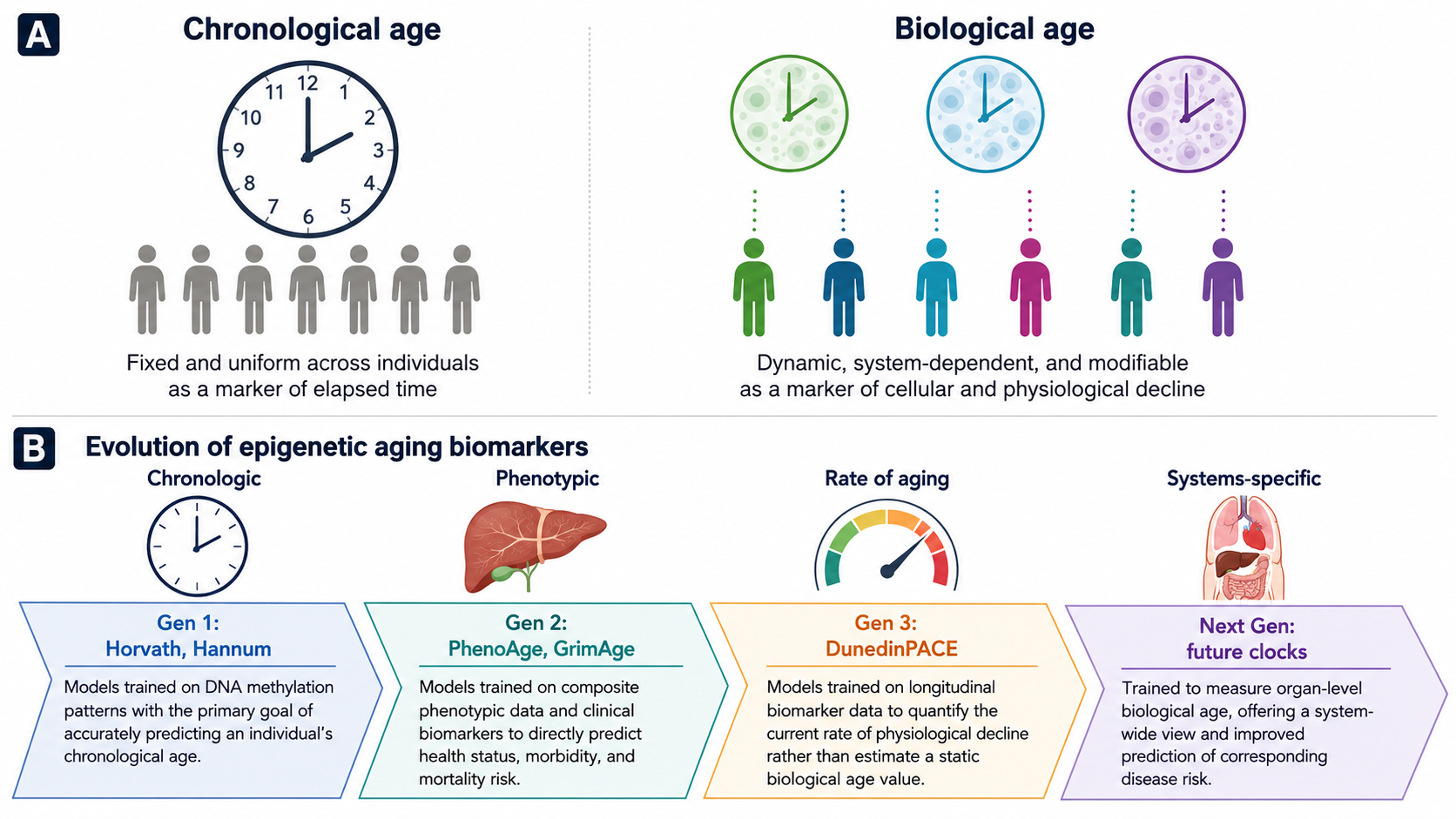
A review by Cheema et al. published in The Journal of Clinical Investigation (JCI) maps the landscape of biological age (BA) measurement, tracing methods from functional tests and blood biomarkers to epigenetic, proteomic, imaging, wearable, and AI-based clocks, including first- through third-generation epigenetic clocks (examples: Horvath, Hannum, PhenoAge, GrimAge, DunedinPACE), per the review (JCI 2026;136(12):e205777, doi:10.1172/JCI205777). The authors report that next-generation efforts aim for organ-specific BA and that evidence remains insufficient for routine clinical use. Per the review, prospective validation is needed before these tools can guide patient care, although they could, in principle, identify high-risk individuals earlier than symptom onset.
What happened
A review by Cheema et al. published in The Journal of Clinical Investigation (JCI 2026;136(12):e205777, doi:10.1172/JCI205777) surveys contemporary approaches to estimating biological age (BA). The paper documents a progression from simple functional tests such as gait speed and frailty measures to molecular and digital approaches, and explicitly categorizes epigenetic clocks into generations: first-generation clocks trained on chronological age (examples: Horvath, Hannum), second-generation clocks tied to phenotypic outcomes (examples: PhenoAge, GrimAge), and third-generation clocks measuring pace or rate of aging (example: DunedinPACE). The review lists data modalities now in active development for BA: DNA methylation, proteomics, blood biomarkers, medical imaging, wearables, and AI analysis of clinical text and scans. The authors state that prospective validation is required before routine clinical deployment and note that the role of these tools in standard care remains unresolved.
Technical details
Per the review, methods differ by target and training objective: earlier models predict chronological age, later models predict mortality or morbidity, and newer approaches aim to quantify current aging rate or organ-specific decline. The review summarizes methodological challenges including cross-cohort calibration, confounding by adiposity, differential predictive performance across populations, and the need for longitudinal, prospective outcome data to establish clinical utility. The paper also highlights digital and AI-enabled clocks that repurpose imaging and clinical-text data but emphasizes variable evidence supporting each modality.
Industry context
What to watch
Editorial analysis
Reviews that map a measurement field typically accelerate multi-disciplinary uptake by clarifying terminology and performance gaps. For data scientists and ML engineers, the JCI review consolidates which label definitions and outcome targets are in use, and it underscores common data-quality and generalization challenges when models are trained on surrogate labels such as chronological age or cross-sectional biomarkers rather than long-term clinical endpoints.
Observers should track prospective cohort studies and randomized prevention trials that include BA measures as prespecified endpoints, cross-population benchmarking efforts, and open datasets that link multi-omic, imaging, wearable, and EHR-derived streams. For practitioners, improvements in covariate adjustment, calibration across ancestries, and standardized reporting of effect sizes versus established clinical risk scores will be key indicators of maturity.
Key Points
- 1The JCI review catalogs BA methods from functional tests to AI-based clocks, clarifying generations and training targets for researchers.
- 2Because many clocks are trained on surrogate labels, prospective validation and longitudinal endpoints remain the critical evidence gap.
- 3For practitioners, standardization, cross-cohort calibration, and open longitudinal datasets will determine whether BA tools move from research to clinical decision support.
Scoring Rationale
The review synthesizes diverse BA measurement approaches relevant to ML and biomarker teams, but clinical utility remains unproven; the piece is notable for clarifying terminology and evidence gaps that affect model training and evaluation.
Sources
Public references used for this report.
Practice interview problems based on real data
1,625 SQL & Python problems across 15 industry datasets — the exact type of data you work with.
Try 250 free problems