
Bernstein Sees Upside for Bitcoin Miners
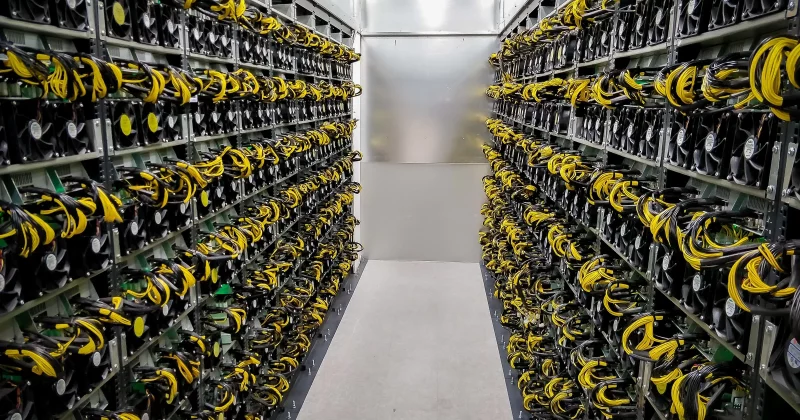
Bernstein issued Outperform ratings on four U.S.-listed bitcoin miners, naming IREN, Riot Platforms, CleanSpark, and Core Scientific as top picks, according to reporting by CryptoBriefing and KuCoin. Bernstein's research note frames an estimated $90 billion wave of AI infrastructure investment as a key value driver for miners, per CryptoBriefing and KuCoin. The firm shifted from a discounted cash flow methodology to a sum-of-parts valuation that includes AI colocation and power-site value, using a $3 million per megawatt multiple, according to CoinDesk and Blockonomi. Bernstein raised Core Scientific's price target to $24 from $17 and cited plans for roughly 590 megawatts of IT load by early 2027, as reported by CoinDesk and Blockonomi. CryptoBriefing and KuCoin note CoreWeave's multi-billion-dollar hosting deal with Core Scientific as a sector proof-of-concept.
What happened
Bernstein issued Outperform ratings on four bitcoin miners: IREN, Riot Platforms, CleanSpark, and Core Scientific, according to reporting by CryptoBriefing and KuCoin. CryptoBriefing and KuCoin report that Bernstein's research note estimates a $90 billion wave of AI infrastructure investment that could create demand for colocation and high-density power sites. CoinDesk and Blockonomi report that Bernstein raised Core Scientific's price target to $24 from $17, and that the firm expects Core Scientific to deliver about 590 megawatts of IT load by early 2027.
Technical details
CoinDesk and Blockonomi report that Bernstein abandoned a traditional discounted cash flow model in favor of a sum-of-parts valuation, combining bitcoin holdings, mining EBITDA, AI colocation and cloud revenues, and the potential value of power sites. CoinDesk and Blockonomi further report that the note applies a $3 million per megawatt multiple to value sites earmarked for AI data centers. CryptoBriefing and KuCoin highlight operational assets that matter for AI colocation: permitted sites, energized substations, and cooling systems designed for high-density racks.
Context and significance
Editorial analysis: Companies that built large-scale mining facilities historically optimized throughput for ASIC rigs, not GPU clusters, but those sites nonetheless solved grid connection and permitting constraints that now limit AI data-center expansion. Industry observers noted in reporting that CoreWeave's multi-billion-dollar hosting agreement with Core Scientific served as a practical example that miners can host AI workloads, according to CryptoBriefing and KuCoin. CoinDesk and Blockonomi report Bernstein raised targets for other miners, including Riot to $25 from $19 and CleanSpark to $24 from $20, reflecting the analyst view that power-site value materially changes valuation frameworks.
Observed patterns in similar transitions
Editorial analysis: In other sectors where infrastructure ownership matters, markets often re-rate companies when asset utility shifts to growth industries, but execution and retrofit costs vary widely. Public reporting on miners emphasizes that retrofitting ASIC-oriented facilities to GPU-ready colocation requires additional capital expenditure for networking, power distribution, and liquid or other high-density cooling solutions, as noted by CryptoBriefing and KuCoin.
What to watch
Editorial analysis: Observers should track announced colocation contracts, measured GPU load delivered to sites, and concrete engineering upgrades that enable dense GPU racks. Reporting to date flags indicators such as disclosed AI-hosting revenue lines, signed multi-megawatt colocation agreements, and regulatory or utility approvals for additional energized capacity. Also watch for transaction terms and counterparties, since CryptoBriefing and KuCoin identify the CoreWeave-Core Scientific deal as an early proof point that may influence future pricing for colocation capacity.
Limits and execution risk
Editorial analysis: Public reporting stresses that not every miner with spare land or a substation will convert into an AI colocation provider without substantial capital and engineering work. Sources caution that valuation upside implied by a $90 billion AI wave depends on site readiness, financing, and competitive supply of utility hookups, per CryptoBriefing and KuCoin.
Bottom line for practitioners
Editorial analysis: For infrastructure, power engineering, and data-center operations teams, the sector shift reported by multiple outlets signals stronger market interest in high-density power capacity and accelerated timelines for utility interconnection. Teams evaluating colocation or migration should treat announced analyst valuations as contingent on demonstrable engineering changes and signed contracts, not solely on theoretical site potential.
Key Points
- 1Bernstein rated IREN, Riot, CleanSpark, and Core Scientific Outperform, linking miner valuations to AI colocation potential.
- 2The firm models a $90 billion AI infrastructure wave and uses a $3 million per MW multiple to value power sites.
- 3Editorial analysis: Observers should track signed multi-megawatt contracts, delivered GPU IT load, and site engineering upgrades.
Scoring Rationale
This is a notable sector revaluation story for mining and infrastructure investors because analysts changed valuation methodology to include AI colocation value, which affects capital allocation and M&A signals. The story is relevant to practitioners working on power, cooling, and data-center readiness, but it is not a frontier technical development.
Sources
Public references used for this report.
Practice interview problems based on real data
1,625 SQL & Python problems across 15 industry datasets — the exact type of data you work with.
Try 250 free problems


