Banks Increase Hiring Amid AI Investment Trends
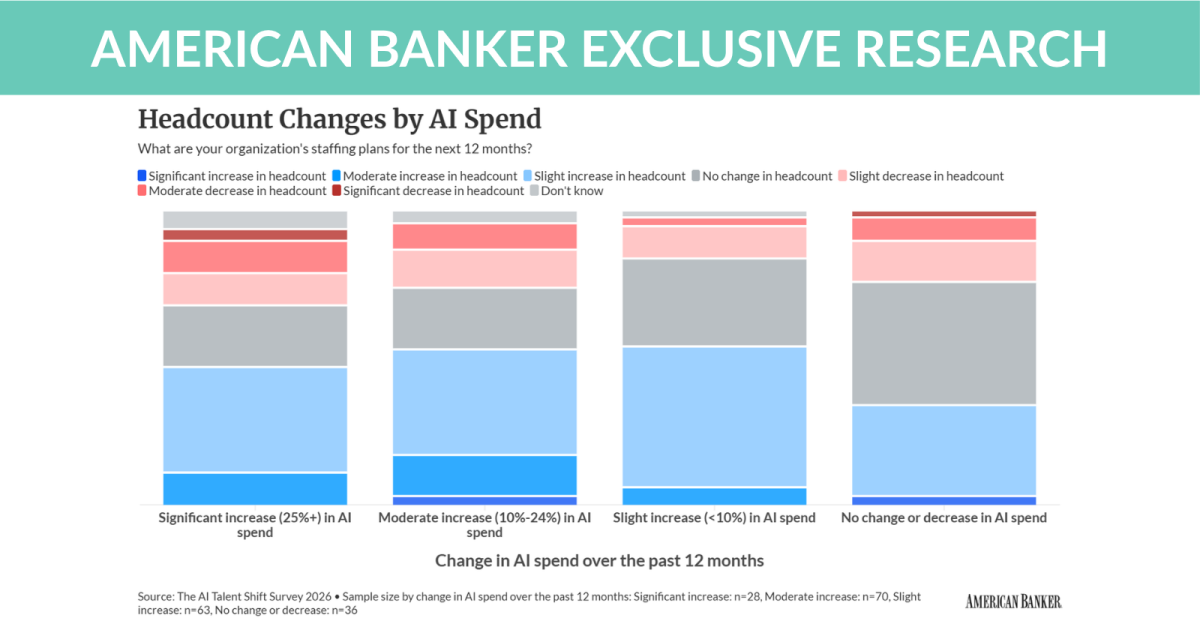
American Banker's 2026 AI Talent Shift survey of 206 banking professionals finds banks are, on balance, increasing headcount even as they invest in AI. Sales, relationship managers and software engineers are the most commonly added roles: corporate and commercial units report 37% adding bankers/relationship managers, 33% adding sales roles and 26% adding software engineers. Wealth and investment units show 35% adding software engineers and 35% adding client-facing sales roles, with 29% adding AI-related positions. Retail and small business banks also add sales (31%), IT (24%) and AI roles (21%). Risk and compliance teams show modest reductions, but institutions investing in AI are more likely to expand headcount than to cut it.
What happened
American Banker's 2026 AI Talent Shift survey of 206 banking professionals, fielded in March 2026, shows that banks are broadly increasing headcount even as they accelerate AI investments. The clearest hiring increases are in sales, relationship management and engineering functions, with several divisions reporting double-digit shares adding software engineers and AI engineers.
Technical details
The survey highlights the top roles being added across divisions, indicating where practical demand will land:
- •Corporate and commercial: 37% adding bankers/relationship managers, 33% adding sales, 26% adding software engineers
- •Wealth and investment banking: 35% adding software engineers, 35% adding sales/client-facing, 29% adding AI-related roles
- •Retail and small business: 31% adding sales, 24% adding IT, 21% adding AI roles
- •Payments: notable increases in software engineering hires (reported 35% in some units)
These patterns suggest banks are staffing for product delivery, client coverage and in-house engineering rather than pursuing broad automation-driven headcount cuts. The only material reduction signals are in risk and compliance, where respondents reported moderate layoffs.
Context and significance
This counters the dominant narrative that AI deployments will lead to mass downsizing in financial services. Banks appear to be treating AI as a force multiplier that requires complementary human capital: product managers, software engineers, data engineers, MLOps practitioners and sales teams to monetize new offerings. The tilt toward hiring in credit unions and parts of retail banking also reflects competitive pressures to digitize and to keep customer-facing expertise in-house. For practitioners, the implication is sustained demand for engineering, data and AI governance skills inside regulated institutions rather than an immediate contraction of roles.
What to watch
Track whether hiring translates into increased budgets for data infrastructure, MLOps tooling and model governance, and watch regulatory scrutiny that could shift hiring from front-line product teams to compliance and explainability roles. Also monitor whether banks convert temporary headcount increases into longer-term talent pipelines or subcontract more capabilities to vendors.
Key Points
- 1Banks report net hiring, not mass layoffs, indicating AI is prompting role creation rather than wholesale displacement.
- 2Demand concentrates in sales, relationship management, software engineering and AI roles, signaling growth in product and engineering capacity.
- 3Risk and compliance face modest cuts, highlighting a rebalancing toward revenue-facing and technical teams with regulatory oversight implications.
Scoring Rationale
This survey is notable for practitioners because it challenges the mass-layoff narrative and signals sustained demand for engineering and AI talent in finance, affecting hiring and career planning. It is not industry-shaking at the frontier-model level, so it sits in the 'notable' range.
Practice with real Banking data
90 SQL & Python problems · 15 industry datasets
250 free problems · No credit card
See all Banking problems