Banks Increase AI Fluency Across Institutions
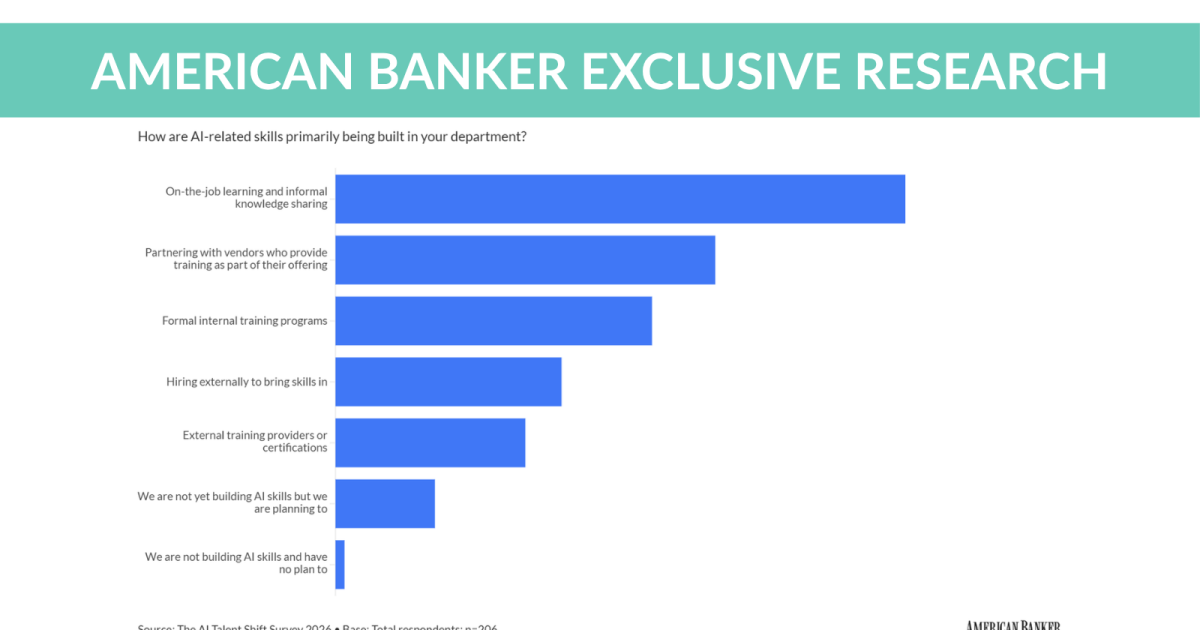
American Banker's 2026 AI Talent Shift survey finds that half of surveyed banks and credit unions report being at least moderately fluent in AI. The online survey of 206 banking professionals, fielded in March 2026, shows variation by institution type: national banks report the highest AI literacy at 73% moderately to very fluent, midsize banks at 57%, community banks at 61%, and credit unions at 57% with the largest share reporting low fluency (43%). Institutions are actively closing knowledge gaps through internal initiatives and tracking of AI usage and skills. The results signal a widespread operational shift: financial firms are moving from experimentation to workforce enablement, which raises near-term priorities around governance, validation, and vendor controls for AI systems.
What happened - American Banker's 2026 AI Talent Shift survey, fielded online in March 2026 among 206 banking professionals, shows banks and credit unions are growing more fluent in AI, with 50% of institutions reporting at least moderate AI literacy. Responses vary by institution type: national banks lead at 73% moderately to very literate, midsize banks at 57%, community banks at 61%, and credit unions at 57% reporting moderate to high literacy while also having the largest share declaring low literacy at 43%.
Technical details - The survey sample covers a mix of banks, credit unions, neobanks, and payments firms and captures self-assessed AI skill levels and organizational practices. Respondents indicate that firms are actively measuring and tracking AI usage and skills and investing in capability building. The public excerpt omits a full breakout of specific training channels and exact skills ranked highest, but the dataset emphasizes workforce-focused interventions rather than pure procurement of external AI products.
Context and significance - Banks face rising competition from AI-native entrants and broad vendorization of foundation models, so workforce enablement is the logical next phase after pilot projects. Higher AI literacy in national and community banks suggests resources and scale both matter: larger institutions can staff governance teams while community banks may be focused on targeted operational gains. For practitioners this means priorities will shift from proof-of-concept work to production controls: model validation, data lineage, access controls, explainability, and audit-ready documentation.
What to watch - Watch hiring and training investments, whether firms standardize on vendor platforms or develop in-house model validation frameworks, and how regulators respond with guidance around model risk and explainability. The pace of literacy improvement will determine how quickly institutions can safely move AI from pockets of efficiency to enterprise-wide deployments.
Key Points
- 1Half of surveyed institutions report at least moderate AI literacy, signaling a shift from pilots to workforce enablement.
- 2AI literacy varies by institution size, with national banks at 73% and credit unions showing wider literacy gaps.
- 3Growing fluency increases focus on model governance, validation, and vendor controls as production deployments scale.
Scoring Rationale
This is a notable indicator of industry adoption: rising AI literacy across banks matters for operational deployments and governance. It is not a frontier technical breakthrough, but it signals a shift to production readiness that affects practitioners building and auditing models in finance.
Practice with real Banking data
90 SQL & Python problems · 15 industry datasets
250 free problems · No credit card
See all Banking problems