AWS Ships DevOps Agent For Automated Incident Investigation
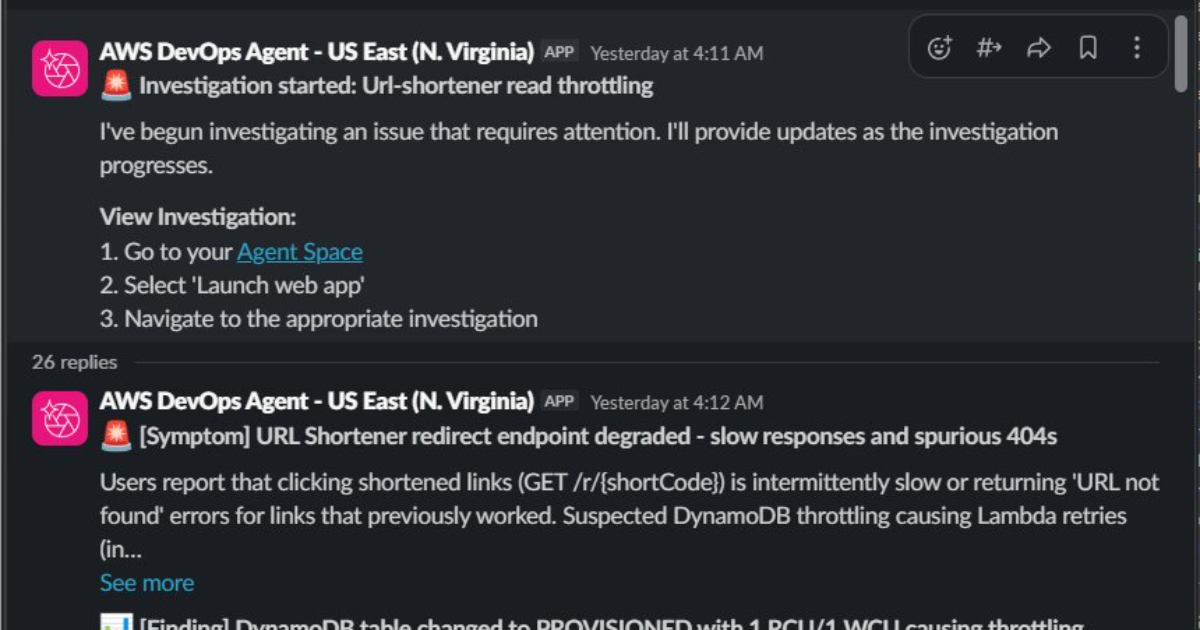
AWS has made DevOps Agent generally available, delivering a generative AI powered operations teammate that autonomously investigates incidents, correlates telemetry and code, and integrates with observability, CI/CD, and ticketing systems across AWS, multicloud, and on-prem environments. In preview, customers reported up to 75% lower MTTR, 80% faster investigations, and 94% root cause accuracy. GA adds expanded multicloud and on-prem support, custom agent skills, custom charts and reports, and updated IAM managed policies such as AIDevOpsAgentAccessPolicy. The agent triggers on alerts from sources like CloudWatch, PagerDuty, Dynatrace, Datadog, and ServiceNow, begins investigating immediately, and can escalate to AWS Support with full context. For practitioners, GA means production-grade integrations, new security and IAM changes, and operational workflows to instrument and trust autonomous investigations.
What happened
AWS has announced general availability of AWS DevOps Agent, a generative AI powered frontier agent that autonomously investigates incidents, correlates telemetry with code and deployments, and executes on operational playbooks across AWS, multicloud, and on-prem environments. Preview customers reported up to 75% lower MTTR, 80% faster investigations, and 94% root cause accuracy, and GA adds expanded platform coverage, extensibility, and hardened security controls.
Technical details
The agent learns application topologies and relationships, then ingests signals from observability, CI/CD, and code repositories to build investigation context. It starts work the moment alerts arrive from sources such as CloudWatch, PagerDuty, Dynatrace, Datadog, and ServiceNow, and produces an investigation journal with findings and remediation steps. Key operational changes in GA include new managed IAM policies (for example AIDevOpsAgentAccessPolicy), updated operator role trust relationships, and the removal of on-demand chat histories from the public preview period. The migration guide lists concrete role updates and inline policy replacements; example role names follow the console pattern such as DevOpsAgentRole-AgentSpace-3xj2396z.
Integrations and extensibility
The GA release emphasizes built-in connectors and a skills extension model. Integrations include (but are not limited to):
- •CloudWatch, Datadog, Dynatrace, New Relic
- •Splunk, Grafana, GitHub, GitLab
- •PagerDuty, ServiceNow, and Azure DevOps
These connectors allow the agent to correlate logs, traces, metrics, deployment metadata, runbooks, and pipeline state. Customers can add custom agent skills via the agent capabilities pane to extend automation, create custom charts and reports, and persist investigative findings for follow up.
Security and operational controls
GA tightens access to conversational histories and introduces new managed policies to replace preview-era permissions. The docs require teams to update monitoring and operator roles across accounts, attach AIDevOpsAgentAccessPolicy, and revise trust policies for operator workflows. Investigations can be escalated to AWS Support, and the agent can inject full incident context into support cases to accelerate human collaboration.
Context and significance
Autonomous AIOps agents are steadily moving from research demos to operational products. AWS DevOps Agent follows a broader industry trajectory where cloud providers offer persistent agents that can act on alerts without constant human prompting. For organizations with mature observability and CI/CD pipelines, the value proposition is clear: faster triage, fewer manual correlations, and automated enforcement of runbooks. However, effective use depends on accurate topology mapping, well-instrumented telemetry, and rigorous IAM hygiene. The GA release signals that AWS considers the feature production ready and enterprise suitable, which raises the bar for competing offerings from other cloud vendors and third-party AIOps products.
What to watch
Teams should prioritize updating IAM roles and testing the agent in nonproduction first, validate its root cause findings against known incidents, and plan how to consume its recommendations as continuous improvement items. Monitor audit logs and escalation patterns to ensure the agent's autonomy aligns with organizational risk policies.
"A SRE responding to a 2 AM page must manually correlate telemetry from multiple sources, trace dependencies across services, and form hypotheses, a process that routinely takes hours," said Balaji, senior solution architect at AWS. The GA release aims to replace that manual toil with an autonomous teammate that learns application relationships and applies runbooks and code insights to accelerate resolution.
Key Points
- 1AWS releases DevOps Agent GA, enabling autonomous incident investigation across AWS, multicloud, and on-prem environments.
- 2GA adds expanded integrations, custom agent skills, custom charts, and stricter IAM policies, shifting operational controls to production workflows.
- 3Practitioners gain faster MTTR and proactive recommendations, but must update IAM, instrument telemetry, and validate agent findings before trusting automation.
Scoring Rationale
GA of AWS DevOps Agent is a notable product milestone for AIOps: it brings autonomous incident investigation into production, integrates with major observability tools, and introduces IAM and operational controls teams must adopt. It is significant for operational engineers but not a frontier-model breakthrough.
Sources
Public references used for this report.


Practice interview problems based on real data
1,625 SQL & Python problems across 15 industry datasets — the exact type of data you work with.
Try 250 free problems