AWS Releases Kiro Crew Agent Workspace
AWS released Kiro Crew, an open-source workspace for its Kiro AI coding tool, on August 4, enabling developers to assign asynchronous software-engineering tasks to coordinated AI agents. InfoWorld reports that the platform preserves context across work sessions and supports recurring work such as incident investigation, pull-request monitoring, and ticket triage. DevOps.com reports that it uses the Agent Client Protocol for observable multi-agent orchestration.
AWS released Kiro Crew, an open-source orchestration workspace for its Kiro AI coding tool, on August 4. According to InfoWorld, the platform is designed for long-running software-engineering workflows that can span repositories, developer tools, and multiple work sessions rather than a single interactive coding prompt.
Kiro Crew coordinates multiple AI agents, schedules recurring work, preserves project context across sessions, and integrates with developer tools for tasks including incident investigation, pull-request monitoring, ticket triage, and automated engineering work, AWS told InfoWorld. The company also said the release includes persistent memory, multi-agent orchestration, approval workflows, a web and desktop monitoring dashboard, and security controls.
"Kiro Crew is a persistent, open-source development workspace for work that is bigger than a single task in a single session," Darko Mesaros, distinguished developer advocate at AWS, told InfoWorld. "Think of it as an application layer that turns AI coding agents into always-working, self-learning, autonomous teammates."
Orchestration and observability
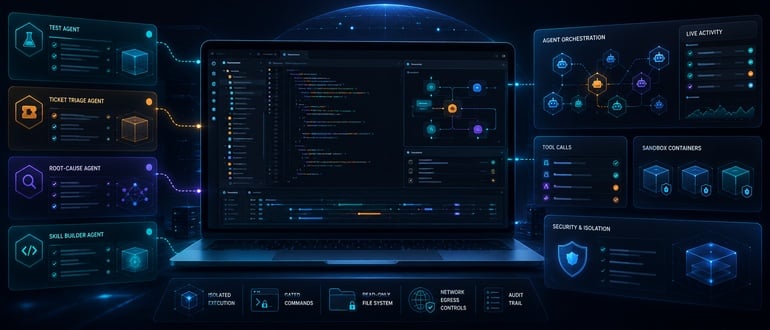
DevOps.com reports that Kiro Crew uses the Agent Client Protocol (ACP) to orchestrate agents and expose activity as sub-agents are created. Its Activity view displays an agent-level card for activity, tool calls, and results in real time, according to the publication.
The reported examples include handing a ticket queue to the workspace for triage and having agents investigate an incident's root cause while a developer works on another task. DevOps.com also reports that the workspace can observe assigned tasks and recommend reusable AI skills based on recurring developer workflows.
Security controls for autonomous work
The security model is a consequential part of the release because Kiro Crew is intended to execute work beyond a single attended coding session. According to DevOps.com, AWS has included an operating system-level sandbox, denied-by-default commands, suspicious-pattern blocking, input validation, sensitive-path blocking, credential redaction, and signed audit logs. The publication reported that external agents attempting to install tools are denied access.
InfoWorld reported that Kiro Crew originated as an internal Amazon project called MeshClaw and was adopted by more than 39,000 Amazon builders in under six months. It also reported that the platform can be deployed entirely within customer environments.
For engineering teams, the release places operational concerns such as approval gates, auditability, tool permissions, and persistent context alongside code generation. Comparable multi-agent systems often shift evaluation from code-completion quality alone toward whether agents can safely perform repeatable work across repositories and developer workflows without losing context or exceeding delegated access.
Key Points
- 1AWS released Kiro Crew to orchestrate persistent coding agents, extending AI assistance from interactive prompts to asynchronous engineering workflows.
- 2ACP-based activity views expose agents, tool calls, and results, making observability a central requirement for multi-agent developer automation.
- 3Comparable autonomous coding systems increase the importance of approval workflows, least-privilege tool access, sandboxing, and auditable action logs.
Scoring Rationale
Kiro Crew is a notable developer-tool release because it packages persistent, multi-agent orchestration with governance and observability controls. It is relevant to teams evaluating autonomous software-engineering workflows, though its immediate impact is narrower than a major foundation-model release.
Sources
Primary source and supporting public references used for this report.
Practice interview problems based on real data
1,625 SQL & Python problems across 15 industry datasets — the exact type of data you work with.
Try 250 free problems