
Author Visits Network School Near Forest City
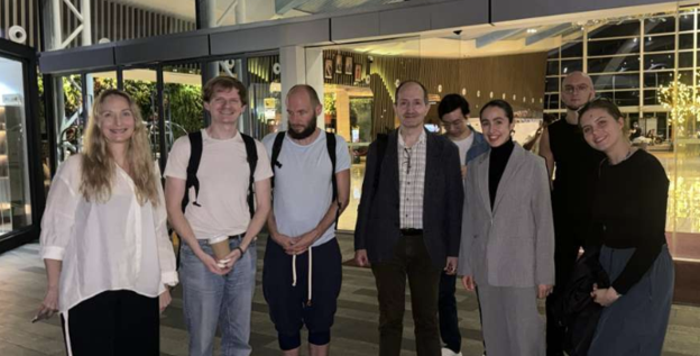
Tommaso Dorigo wrote that he gave an invited plenary at AI4X in Singapore and later visited Network School in Forest City, framing the trip around AI-guided experimental design rather than a formal research result. The Science 2.0 post says AI4X gathered computer scientists, physicists, and engineers to discuss how AI can accelerate scientific discovery, and Dorigo used his talk to argue that future experiments should co-optimize hardware, software, and model-driven search. For practitioners, the useful signal is modest: academic interest is moving from AI as a post-hoc analysis layer toward closed-loop experiment planning, but the item remains a first-person conference and travel report rather than a validated benchmark, tool release, or institutional announcement.
Conference travel reports are weak evidence for product or benchmark claims, but this one is useful as a directional signal: researchers at AI4X are explicitly discussing AI as a design partner for scientific experiments, not just as a downstream analytics layer.
What happened
Science 2.0 published Tommaso Dorigo's June 20, 2026 first-person account of traveling to Singapore for an invited plenary at AI4X and then visiting Network School in Forest City, Malaysia. The post says the conference gathered computer scientists, physicists, and engineers around AI for scientific discovery, and that Dorigo argued for treating hardware and software optimization as a coupled problem in experimental design.
Technical context
The important practitioner angle is closed-loop experimentation. In that workflow, models help choose the next measurement, simulation, or instrument setting while human teams preserve constraints around uncertainty, physical feasibility, and reproducibility. The post does not announce a reusable system, dataset, or benchmark, so it should be read as conference-positioning evidence rather than proof that a particular AI4X method is production-ready.
For practitioners
Teams building AI for science should watch for concrete follow-through from this community: public code, benchmark tasks, instrument-control examples, and negative results. Without those artifacts, the safest takeaway is that experiment orchestration is becoming a shared research theme across physics, engineering, and computer science.
Key Points
- 1AI4X is being framed as a venue for AI-assisted scientific discovery rather than only post-hoc model analysis.
- 2Dorigo's post argues for co-optimizing hardware, software, and model-driven search in future experimental workflows.
- 3Practitioners should wait for code, benchmarks, or reproducible instrument examples before treating the idea as deployable.
Scoring Rationale
This is relevant to AI-for-science practice but remains a single-author conference and travel report with no released benchmark, tool, or institutional announcement. The impact is limited to early research-community signal rather than near-term deployment consequence.
Sources
Public references used for this report.
Practice interview problems based on real data
1,625 SQL & Python problems across 15 industry datasets — the exact type of data you work with.
Try 250 free problems
