Amazon Deploys AI Tool to Match Shelter Pets
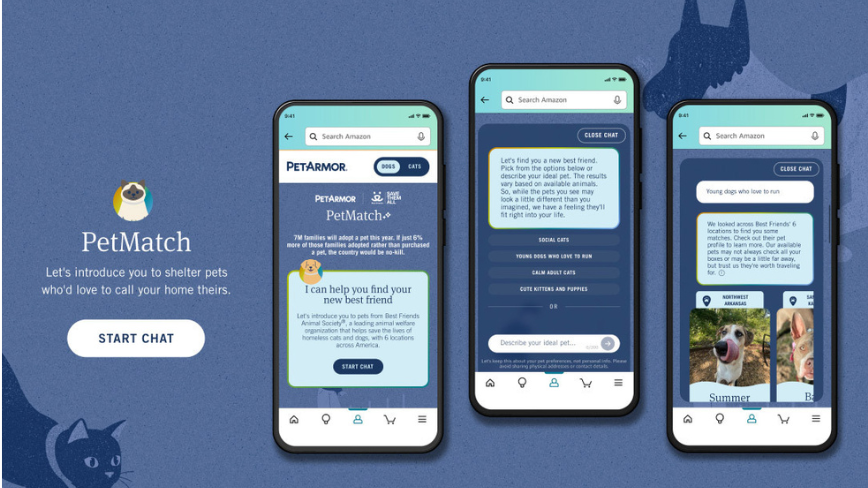
Amazon, in partnership with PetArmor and Best Friends Animal Society, launched an AI-powered matching tool and a generative-video campaign called Protect Playtime to increase pet adoptions and reduce shelter euthanasia in the U.S. The tool ingests natural-language descriptions of a user's lifestyle and preferences (e.g., "low-energy dog good for apartments"), analyzes factors such as temperament, energy level, living situation compatibility, and household composition, and returns personalized recommendations of adoptable dogs and cats from Best Friends centers nationwide. The initiative pairs a practical recommendation engine with advertising-driven creative to drive visibility for shelter animals, accelerate matches, and support a broader no-kill advocacy push.
What happened
Amazon, working with PetArmor and Best Friends Animal Society, launched an AI-powered matching tool and the Protect Playtime generative-video campaign to surface adoptable dogs and cats to potential adopters. The experience accepts natural-language prompts (for example, "I need a low-energy dog good for apartments") and returns personalized recommendations of animals available at Best Friends centers across the U.S.
Technical details
The tool evaluates user-provided text to infer temperament, energy level, living-situation compatibility, and household composition before ranking candidate animals. Key capabilities include:
- •Accepting free-form, conversational prompts and mapping intent to adoption-relevant attributes
- •Scoring and matching animals by behavioral and environmental compatibility
- •Returning location-aware recommendations from Best Friends centers nationwide
- •Pairing matches with a generative-video campaign to increase discoverability and emotional engagement
Context and significance
This is an applied deployment of conversational retrieval and recommendation techniques rather than a foundational model release. It demonstrates practical uses of natural-language understanding to map user intent onto structured pet metadata and behavioral profiles held by shelter databases. For practitioners, this highlights common production challenges: building robust intent-to-attribute pipelines, maintaining up-to-date inventory sync with distributed shelter centers, and combining recommendation outputs with creative assets (here, generative video) to improve conversion and engagement. The initiative also signals how major platforms and advertisers can integrate lightweight AI experiences into awareness campaigns to drive measurable social outcomes.
What to watch
Monitor adoption-conversion metrics and how animal attribute ontologies are modeled and audited for bias (e.g., misclassification of temperament). Operational details to watch include inventory freshness, privacy of household data, and whether the generative video component uses synthetic animal imagery or augments real shelter footage.
Key Points
- 1AI-driven natural-language matching converts conversational intent into adoption-relevant attributes, improving candidate discovery and reducing search friction.
- 2Combining a recommendation engine with generative-video advertising amplifies visibility, shifting focus from algorithmic accuracy to engagement and conversion metrics.
- 3Real-world deployment surfaces engineering challenges: inventory sync, attribute modeling, ethical labeling, and measuring impact on shelter intake and euthanasia rates.
Scoring Rationale
This is a notable applied AI deployment demonstrating natural-language matching and creative integration at scale, useful for practitioners building recommendation and NLU systems. It is not a foundational research breakthrough, so its industry impact is moderate.
Sources
Public references used for this report.

Practice with real Ad Tech data
90 SQL & Python problems · 15 industry datasets
250 free problems · No credit card
See all Ad Tech problems