AI Markets Shift Toward Task-Based Human Work
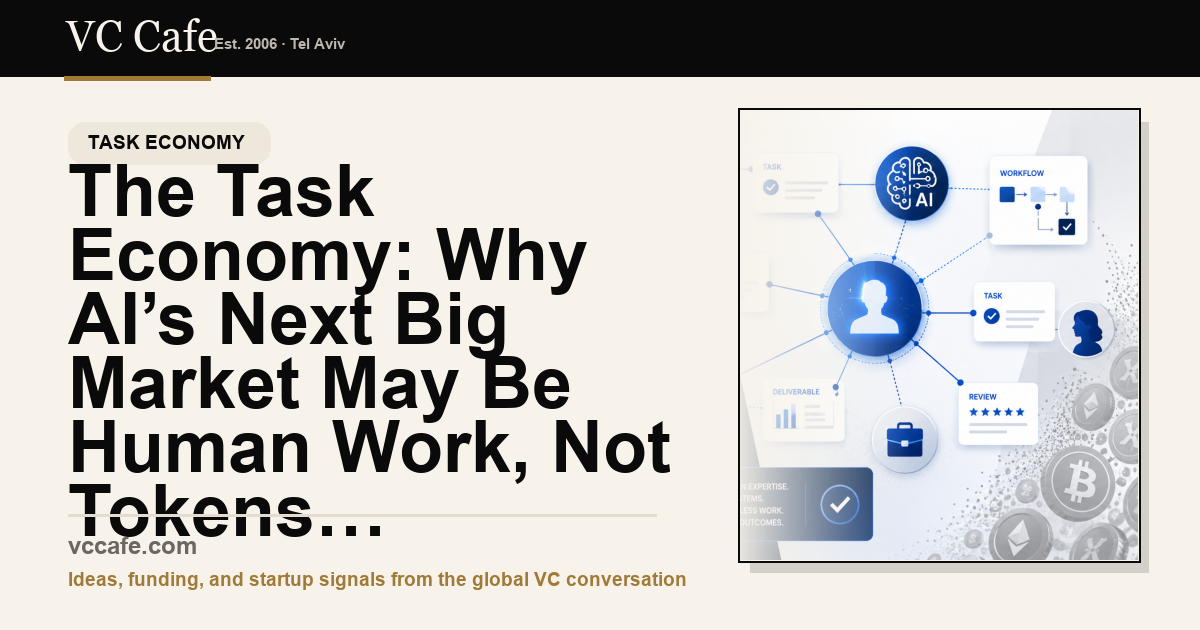
VC Cafe's July 8, 2026 analysis argues that AI's next market layer may be a task economy built around expert judgment, workflow completion, data labeling, compliance, and payouts rather than token volume alone. According to Eze Vidra, the connective tissue is platforms that decompose knowledge work into verifiable tasks, match those tasks with experts, and convert the results into training data, evaluations, workflows, or AI-native services. The claim is directional, not a funding announcement, so it should be read as a market thesis: companies such as Mercor, Scale AI, GLG, Fiverr, and Deel are examples of how human-in-the-loop labor is becoming infrastructure for deployed AI products.
The useful practitioner signal in this analysis is that human work is not disappearing from AI systems; it is being productized into smaller, auditable units that can be priced, routed, reviewed, and later automated. For AI teams, the relevant market shift is less about replacing tokens with people and more about turning expert feedback, labeling, red-teaming, and workflow completion into durable evaluation and training assets.
What happened
Eze Vidra published a VC Cafe analysis on July 8, 2026, arguing that the next AI market may be measured in tasks rather than tokens. The piece frames expert judgment, workflow completion, labeled data, compliance, and payouts as the supply chain behind AI-native services, and it links examples such as Mercor, Scale AI, Surge AI, GLG, Fiverr, and Deel to the same broader pattern. The article is analysis, not a company announcement, so the strongest claim is that these businesses illustrate a category forming around human-in-the-loop task infrastructure.
Market context
The thesis is plausible because several adjacent markets already monetize structured human judgment. Mercor describes connecting expert networks with AI labs and enterprises, including a $350 million Series C announced in 2025. Deel describes contingent workforces for AI data labeling, including contractor management, payments, compliance, and quality controls. Reuters-syndicated coverage in The Business Times reported Meta's 2025 Scale AI investment at a valuation above $29 billion, underscoring how valuable the data and evaluation layer has become to frontier AI companies.
For practitioners
The operational takeaway is to design human-in-the-loop systems as data products, not one-off outsourced chores. A useful task platform needs clear work decomposition, domain-expert sourcing, quality review, provenance, payment controls, and a way to convert accepted outputs into reusable evals, rubrics, prompts, or workflows. Teams buying these services should ask what evidence trail each task creates and whether it improves the model, the product workflow, or only a temporary backlog.
What to watch
The open question is whether task platforms can maintain quality, worker compliance, and data security as demand scales. If buyers move from software seats to completed outcomes, vendors that combine human review with model inference could capture more budget. If quality control stays weak, the category risks becoming another labeling marketplace with AI branding rather than defensible infrastructure.
Key Points
- 1The article reframes human expert work as task infrastructure that can feed training, evaluation, workflow automation, and compliance systems.
- 2Mercor, Scale AI, Deel, and expert networks show different ways human judgment is being packaged for AI operations.
- 3Buyers should evaluate whether task vendors create reusable evidence trails, not just cheap labor for temporary model-cleanup work.
Scoring Rationale
This is a useful AI-market analysis piece, not a primary funding, product, or policy event. It deserves solid visibility because human-in-the-loop task infrastructure is relevant to AI teams, but the evidence supports a mid-tier score rather than a major-news framing.
Sources
Public references used for this report.
Practice interview problems based on real data
1,625 SQL & Python problems across 15 industry datasets — the exact type of data you work with.
Try 250 free problems