Agibot Deploys G2 Humanoids in Production
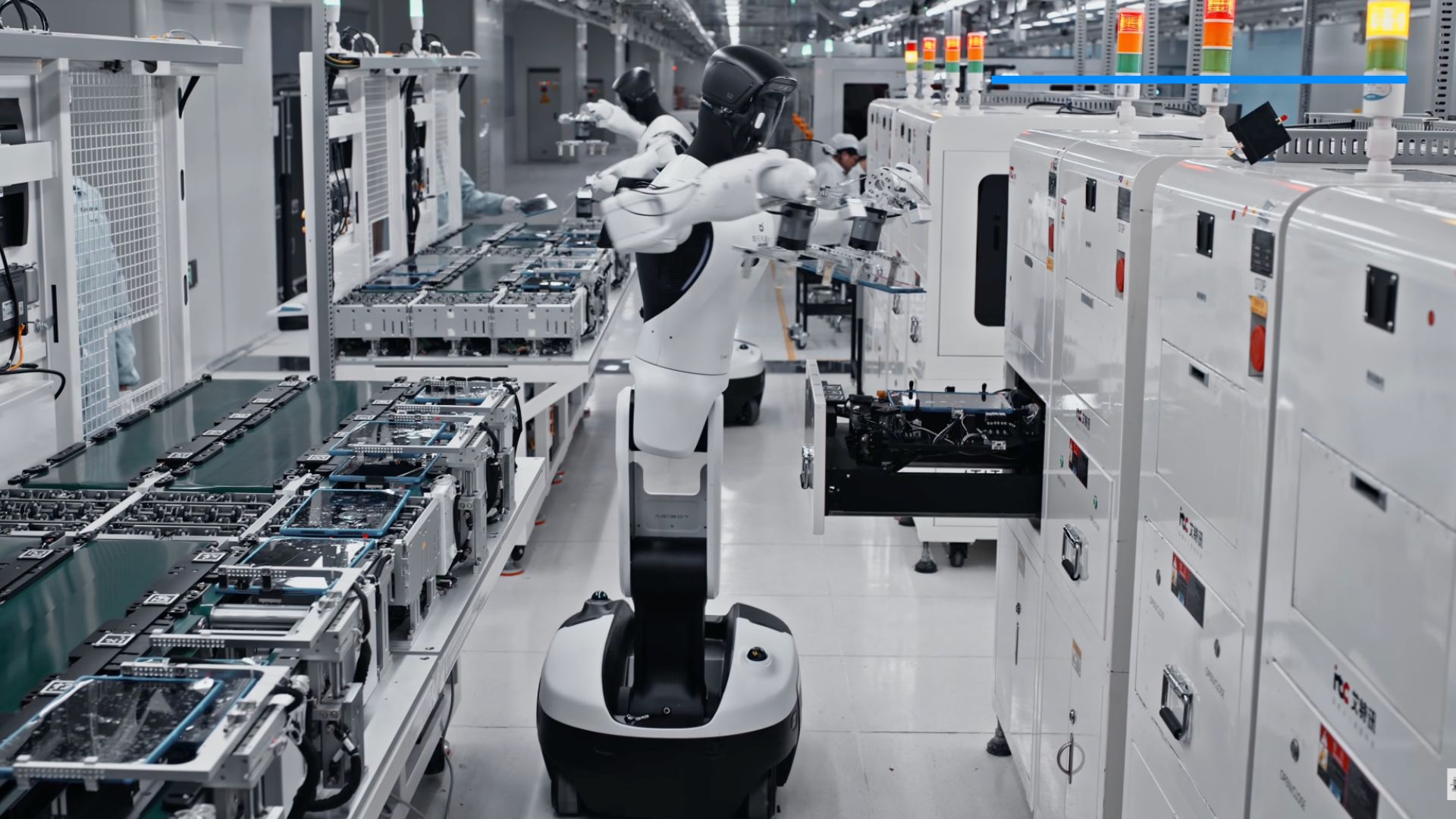
Agibot has deployed its AGIBOT G2 humanoid robots into Longcheer Technology's tablet production lines, marking a claimed milestone in industrial embodied AI. The robots operate at multimedia-integrated testing stations performing precision loading, unloading, sorting, and manipulation tasks with metrics reported at 310 units/hour, 19-20 second cycles, and 99% success. Agibot frames the rollout as part of a full-stack embodied intelligence approach that combines hardware, multi-modal perception, motion planning, manipulation, and large-scale data infrastructure for continuous learning. The system reportedly integrated quickly into existing workflows and now runs alongside human operators to increase throughput and consistency for small-batch, multi-model consumer electronics manufacturing.
What happened
Agibot deployed its AGIBOT G2 humanoid robots into Longcheer Technology's tablet production lines and testing stations, moving embodied AI from lab demos into continuous production. The company reports the system achieves 310 units/hour, 19-20 second cycle times, and 99% success for precision loading, unloading, sorting, and defect separation. Executives framed this as the first large-scale industrial implementation of embodied AI in consumer electronics manufacturing, with integration timelines presented as rapid and production-grade.
Technical details
The AGIBOT G2 deployment emphasizes multi-modal sensing and integrated perception-to-action stacks. Key capabilities called out include:
- •multi-modal perception combining vision and spatial awareness for object identification and bin picking
- •motion planning and manipulation tuned for fine placement and high-repeatability tasks
- •continuous operation within structured workflows alongside human operators
The company describes a full-stack architecture coupling robot hardware, onboard AI models, and cloud or edge data infrastructure to support iterative improvement and task adaptation. Integration work focused on linking robots to multimedia-integrated testing stations where sequence coordination, timing, and throughput constraints are critical. Reported deployment metrics imply low-latency control loops and deterministic cycle times adequate for mass-production segments.
Context and significance
This deployment matters because industrial robotics has historically relied on fixed-arm cells and bespoke end-effectors for high-volume lines. Humanoid platforms like AGIBOT G2 target a different value proposition: flexibility to work in human-centric layouts, reduced fixturing, and faster reconfiguration for multi-model, small-batch production. If the claimed 99% success and 310 units/hour hold across product variants, embodied AI could lower the barrier to automating tasks that currently require human dexterity or long retooling windows. The project also signals maturity in software stacks that integrate perception, planning, and fleet learning at scale.
What to watch
Validate sustained uptime, mean time between failures, maintenance and total cost of ownership versus conventional automation, and how the system handles product changes. Also monitor safety certification, human-robot collaboration ergonomics, and whether the speed and accuracy claims generalize beyond the demonstrated station.
Executive view
"2026 marks the beginning of large-scale deployment for embodied intelligence," said Dr. Yao Maoqing, AGIBOT SVP. Longcheer leadership emphasized accelerated commercialization, noting tight integration timelines and production stability as primary achievements.
This deployment is an industry inflection signal for practitioners: it demonstrates a commercially oriented software-hardware stack for embodied AI, but real industrial impact will depend on repeatability across product families, lifecycle costs, and safety and maintenance ecosystems.
Key Points
- 1Agibot moved AGIBOT G2 from demo to production, achieving 310 units/hour and 99% per-claim reliability, showing real-world throughput.
- 2Full-stack embodied AI couples multi-modal perception, motion planning, and fleet data infrastructure to enable continuous learning and faster line reconfiguration.
- 3Practical impact depends on sustained uptime, maintenance cost, safety certification, and generalization across product variants and production lines.
Scoring Rationale
This is a notable, near-production scale deployment of humanoid embodied AI in consumer electronics manufacturing. It advances industrial adoption beyond lab demos, but broader impact hinges on reproducibility, economics, and long-term reliability.
Sources
Public references used for this report.
Practice interview problems based on real data
1,625 SQL & Python problems across 15 industry datasets — the exact type of data you work with.
Try 250 free problems