3AI Demonstrates Alpha Intelligence Forecasting for Advisors
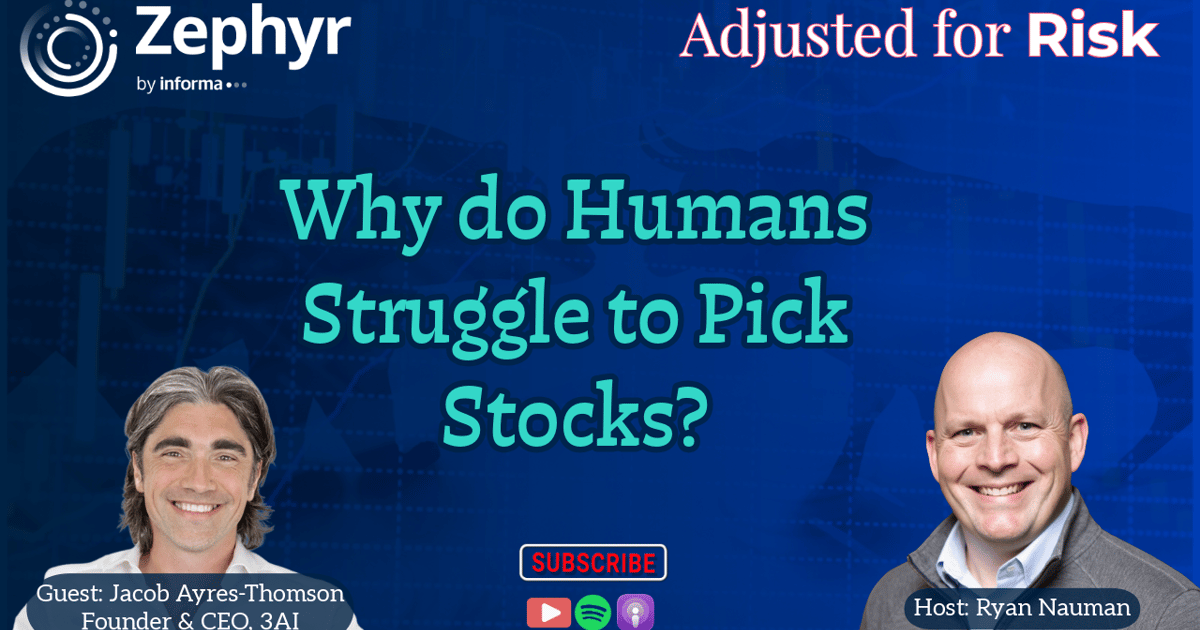
Zephyr's podcast interview with Jacob Ayres-Thomson, founder and CEO of 3AI, outlines the firm's Alpha Intelligence offering and its use cases in wealth management. In the interview, Ayres-Thomson described Alpha Intelligence as targeting equity outperformance through predictive signals delivered to human advisers, quantitative models, and AI-powered funds and indices, and he said the product includes statistically tested signals and indices built with S&P Global (Zephyr podcast, April 27, 2026). The conversation covers why humans struggle with stock picking-noisy markets, limited reliable training data, and benchmark concentration effects-and how AI can condense large data sets into forecasts and explainable research. The episode also touches on due diligence for advisor adoption and the idea of combining human judgment with model outputs.
What happened
In a Zephyr podcast episode published April 27, 2026, Ryan Nauman interviewed Jacob Ayres-Thomson, founder and CEO of 3AI, about the firm's product Alpha Intelligence and its application in wealth management. Per the podcast, Ayres-Thomson described Alpha Intelligence as aiming for equity outperformance by producing predictive insights that serve advisers, quantitative models, and AI-driven funds and indices. The interview reports that 3AI provides statistically tested signals and indices developed with S&P Global, and that the conversation covered topics including market noise, data limitations for reliable learning, benchmark effects from market-cap concentration, and advisor due diligence on forecasts.
Editorial analysis - technical context
Companies pitching predictive signals for equities face standard technical challenges: overfitting to backtests, lookahead bias, short sample sizes for meaningful signal validation, and the need for robust walk-forward testing and uncertainty quantification. For practitioners, emphasis on "statistically tested" signals implies model validation beyond in-sample fits, which typically requires held-out periods, bootstrap or permutation tests, and stress scenarios to surface fragile signal components. Explainability and factor decomposition remain important for adviser adoption because human stakeholders demand interpretable drivers when allocating client capital.
Industry context
Industry reporting frames this story within broader adoption of ML in asset management, where vendors supply both signal layers and turnkey indices. Observed patterns in similar integrations show that advisory uptake depends on operational integration (data pipelines, risk overlays), transparent performance attribution, and documented governance for model updates.
What to watch
Indicators useful to observers include third-party audit or independent validation of the signals, publicized live track records or out-of-sample results, specifics of the S&P Global collaboration mentioned by 3AI, and any documented procedures for model governance and adviser-facing explainability.
Key Points
- 13AI's Alpha Intelligence produces predictive equity signals intended for advisers, quant models, and AI-driven funds, per the Zephyr podcast.
- 2Noisy markets and limited reliable training data make human stock picking difficult, motivating AI tools that condense large datasets into forecasts.
- 3For practitioners, robust out-of-sample validation, explainability, and governance determine whether adviser firms adopt third-party predictive signals.
Scoring Rationale
Practical application of ML-driven forecasting in wealth management is notable for advisers and quant teams, but this is an interview about a commercial product rather than a new research breakthrough or industry-shaping release.
Practice interview problems based on real data
1,625 SQL & Python problems across 15 industry datasets — the exact type of data you work with.
Try 250 free problems